


The Original Research
In 1993, Ericsson, Krampe, and Tesch-Römer published “The Role of Deliberate Practice in the Acquisition of Expert Performance” in Psychological Review. They recruited three groups of violin students from the Music Academy of West Berlin: an elite group rated as most likely to become soloists, a good group likely to join professional orchestras, and a group training to become music teachers.
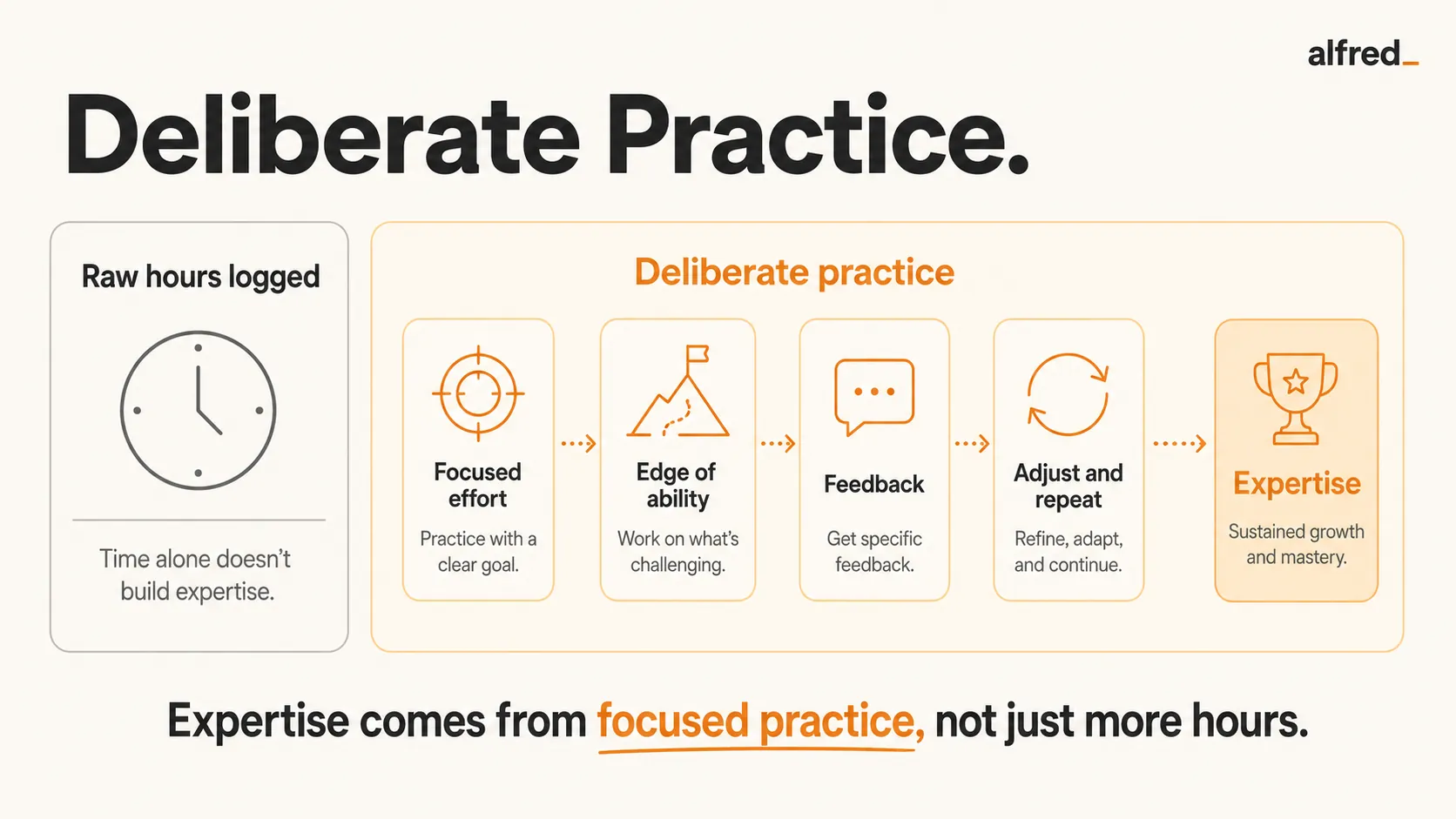
The researchers asked all three groups to estimate how they spent their time, keep diaries for a week, and retrospectively estimate their cumulative practice hours since childhood. They also asked them to rate every activity by its relevance to skill improvement and by how effortful it felt.
The elite group had accumulated dramatically more hours of one specific type of practice: solitary deliberate practice. Not group rehearsals, not performances, not music theory lessons, but structured solo practice sessions designed to address specific weaknesses with immediate feedback. By age 20, the elite group had averaged over 10,000 hours of this type of practice; the good group around 8,000; the music teachers around 4,000.
10,000 hrs
average accumulated deliberate practice by elite violinists by age 20. The hours were a byproduct of the method, not the point.
Ericsson, Krampe & Tesch-Römer, Psychological Review, 1993What Gladwell Got Wrong
Gladwell read the 10,000-hour accumulation as the cause of expertise. Ericsson’s actual argument was the opposite: the hours were a downstream consequence of engaging in a particular kind of structured activity. Ericsson later wrote explicitly that Gladwell’s rule “is wrong in several ways.”
The three failure modes of the Gladwellian reading:
1. Hours ≠ deliberate practice hours
The 10,000-hour figure refers specifically to deliberate practice, not total time spent on an activity. A surgeon who has performed 10,000 routine appendectomies without seeking feedback on technique has not engaged in 10,000 hours of deliberate practice. A consultant who has been in 10,000 client meetings but never systematically analyzed what makes a meeting persuasive has not either. Time spent is not the variable that matters.
2. 10,000 is not a universal threshold
Ericsson explicitly stated there is no magic threshold. The elite group happened to average around 10,000 hours by age 20 given their particular starting age and practice schedule, not because 10,000 is the minimum for expertise. Different domains, different starting ages, and different learning rates all produce different numbers.
3. Ignores the expert coach requirement
Deliberate practice as Ericsson defined it requires an expert teacher who can identify the specific gap between current performance and the next level, design exercises that address exactly that gap, and provide immediate, accurate feedback. Without this, you are practicing your habits, not improving your ceiling.
The Three Types of Practice
Ericsson’s later work (particularly Peak: Secrets from the New Science of Expertise, 2016, co-written with Robert Pool) distinguishes three types:
Naive practice
Repetition of an activity without any deliberate effort to improve. Most people’s professional development is naive practice. Attending meetings for 20 years, writing emails for 20 years, giving presentations for 20 years. Without structured feedback and deliberate effort to close specific gaps, these activities produce experience but not expertise.
Purposeful practice
Structured effort with clear goals, focus, feedback, and stepping outside the comfort zone. Better than naive, but without expert guidance it can entrench bad habits or plateau at a level below actual potential.
Deliberate practice
Purposeful practice plus: an expert coach or teacher who has a mental model of what excellent performance looks like, can identify the specific gap in your current performance, and can design exercises that address exactly that gap. This requires operating at the edge of current ability (difficult enough to challenge, not so difficult as to be impossible) with immediate accurate feedback and correction.
“Deliberate practice involves well-defined, specific goals and often involves improving some particular aspect of the target performance; it is not aimed at some vague overall improvement.”
K. Anders Ericsson, Peak (2016)
What This Means at Work
Most executives and knowledge workers operate almost entirely in the naive practice regime. They accumulate experience (years of managing teams, making decisions, negotiating) without ever engaging in the structured feedback loops that deliberate practice requires. The result is that experience produces confidence but not proportional improvement in performance.
The practical question is not “how many hours have I spent doing this?” but “how much of that time was structured to specifically close identified gaps, with immediate feedback from someone with a better mental model of excellence than I have?” The honest answer for most senior executives is: very little.
Ericsson also found that elite performers in several domains, including chess masters and tennis professionals, who began their serious training later than peers but engaged in more deliberate, structured practice outperformed peers who had started earlier but practiced more naively. Early start matters less than the quality of what you do when you practice.