


You have read about it three times. You have nodded along in the meeting. You would say, without hesitation, that you understand it. Then someone asks you to explain it plainly and you reach for jargon, hedge, and realize the understanding was never there. It was familiarity wearing the costume of knowledge. Richard Feynman built his entire intellectual life around catching exactly that gap, and the method that carries his name turns the ability to explain something simply into a test you cannot fake. Here is the diagnostic, the four steps, and the cognitive science that explains why explaining beats rereading every time.
Feynman’s Diagnostic
Feynman kept notebooks throughout his career, not for storage but for testing. When he encountered a concept he could not explain clearly, he treated that inability as information: it meant the concept was not actually understood, regardless of how many times he had read about it or how familiar the terminology felt.
This inverts the common rationalization for jargon-dependent explanations. Most people, when they cannot explain something without technical vocabulary, conclude that the subject is inherently too complex for simple language. Feynman concluded the opposite: if the explanation requires jargon to hold together, the understanding is shallow. The jargon is hiding the gap.
His autobiographical writing in Surely You’re Joking, Mr. Feynman! (1985) documents this principle in practice: repeatedly returning to fundamentals, refusing to accept explanations he could not reconstruct from scratch, and treating the ability to teach a subject as the test of whether he had learned it.
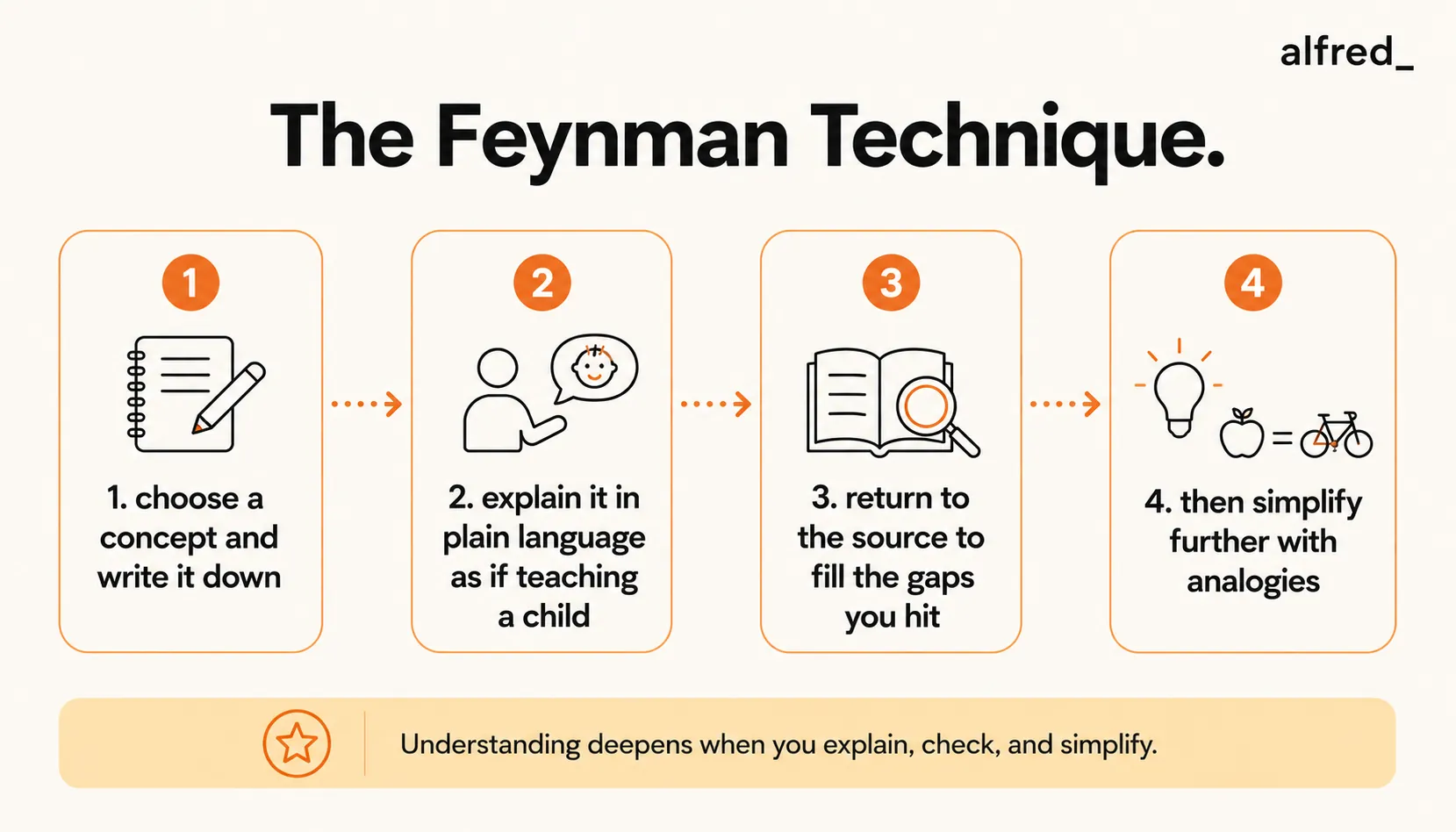
The four-step method that now carries his name was primarily formalized by Shane Parrish at Farnam Street, drawing on Feynman’s documented approach. The behaviors, simple explanation, gap identification, return to source, further simplification, are well-evidenced in Feynman’s notebooks and correspondence. The precise four-step framework is a later pedagogical structure applied to his practice.
The Four Steps
Step 1: Choose the concept and write it at the top of a blank page
Any concept works: a scientific principle, a business framework, a historical event, a technical architecture. The constraint: one concept per session. The blank page serves as the commitment device: you are going to explain this, not reference it.
Step 2: Explain it in simple language as if teaching a child
Write out the explanation in plain terms: no jargon, no field-specific vocabulary, no technical shorthand. Aim for an explanation that a smart 12-year-old could follow. This is not about oversimplification; it is about testing whether the conceptual structure holds without the technical scaffolding.
Where the explanation stalls, becomes circular, or requires a jargon term that cannot itself be explained simply, that is a gap. Mark it.
Step 3: Return to source material to fill the gaps
Go back to the source for specifically the parts that stalled. Not to reread the whole thing, but to resolve the specific failures that the explanation revealed. This targeted return is more efficient than rereading because the explanation exercise has already identified exactly which parts of the understanding are missing.
Step 4: Simplify further and use analogies
With the gaps filled, revise the explanation. Remove remaining jargon. Introduce analogies: mappings to domains the audience already understands. An analogy that correctly captures the relationship between two elements is stronger evidence of understanding than a technically accurate description, because constructing an analogy requires understanding the underlying structure.
The Cognitive Science: Generation Effect
The Feynman Technique’s effectiveness has a well-established cognitive science explanation: the generation effect. Research consistently shows that information produced by the learner, recalled, reconstructed, or explained in the learner’s own words, is encoded more durably in long-term memory than information passively received.
Rereading a chapter produces recognition memory: the content feels familiar. Writing an explanation of the chapter produces retrieval and reconstruction: the content must be actively assembled from memory into a coherent structure. Retrieval practice is a more reliable predictor of long-term retention than total study time.
The gap-identification step adds a second mechanism: targeted re-encoding. Instead of re-reading everything (low efficiency), the learner re-reads precisely the sections where the explanation revealed genuine incomprehension. This combines retrieval practice with optimal re-study targeting, producing durable learning in significantly less time than passive re-reading.
For Executives: Beyond Personal Learning
The technique extends beyond individual study. Feynman’s diagnostic applies to three common executive knowledge problems: if you cannot explain it simply, you do not understand it.
- Evaluating briefings received. When a direct report presents a complex plan, ask for a simple explanation. If they cannot provide one, the plan has not been fully thought through. The request “explain this to me as if I knew nothing about this domain” surfaces gaps in the presenter’s understanding, not just your own.
- Stress-testing proposed strategies. Before committing to a strategic direction, attempt to explain why it will work in simple terms, including the causal mechanism, to an audience outside the function. Breakdowns in this explanation reveal assumptions that need testing.
- Auditing domain knowledge. The feeling of familiarity with a domain is not the same as understanding it. Running the Feynman technique on foundational concepts in your own field, attempting to explain them from scratch, regularly surfaces gaps that familiarity has concealed.
The Resource the Technique Actually Costs
The Feynman Technique is free in money and expensive in something most professionals have almost none of: uninterrupted attention. Reconstructing an idea from scratch, finding where it stalls, and rebuilding it cannot be done in the gaps between Slack pings. It needs a quiet block, and quiet blocks are exactly what a reactive inbox dismantles. This is not work alfred_ can do for you. No tool understands a concept on your behalf, and we will not pretend otherwise.
What alfred_ does is protect the conditions the technique depends on. It triages the inbox, handles the routine replies, and surfaces only what genuinely needs you, so the hour you set aside to actually think is not quietly eaten by everything else demanding a response. The understanding is yours to build. alfred_ just keeps the room quiet enough for you to build it.