


The 2006 Research
Henry Roediger and Jeffrey Karpicke published two complementary papers in 2006. The first, in Psychological Science, compared different ratios of studying and testing. The second, in Perspectives on Psychological Science, synthesized the broader testing effect literature and its implications for educational practice.
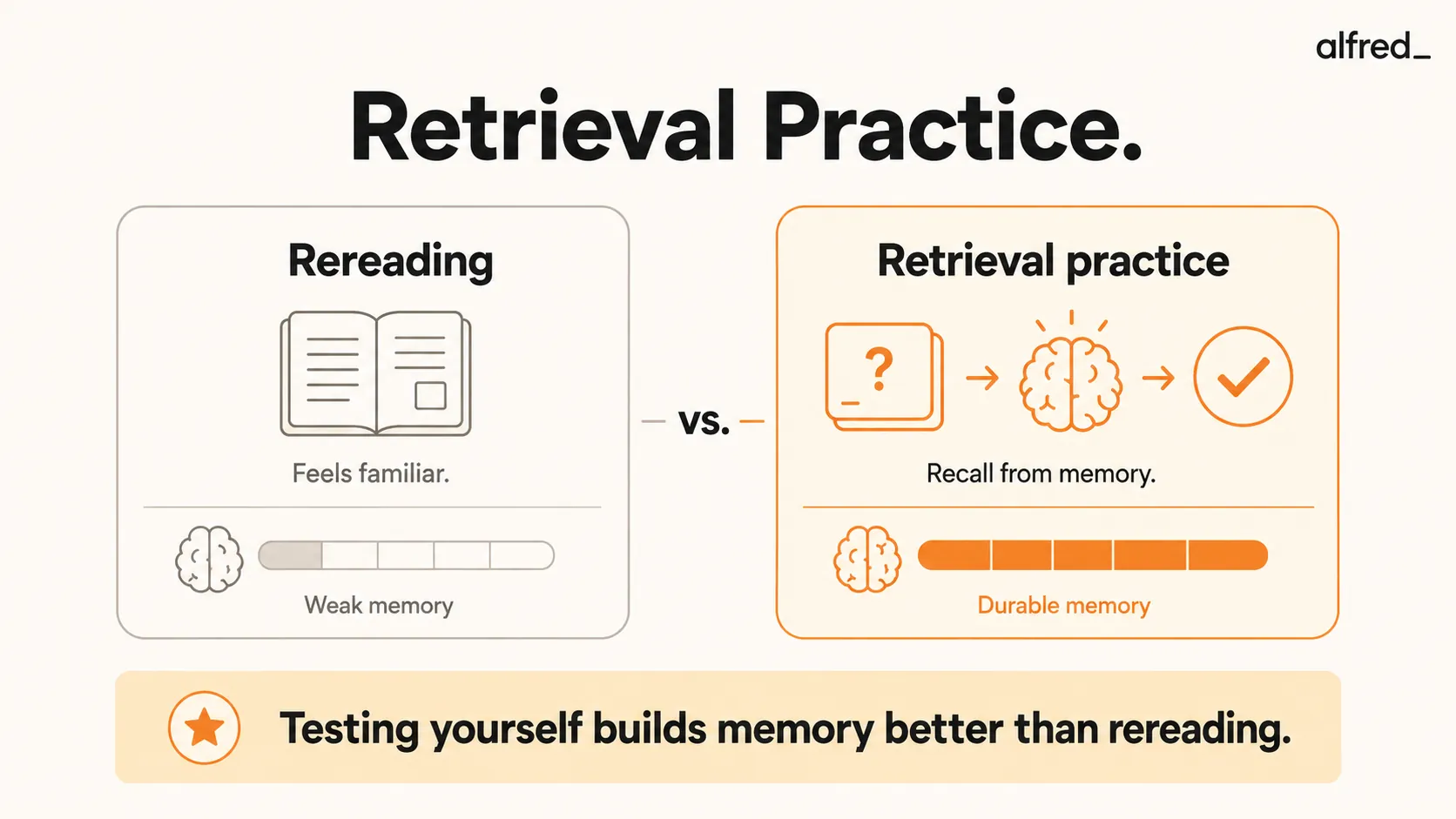
The core finding was both simple and counterintuitive: students who studied material once and then retrieved it multiple times retained significantly more over a one-week delay than students who spent the same total time restudying the material. More testing, less studying, despite feeling less productive in the moment, produced substantially better outcomes at the interval that matters for professional use.
This finding has since been replicated across domains, populations, and retention intervals. The advantage of retrieval practice over restudy is one of the most robust effects in cognitive psychology: it holds for factual knowledge, conceptual understanding, foreign language acquisition, mathematical problem-solving, and procedural skills.
Why Retrieval Works: The Generation Effect
The mechanism is the generation effect: information produced by the learner (recalled, reconstructed, or explained in the learner’s own words) is encoded more deeply in long-term memory than information received passively. The act of generation forces the brain to actively reconstruct the memory trace rather than simply recognize a familiar stimulus.
When you reread a passage, the brain pattern-matches against existing traces and produces a familiarity signal: it feels known. But familiarity is not the same as retrievability. A week later, the familiarity is gone and nothing remains because the retrieval pathway was never exercised.
When you attempt retrieval (try to recall the key points of a meeting without looking at your notes, write down what you remember from a briefing before checking it) the attempt itself strengthens the pathway regardless of whether it succeeds fully. Even failed retrieval attempts, followed by checking the correct answer, produce better subsequent recall than rereading.
Recognition vs. Recall
A critical distinction: recognition memory (does this feel familiar?) and recall memory (can I produce this from scratch?) are distinct systems with different reliability profiles.
Multiple-choice tests primarily measure recognition. They allow students to score well without genuine retrieval capability, which is why students who perform well on multiple-choice exams often cannot explain the same material in their own words. For professional purposes (explaining a strategy to a client, applying a framework to a new problem, teaching a concept to a team member) recall is the relevant capacity, not recognition.
The practical implication: learning activities that require free recall (write down what you know, explain without references, teach someone else) produce more professionally useful retention than activities that require only recognition (highlight the correct answer, mark the right option, identify what rings a bell).
Professional Applications
- Before-then-after briefing review. Before checking your morning briefing, spend 90 seconds writing down what you remember about a client’s situation or a project’s status. Then check the briefing. The attempt-then-verify sequence produces far better retention than reading the briefing passively.
- Teach-back after learning. After reading a report, attending a training, or finishing a book chapter, explain the key points aloud or in writing before returning to the source. The act of formulating your own explanation is retrieval practice.
- Meeting summaries without notes. Immediately after a meeting, write a brief summary from memory before consulting your notes. Even an imperfect recall attempt encodes the meeting content more durably than reviewing the notes alone.