


The Broaden-and-Build Theory: What Positive Emotions Actually Do
The conventional view of positive emotions is hedonistic. They feel good, which is why people seek them. Fredrickson's broaden-and-build theory offers a different account: positive emotions are functionally useful, not merely pleasant. They expand the range of thoughts and actions a person considers in the moment, and over time, they build lasting cognitive, social, and physical resources.
What is the broaden-and-build theory?
- Barbara Fredrickson's theory (American Psychologist, 2001) that positive emotions broaden thought-action repertoires and build lasting personal resources
- Broadening claim: positive emotions widen the scope of attention (joy produces the urge to play, interest produces the urge to explore), expanding what we consider doing
- Building claim: recurring positive emotions accumulate into lasting physical, psychological, social, and intellectual resources
- Undoing effect (Fredrickson et al., 2000): positive emotions speed cardiovascular recovery from stress faster than neutral or negative states
Important distinction: the theory describes genuinely experienced positive emotions, not forced or performed positivity. Emotional display rules that require positive affect expression don't produce the broadening effects.
The Theory
Barbara Fredrickson published "The Role of Positive Emotions in Positive Psychology: The Broaden-and-Build Theory of Positive Emotions" in American Psychologist in 2001 (Vol. 56, No. 3, pp. 218–226). The paper proposed a functional theory of positive emotions, asking not what positive emotions feel like but what they do.
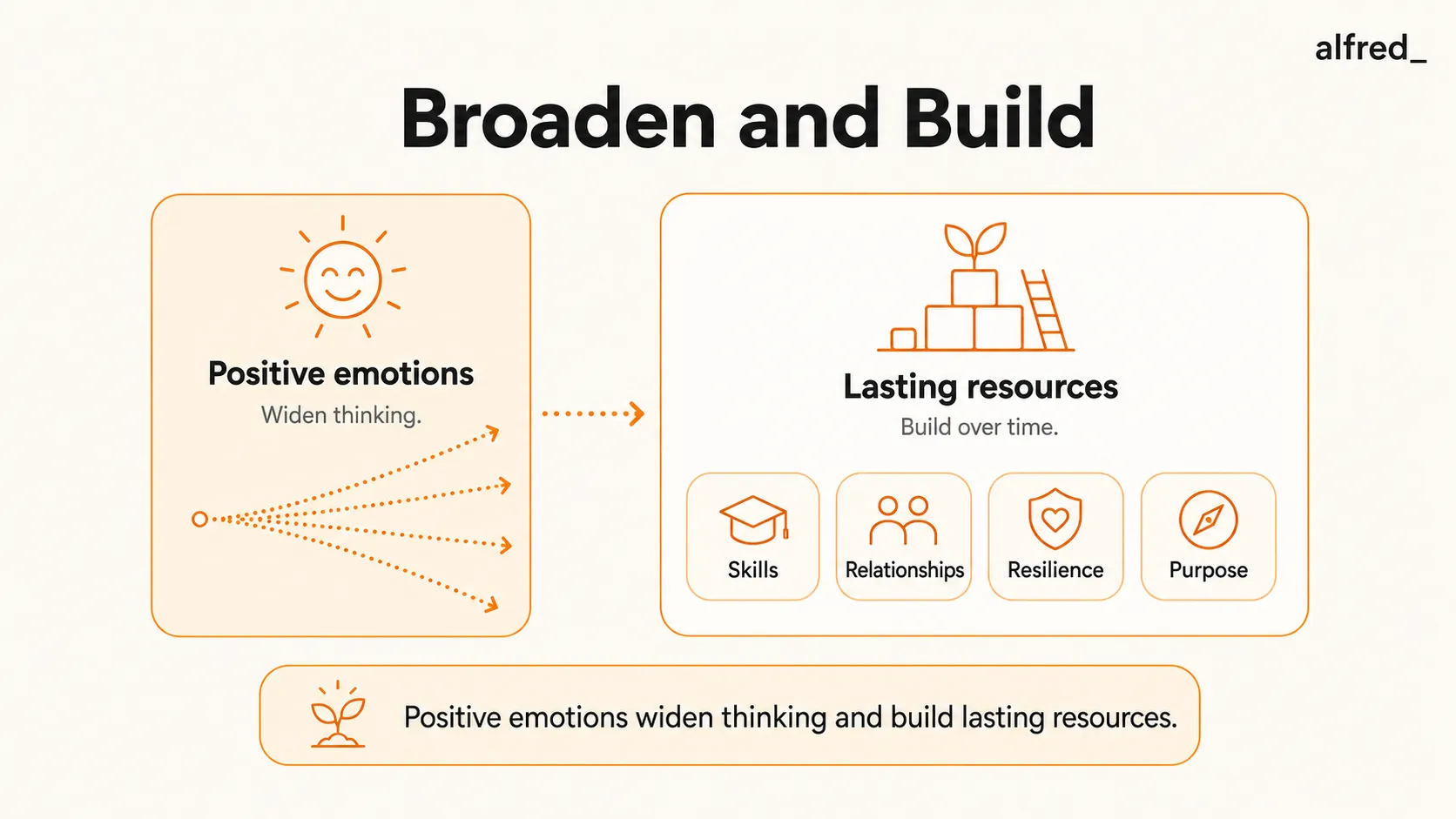
The theory has two claims. The broadening claim: positive emotions momentarily widen the scope of attention and expand the range of thoughts and actions that come to mind. Negative emotions narrow thought-action repertoires: fear produces the urge to escape; anger produces the urge to attack. Positive emotions produce the opposite: joy produces the urge to play; interest produces the urge to explore; contentment produces the urge to savor and integrate. These expanded repertoires make available a wider range of responses to any situation.
The building claim: the expanded repertoires produced by recurring positive emotions accumulate into lasting personal resources, including physical (health, coordination), psychological (resilience, optimism), social (trust, relationship quality), and intellectual (knowledge, mental complexity). While positive emotions are transient, the resources they build are durable. This is why well-being compounds over time in a way that purely hedonic accounts don't predict: positive states build capacity, not just mood.
The Undoing Effect
One of the most consequential empirical demonstrations associated with the broaden-and-build framework is the undoing effect, documented in Fredrickson, Mancuso, Branigan, and Tugade (2000), "The Undoing Effect of Positive Emotions," published in Motivation and Emotion (Vol. 24, pp. 237–258).
The study induced cardiovascular arousal in participants by telling them they had a short time to prepare an evaluated speech (a standard stress induction that reliably elevates heart rate and blood pressure). Participants were then randomly assigned to watch a short film clip designed to induce contentment, amusement, sadness, or neutral affect (the control). Cardiovascular recovery, the time to return to pre-stress baseline, was significantly faster in the contentment and amusement conditions than in the sad or neutral conditions.
The finding is that positive emotions don't simply coexist with stress. They actively speed physiological recovery from it. This is the "undoing" effect: positive emotions undo the lingering cardiovascular and cognitive effects of negative arousal more efficiently than neutral or negative states do. The mechanism is physiological: positive emotions reverse the cardiovascular effects of negative emotional arousal through distinct activation of the autonomic nervous system.
alfred_'s daily briefing creates deliberate transitions between the reactive inbox and intentional work, providing the recovery windows the undoing research shows are needed.
Try freeProfessional Applications
- Creative and strategic work. Broadened thought-action repertoires are precisely what complex problem-solving and creative work require. Emotional states that narrow attention (anxiety, frustration, fear of failure) reduce the range of cognitive approaches available. This explains why high-pressure environments systematically underperform their potential on tasks requiring novel thinking, even when they may perform comparably on routine execution.
- Recovery between high-stakes interactions. The undoing effect has direct implications for executive schedules packed with back-to-back high-stakes meetings. Each stressful interaction creates lingering cardiovascular arousal that impairs subsequent cognitive performance if it is not resolved. Even brief positive-affect experiences between meetings (a genuine laugh, a moment of genuine interest in something) speed recovery and reset the cognitive baseline for the next interaction.
- Team climate and sustained performance. The building function of positive emotions means that team climates with recurring positive affect build cumulative resilience, trust, and cognitive flexibility over time. This is not the same as a team that is uniformly pleasant. It means a team in which positive affect is genuinely experienced regularly enough to accrue resource-building benefits. Psychologically safe environments that allow genuine positive experience (not performed positivity) produce teams with greater cognitive resources over time.
Try alfred_
Create space for recovery.
alfred_'s daily briefing structure creates deliberate transitions between the reactive inbox and intentional work, providing brief recovery windows that the undoing research shows are needed for cognitive reset. The alternative is continuous partial attention that prevents both recovery and broadening. $24.99/month.
Try alfred_ freeFrequently Asked Questions
Does broaden-and-build mean that constant positivity improves performance?
No. This is an important misreading of the theory. Fredrickson's research is about the functional consequences of genuinely experienced positive emotions, not about maintained positive affect as a performance technique. Forced positivity or emotional display rules that require positive affect expression regardless of genuine experience don't produce the broadening effects the theory describes. The building function accrues from authentic positive emotional experience over time, not from performed or mandated positivity. Additionally, the theory does not suggest negative emotions are undesirable; it proposes that positive and negative emotions serve different adaptive functions, and that the narrowing function of negative emotions is appropriate in genuine threat situations.
What is the evidence that broaden-and-build effects apply in professional settings, not just laboratory studies?
Several field studies have extended the laboratory findings. Research on physician affect and diagnostic reasoning has shown that physicians in positive affect conditions (given a small gift) reached correct diagnoses faster and showed less premature closure than control physicians. Studies of teacher affect and classroom creativity, military unit morale and performance, and call center agent positivity and problem-solving effectiveness all show effects consistent with the broadening hypothesis. The effect sizes in field settings are typically smaller than in laboratory conditions, which is expected, as organizational contexts have many competing influences, but the directional findings are consistent with the theory.
How do you create genuine positive emotions in professional settings without forced positivity?
Fredrickson's own research points to several routes: meaningful challenge (interest and curiosity arise from engaging tasks at the right difficulty level), social connection (even brief genuine social interactions produce positive affect), meaning (perceiving work as contributing to valued goals), and variety (novelty sustains interest and prevents hedonic adaptation). The common thread: positive emotions arise from genuine engagement, not from performance of positivity. Environments that provide genuine challenge, authentic relationships, clear purpose, and periodic variety produce authentic positive affect, and thereby the cognitive and resource-building benefits the theory describes.