


Bandura’s 1977 Framework
Albert Bandura published “Self-efficacy: Toward a Unifying Theory of Behavioral Change” in Psychological Review in 1977 (84(2), 191–215). The paper proposed that self-efficacy, beliefs about one’s capacity to execute the behaviors required to produce specific outcomes, was a key determinant of whether people initiate coping behavior, how much effort they expend, and how long they persist in the face of obstacles.
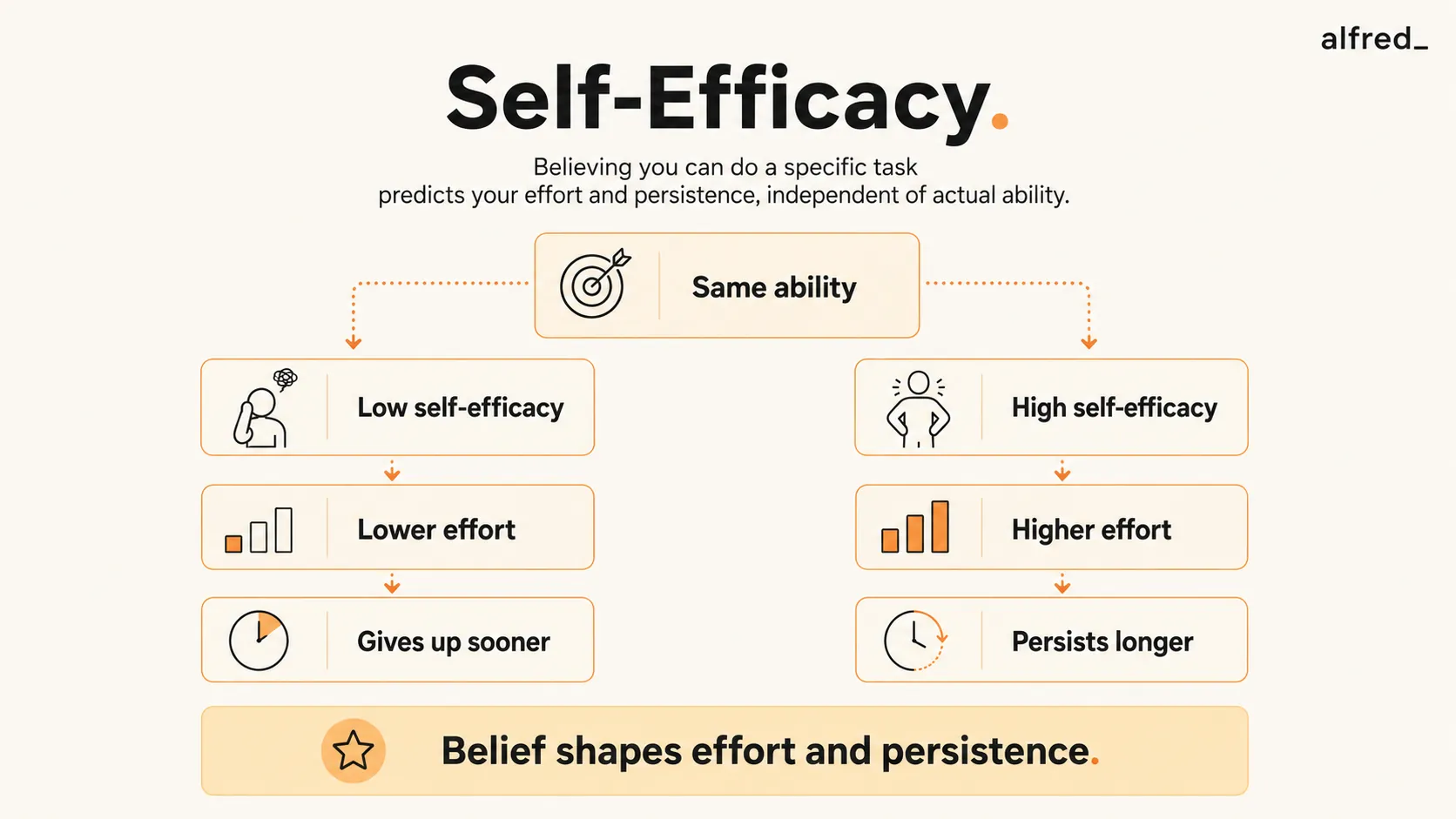
Bandura was careful to distinguish self-efficacy from general self-confidence, self-esteem, or outcome expectations. Self-efficacy is domain- and task-specific: high self-efficacy for managing difficult conversations does not transfer automatically to high self-efficacy for financial modeling. This specificity is important because it explains why overall confidence-building interventions have weaker effects than targeted mastery experiences in the specific domain of interest.
Domain-specific
Self-efficacy is task- and context-specific, not a general trait. Building it in one domain through mastery experience does not automatically transfer to other domains. The same person may have high efficacy for written communication and low efficacy for public speaking.
Bandura, A. (1977), Psychological Review, 84(2), 191–215Bandura formalized the theory more completely in Social Foundations of Thought and Action: A Social Cognitive Theory (Prentice-Hall, 1986), which organized the evidence on self-efficacy within a broader social cognitive framework. A further review in Psychological Bulletin (Stajkovic & Luthans, 1998) meta-analyzed 114 studies and found that self-efficacy was significantly related to work-related performance across a range of tasks and settings.
The Four Sources
Bandura identified four sources of self-efficacy information, ordered from most to least influential:
- Mastery experiences. Direct performance accomplishments are the strongest source. Successfully completing a difficult task raises self-efficacy; failing lowers it. The key variables are difficulty (easy successes have limited efficacy-building value) and attribution (success attributed to effort and strategy raises efficacy more than success attributed to luck). This is why calibrated challenge (tasks difficult enough to require effort but achievable) is the most reliable way to build self-efficacy.
- Vicarious learning. Observing similar others succeed raises self-efficacy for that task (“if they can do it, I can too”); observing them fail lowers it. The comparison target matters: observing someone much more skilled succeed provides less efficacy information than observing someone at a similar level succeed. Modeling by peers is more efficacy-building than modeling by experts for this reason.
- Verbal persuasion. Credible encouragement from others raises self-efficacy, but this source is weaker and more fragile than mastery experience. Encouragement that leads to failure undermines efficacy more than if no encouragement had been given. Social persuasion is most useful when it prompts effort that leads to mastery experiences.
- Physiological and emotional states. How a person interprets their own arousal states affects self-efficacy. Racing heart before a presentation can be interpreted as anxiety (lowering efficacy) or as readiness (raising it). Fatigue during a difficult task can be interpreted as inability (lowering efficacy) or as a signal that effort is appropriate to the difficulty.
Professional Implications
- Stretch assignments and development. The mastery experience source implies that the most effective development assignments are ones that are genuinely difficult but achievable: tasks where success requires real effort and strategy. Assignments that are too easy produce “easy wins” with limited efficacy-building value. Assignments that are too hard produce failure that can reduce efficacy. The developmental lever is calibrated stretch, not either extreme.
- Feedback framing. Feedback affects the efficacy-building value of mastery experiences. Feedback that attributes success to effort and strategy (“your preparation made the difference here”) builds efficacy more than feedback that attributes it to luck or external factors. Feedback that attributes failure to strategy (“the approach needs adjustment”) preserves efficacy more than feedback that attributes it to ability (“this isn’t your strength”).
- Goal commitment. Self-efficacy is one of the key moderators of goal-setting theory. Difficult goals only produce the expected performance gains when the individual commits to them, and commitment is partly a function of self-efficacy: people commit to goals they believe they can achieve. Low self-efficacy for a goal, even a correctly set, specific, and difficult goal, reduces the commitment that activates the direction and effort mechanisms goal-setting theory predicts.