

Psychology

Goal Setting Theory: Why Specific, Hard Goals Outperform 'Do Your Best'

The annual performance review instructs everyone to 'do their best.' The strategic planning offsite produces goals like 'improve customer experience' and 'drive growth.' Research on goal setting developed over five decades shows that vague and easy goals systematically underperform specific, difficult ones, not by a small margin but reliably and across domains.

Feb 19, 20266 min read
Quick Answer

What does goal setting theory say about how to set goals?

  • Specific, difficult goals consistently outperform vague goals ("do your best"), established by Locke (1968) and confirmed in 183 studies by Klein et al. (1999)
  • Goals work through four mechanisms: direction (focus on relevant activities), effort (mobilized proportional to difficulty), persistence, and task strategy search
  • Two critical moderators: goal commitment (people must genuinely accept the goal) and feedback (without progress feedback, goals lose effectiveness)
  • For complex novel tasks, learning goals ("develop three approaches") outperform performance goals ("solve this by Friday"), the exception to the general rule

OKRs operationalize goal-setting theory: objectives provide qualitative direction, key results are specific and measurable. The research supports key result specificity and difficulty as the active ingredient.

The Foundational Research

Edwin Locke published "Toward a Theory of Task Motivation and Incentives" in Organizational Behavior and Human Performance in 1968 (Vol. 1, No. 3, pp. 157–189). The paper synthesized laboratory studies of task motivation and proposed several propositions that would be tested and refined over the following decades.
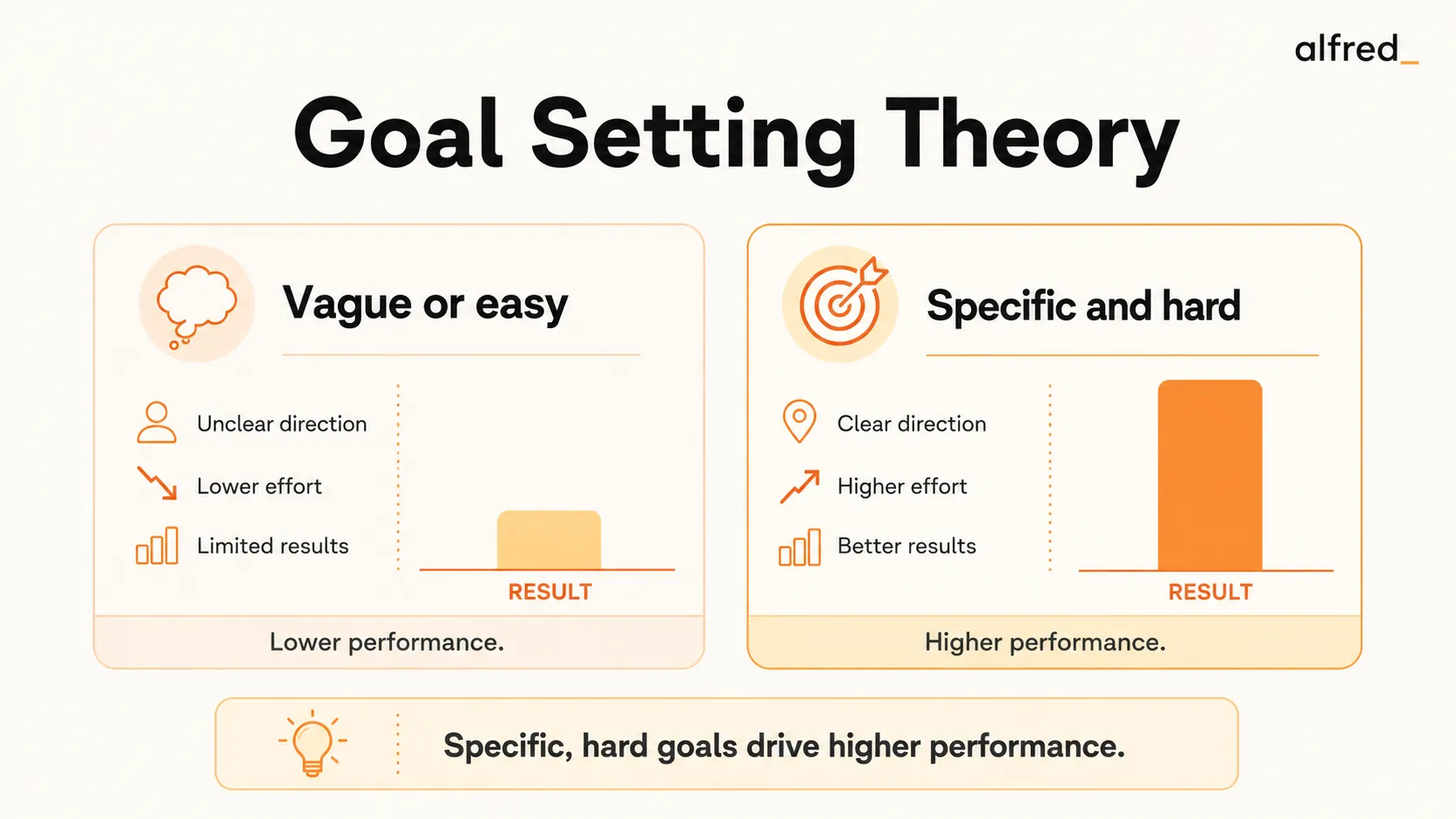
The central finding was that specific goals produced higher performance than vague goals such as "do your best," and that difficult goals produced higher performance than easy goals, provided the individual was committed to the goal. The paper also proposed that goal specificity and goal difficulty interact: a specific easy goal is better than vague, but a specific difficult goal is better still.

183 studies

Klein, Wesson, Hollenbeck & Alge (1999) meta-analyzed 183 independent studies in Psychological Bulletin and confirmed goal-setting's effect as among the most reliable in organizational research.

Source: Klein, Wesson, Hollenbeck & Alge (1999), Psychological Bulletin, 125(1)

Locke and Gary Latham synthesized two decades of subsequent research in A Theory of Goal Setting and Task Performance (Prentice-Hall, 1990). The book formalized the goal-setting theory, organized the evidence for its core propositions, and identified the boundary conditions under which the effects hold. A follow-up review, "Building a Practically Useful Theory of Goal Setting and Task Motivation" (Locke & Latham, 2002, American Psychologist, 57(9), 705–717), confirmed the theory's robustness across more than 400 studies over 35 years.

Four Mechanisms

Locke and Latham identified four mechanisms by which goals affect performance:

  • Direction. Goals direct attention toward goal-relevant activities and away from goal-irrelevant ones. A specific sales target directs attention to sales behaviors; "do well" does not create the same focus.
  • Effort. Goals mobilize effort proportional to their difficulty. Easy goals produce less effort than difficult ones, which is why the research consistently shows that within the commitment range, harder goals produce higher performance.
  • Persistence. Goals affect how long effort is sustained. Specific deadlines and milestones maintain effort over time in a way that open-ended aspirations do not.
  • Task strategy. When faced with a difficult goal, people are more likely to search for effective strategies. They plan, prioritize, and problem-solve in ways they would not when the goal is vague or easy.

Two moderators determine whether these mechanisms translate into performance: goal commitment and feedback. Goals that people do not believe in or have not accepted do not produce the expected performance increases. And goals without feedback about progress are less effective than goals with feedback, because feedback closes the gap between current state and goal state, and it is that gap which sustains effort.

Try alfred_

See what this looks like in practice

alfred_ applies these principles automatically — triaging your inbox, drafting replies, extracting tasks, and delivering a Daily Brief every morning. Theory becomes system. $24.99/month. 30-day free trial.

Try alfred_ free

Professional Applications

  • Setting objectives. The OKR (Objectives and Key Results) framework used widely in technology companies operationalizes goal-setting theory: objectives are qualitative direction, key results are specific and measurable. The research supports the specificity and difficulty of key results as the active ingredient. "Increase NPS to 52" is more performance-generating than "improve customer satisfaction."
  • Individual performance reviews. "Do your best" objectives ("be a better communicator," "take more initiative") satisfy the form of goal-setting without the substance. Translating these into specific behavioral goals with measurable criteria brings the performance-generation mechanism into play. The goal needs to have a defined endpoint the performer can recognize.
  • Weekly planning. The goal-setting literature supports daily or weekly specific goals as a complement to longer-horizon objectives. The direction and effort mechanisms operate on the timescale of a task, not just a year. Setting specific daily priorities (not "do emails" but "respond to the three pending client proposals") applies goal-setting theory at the execution level where most actual work happens.

Frequently Asked Questions

Does goal difficulty always improve performance, or is there a ceiling?

The research shows a linear relationship between goal difficulty and performance up to the individual's ability ceiling. Beyond that ceiling, performance plateaus or declines as the goal becomes unattainable and commitment drops. The relationship holds within what Locke and Latham call the 'commitment range': the range of difficulty where the person genuinely accepts the goal. Above that range, impossible goals can produce lower commitment than moderately difficult goals, reducing performance. The practical implication is that goals should be difficult enough to require effort and strategy, but within the credible range for the individual's current ability.

How does goal setting theory relate to intrinsic motivation? Can goals undermine it?

The relationship between external goals and intrinsic motivation is nuanced. Deci and Ryan's self-determination theory suggests that externally imposed goals can undermine intrinsic motivation if they feel controlling. The goal-setting research addresses this through the commitment moderator: goals that people genuinely accept and commit to, regardless of whether they originated externally or internally, produce the predicted performance effects. Goals that feel imposed without genuine acceptance are likely to produce both lower commitment and lower intrinsic motivation. The practical resolution is goal participation: involving people in setting or understanding the rationale for goals tends to increase commitment and reduce the risk of undermining intrinsic motivation.

Does goal-setting theory apply to complex, creative, or ill-defined work?

The research is clearer for well-defined tasks than for complex or creative ones. For tasks where the strategy is unknown (genuinely novel problems), assigning a learning goal ('develop three possible approaches to this problem') tends to produce better outcomes than a performance goal ('solve this problem by Friday'), because learning goals encourage exploration while performance goals encourage exploitation of known strategies. Seijts and Latham (2001) tested this and found that learning goals outperformed performance goals for complex novel tasks. For work that is complex but familiar (a difficult but well-understood client project), the standard finding applies: specific, difficult goals outperform 'do your best.'

Try alfred_

Turn Goals Into Tracked Commitments

Goal-setting theory requires feedback about progress to have its full effect. alfred_ surfaces your open commitments and pending deliverables daily so the gap between goal and current state stays visible, not buried in email. $24.99/month.

Try alfred_ Free