

The Oak School Study
Robert Rosenthal and Lenore Jacobson published Pygmalion in the Classroom (Holt, Rinehart and Winston, 1968). The study was conducted at an elementary school they called “Oak School.” They administered a disguised IQ test to all students and told teachers that the test (called the “Harvard Test of Inflected Acquisition”) could identify students poised for significant intellectual growth in the coming year.
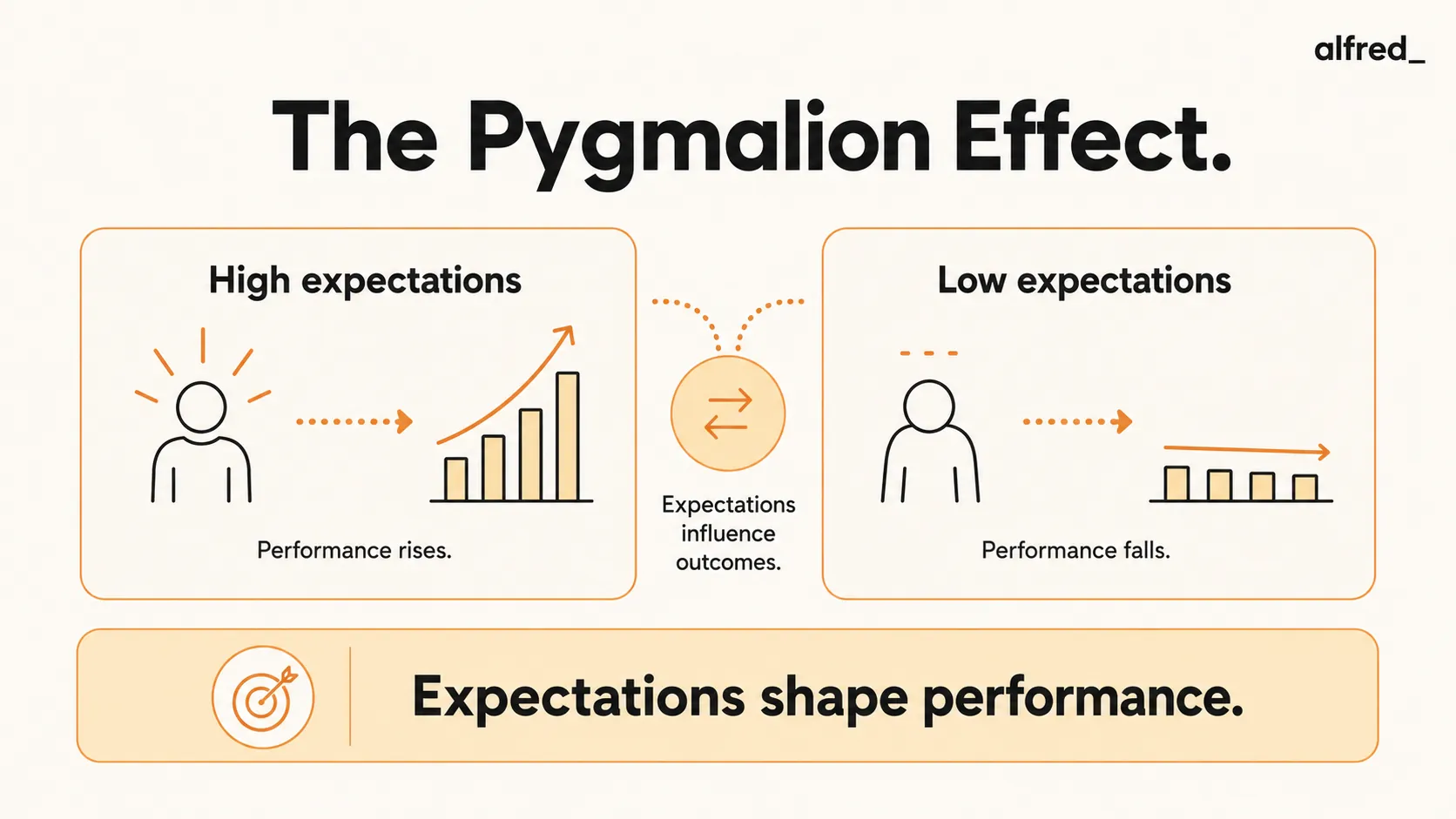
Teachers were given the names of students identified as “intellectual bloomers,” those expected to show unusual gains. In reality, these students were randomly selected from the school population; the test had no predictive validity for the designated students. The key manipulation was only in the teachers’ expectations.
1st and 2nd graders
The Pygmalion effect was strongest in the youngest grades. First and second graders designated as 'late bloomers' showed the largest IQ gains compared to control students by the end of the school year, effects that diminished in older grades where teachers had more prior information about students.
Rosenthal, R. & Jacobson, L. (1968). Pygmalion in the Classroom. Holt, Rinehart & Winston.At the end of the school year, IQ was re-measured. The randomly designated “bloomers,” particularly in 1st and 2nd grades, showed significantly greater IQ gains than the control students who had not been designated. The effect was strongest for the youngest students, where teachers had less prior information to anchor their expectations and the experimental manipulation was therefore more influential.
Rosenthal later proposed a four-factor model of the mechanisms: climate (warmth and supportiveness directed at high-expectancy students), input (more challenging material assigned), output (more opportunities given to respond and elaborate), and feedback (more detailed and useful feedback provided). These four channels translate the expectation into the behavioral treatment that actually affects performance.
Subsequent Research and Limitations
The Pygmalion study was influential but also contested. Jussim and Harber (2005), reviewing the expectancy literature in Personality and Social Psychology Review, concluded that teacher expectancy effects are real but typically small, and, critically, that the causal arrow runs more strongly from student performance to teacher expectations than from teacher expectations to student performance. Teachers form expectations partly from accurate assessment of actual student ability, which means the expectation often follows, rather than creates, the performance.
This qualification matters for organizational applications. The Pygmalion effect does not mean that all expectations are equally powerful or that expectations always override ability. It means that expectations, when inaccurate, tend to shift behavior in a direction that partially confirms the original expectation: a bias rather than a deterministic effect.
Manager Applications
- The Golem effect (negative Pygmalion). If positive expectations raise performance through the four behavioral channels, low expectations lower it through the same channels: less challenging work, less feedback, less warmth, fewer opportunities to demonstrate capability. Early categorization of a team member as a limited performer can trigger a behavioral cycle that reduces their performance to match the expectation. This is the organizational risk: not just missed upside, but actively suppressed performance.
- Differential treatment visibility. Team members are aware of differential treatment, even when managers believe they are being neutral. Higher expectation treatment (more challenge, more specific feedback, more inclusion in decisions) signals positive regard and is often interpreted as evidence of the manager’s assessment, which affects the team member’s own self-efficacy and effort. The expectation is communicated not just through explicit evaluation but through the behavioral choices that follow from it.
- Auditing your own expectation-behavior connections. The practical implication is examining the gap between expectations and the behavioral treatment that follows from them. Are the people you expect most of actually receiving more challenging assignments and higher-quality feedback? If so, are those expectations based on evidence, or on early impressions that may not have been accurate? The Pygmalion effect is a reason to be deliberate about challenge allocation rather than allowing it to follow automatically from prior assessments.