

Psychology

Growth Mindset: The Evidence Behind the Idea

The growth mindset concept has become one of the most widely cited ideas in education and organizational development, and one of the most frequently misrepresented. The research is real and substantive, but the specific findings are more nuanced than the popular account suggests. Understanding what the evidence actually shows determines how the concept can be applied in practice versus how it is typically misapplied.

Feb 19, 20266 min read
Quick Answer

What does the research actually show about growth mindset?

  • Incremental theorists (growth mindset) showed upward math grade trajectories over 2 years vs. flat for entity theorists (Blackwell, Trzesniewski & Dweck, 2007, observational study, n=373)
  • An 8-session growth mindset workshop halted declining math grades in the intervention semester (same study, randomized intervention, n=91)
  • The 2-year finding is observational (cannot establish causation); the intervention finding covers one semester. These are different studies and should not be conflated.
  • Large-scale replications find real but smaller, more context-dependent effects, strongest for lower-achieving students

Growth mindset is not positive thinking. It is a specific belief about the malleability of ability that changes how people interpret challenge and failure. Structural conditions (process feedback, psychological safety, learning resources) matter more than motivational messaging or posters.

The Theoretical Framework

Carol Dweck's research program on implicit theories of intelligence distinguishes between two beliefs about the nature of ability. People with an entity theory (fixed mindset) believe that intelligence and ability are stable traits, meaning you have a certain amount and it doesn't change substantially. People with an incremental theory (growth mindset) believe that intelligence and ability can be developed through effort, learning, and practice.
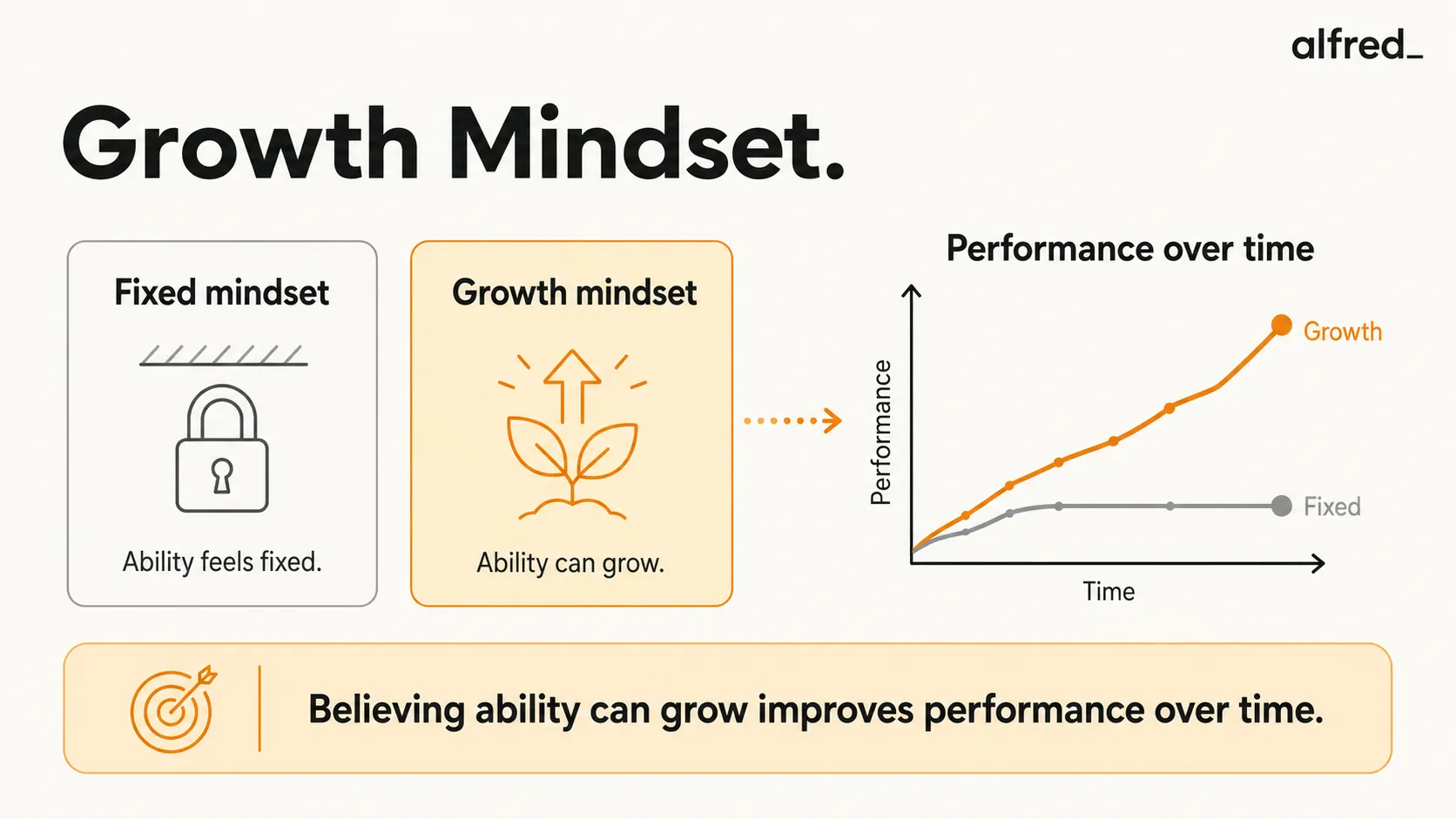
These beliefs are not merely motivational flavors. They predict systematically different behavioral responses to challenge and failure. Entity theorists interpret difficulty and failure as evidence of limited ability, which threatens their self-concept and produces avoidance strategies. Incremental theorists interpret the same difficulty and failure as information about what to work on, which is consistent with their self-concept and produces learning strategies. The behavioral consequences of the beliefs explain the performance differences the research documents.

The Blackwell et al. Study: What It Actually Shows

Blackwell, Trzesniewski, and Dweck published "Implicit Theories of Intelligence Predict Achievement Across an Adolescent Transition: A Longitudinal Study and an Intervention" in Child Development in 2007 (Vol. 78, No. 1, pp. 246–263). The paper contains two studies, and it is important not to conflate them.

Study 1 was observational. A sample of 373 students was followed from the end of 7th grade through the end of 8th grade, a two-year junior high school transition known to be a period when math grades often decline. Students' implicit theories of intelligence were measured at the start. Incremental theorists showed an upward trajectory in math grades across the two years, while entity theorists showed a flat trajectory. The two groups had similar grades at the start but diverged over time as the challenge level of the material increased.

Study 2 was an intervention. A subset of 91 students was randomly assigned to receive either an 8-session workshop on study skills plus a growth mindset module (the intervention condition) or an 8-session study skills workshop without the growth mindset module (the control condition). The specific claim to note: the intervention group's math grades were measured in the subsequent semester, not over two years. The control group's math grades continued on a downward trajectory; the intervention group's grades halted that decline and stabilized.

The two-year finding belongs to Study 1, which was observational and therefore cannot establish causation. The intervention effect belongs to Study 2, which was randomized but measured outcomes over one semester, not two years. Describing the intervention as producing "improved math grades over two years" conflates these two studies.

Try alfred_

See what this looks like in practice

alfred_ applies these principles automatically — triaging your inbox, drafting replies, extracting tasks, and delivering a Daily Brief every morning. Theory becomes system. $24.99/month. 30-day free trial.

Try alfred_ free

Applying the Research in Practice

  • Feedback framing. Research consistently shows that process-focused feedback ("you worked hard on this" or "the strategy you used here didn't work. What could you try differently?") produces more learning behavior than ability-focused feedback ("you're so smart" or "you're not good at this"). The mechanism: ability feedback activates entity thinking, which makes subsequent failure feel like confirmation of fixed limits. Process feedback activates incremental thinking, which makes subsequent failure feel actionable.
  • Organizational cultures around failure. Organizations that explicitly discuss effort, strategy, and learning rather than only outcome and talent create conditions where incremental beliefs are more accessible. This is not the same as tolerating poor performance. It means distinguishing between strategic learning failures (which are informative) and execution failures (which should be reduced), and responding to the former with analysis rather than judgment.
  • Limits of "just believe in growth." A common misapplication is to treat growth mindset as motivational rhetoric: posters, slogans, or exhortations to "believe you can grow." The evidence suggests that outcome-contingent feedback and structural conditions matter more than belief-level interventions. Growth mindset beliefs without actual access to learning resources, feedback, and appropriate challenge do not produce the behavioral effects the research documents. The belief is necessary but insufficient.

Frequently Asked Questions

Is growth mindset just positive thinking, and does the evidence hold up?

Growth mindset is not the same as positive thinking. It is a specific belief about the malleability of ability, which affects how people interpret challenges and setbacks. The evidence is more nuanced than popular accounts suggest. Large-scale replication studies, including a pre-registered replication by Yeager and colleagues across 65 schools, found that growth mindset interventions produced significant improvements for lower-achieving students but smaller effects for higher-achieving students. Some attempted replications of the original findings have shown smaller effect sizes. The field consensus as of 2025 is that the effect is real but smaller and more context-dependent than early research suggested, and that implementation quality and target population matter substantially.

Do adults respond to growth mindset interventions the way students do?

The research base on adults is smaller and shows more mixed results than the student literature. There is evidence that professional adults' implicit theories about their own domain affect their responses to setbacks and development opportunities. Entity-theory managers, for instance, show less interest in training and development programs and are more likely to attribute employee failures to stable ability rather than fixable strategy. But the large-scale intervention research has primarily been conducted with school-age students, and the specific mechanisms (e.g., the transition between educational levels creating a particular vulnerability that growth mindset addresses) may not transfer directly to adult professional contexts.

How do you build a growth mindset culture in an organization without it becoming empty rhetoric?

The evidence points to structural conditions rather than motivational messaging. Four changes matter: (1) Process feedback from managers that focuses on strategy and effort rather than ability attributions, for example asking 'what approach didn't work, and what would you try differently' rather than 'you're talented' or 'that was the wrong hire.' (2) Psychological safety to surface mistakes early: growth mindset beliefs are activated by how the organization actually responds to failure, not by what it says about failure. (3) Genuine learning resources tied to development goals: the belief that ability is malleable is reinforced when people actually experience growth through effort, which requires time and resources for that growth. (4) Leadership modeling: senior leaders who publicly discuss their own learning and strategy adjustments in response to failure make incremental thinking visibly legitimate.

Try alfred_

Track the Gap Between Intention and Action

alfred_ surfaces what was intended but not completed, creating the external record of strategy versus outcome that makes growth-oriented learning possible. Without that record, post-hoc attribution of outcomes (to ability or to circumstances) replaces strategy-level learning. $24.99/month.

Try alfred_ Free