

The New Jersey Mall Study
Anandi Mani, Sendhil Mullainathan, Eldar Shafir, and Jiaying Zhao recruited participants at a New Jersey mall and asked them to think about a hypothetical financial scenario before completing cognitive tests. Half were given a manageable scenario ($150 car repair). Half were given a demanding scenario ($1,500 car repair, large enough to represent a real financial strain for those with limited resources).
The cognitive tests, measuring both fluid intelligence and cognitive control, showed a striking result: the low-income participants who contemplated the expensive scenario scored the equivalent of approximately 13 IQ points lower on subsequent tests than low-income participants who contemplated the manageable scenario.
The financial stress did not change the participants’ actual intelligence or the amount of information available to them. It changed how much cognitive bandwidth was available for unrelated tasks, specifically by occupying working memory with the financial concern and its associated worry.
~13 IQ points
the equivalent cognitive performance reduction when low-income participants contemplated a financially stressful scenario vs a manageable one, comparable to the impairment from a full night of lost sleep
Mani, Mullainathan, Shafir & Zhao, Science, 2013The Indian Sugarcane Farmers
To test the mechanism outside a laboratory setting, Mullainathan’s team studied 464 sugarcane farmers in India who depend on a single annual harvest for the majority of their income. The same individuals were tested before harvest (when money was scarce and financial stress was highest) and after harvest (when the constraint was temporarily lifted).
Pre-harvest, the farmers scored approximately 10 IQ points lower on fluid intelligence and cognitive tests than they did post-harvest. Same people, same tests, 6-month interval. The difference was the presence or absence of financial scarcity and its consequence for cognitive bandwidth.
The Scarcity Mechanism: Tunneling
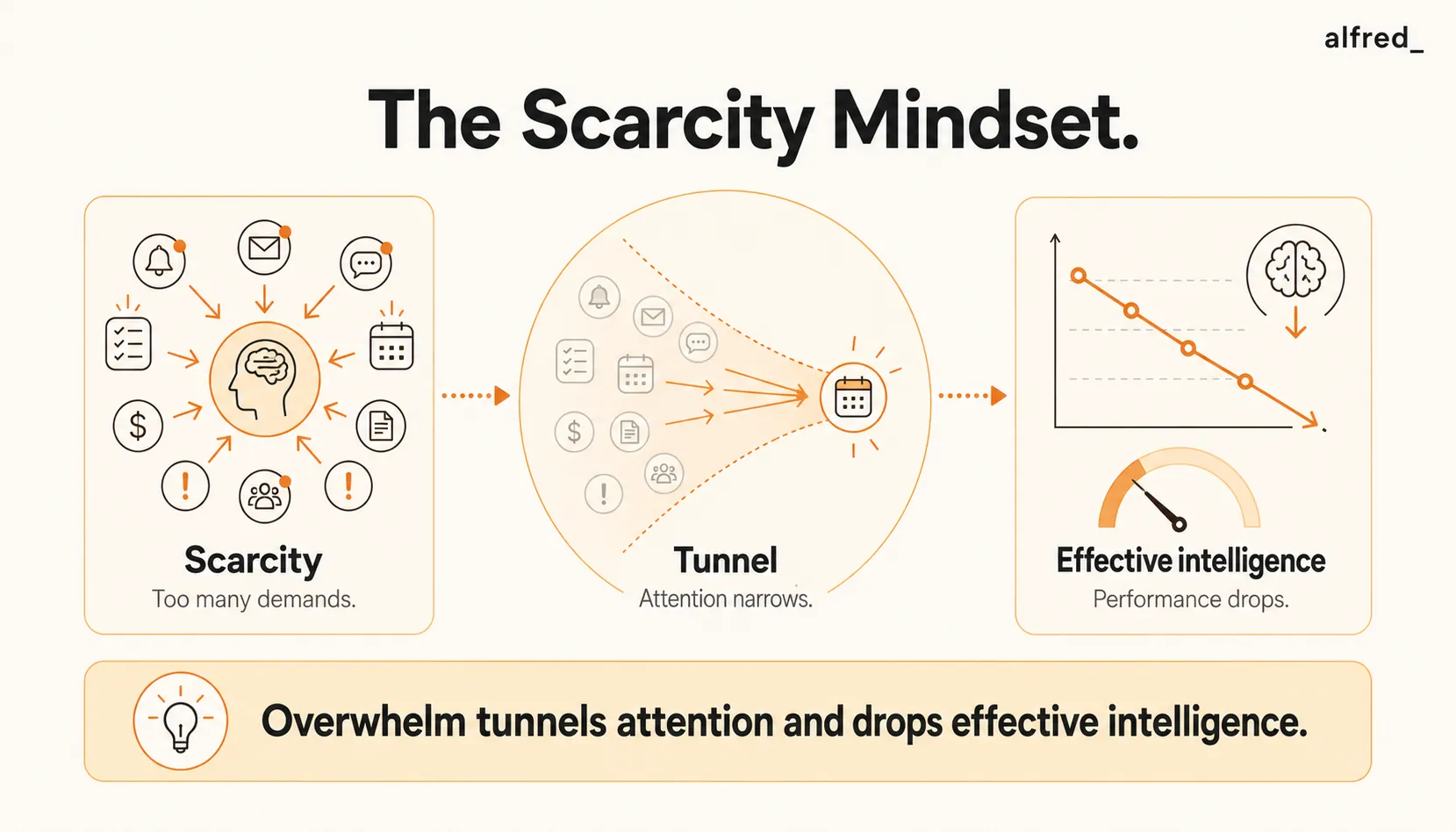
Mullainathan and Shafir named the mechanism tunneling. Scarcity captures attention and focuses it on the scarce resource: money when finances are tight, time when the calendar is overloaded, calories when dieting. This focus is partially functional: it generates vigilance about the scarce resource. But it comes at a cost.
Tunneling crowds out bandwidth for everything outside the tunnel. The person who is chronically worried about making rent is not less intelligent or less disciplined than someone without that concern. They are operating with meaningfully less cognitive capacity available for the full range of decisions their life requires. Their poorer decisions are a consequence of the constraint, not a cause of it.
The Time Scarcity Version
The mechanism is not specific to financial scarcity. Mullainathan and Shafir found the same tunneling pattern with time scarcity, and this is where the research connects most directly to knowledge workers and executives.
An executive operating under chronic schedule overload (12 back-to-back meetings, an email inbox requiring constant triage, deliverables in every direction) is subject to the same bandwidth tax as the financially stressed participants in the mall study. The cognitive capacity available for strategic thinking, relationship quality, and careful decision-making is systematically reduced by the time pressure itself.
The most destructive property of the bandwidth tax is its regressive character. Those most cognitively stretched by scarcity have the fewest cognitive resources to solve the underlying scarcity problem. The executive most overwhelmed by their schedule is least capable of the clear thinking needed to redesign it.
What This Means for Organizations
The implications cut against the organizational tendency to see poor performance under resource constraints as a talent or discipline problem. When teams are systematically understaffed, when deadlines are chronically impossible, or when information overload is standard, the bandwidth tax predicts that performance will degrade independently of who is on the team. The problem is the context, not the people in it.
The corollary for system design: reducing the cognitive overhead of administrative tasks, communication management, and decision fatigue directly increases the bandwidth available for high-value work. This is not a soft benefit. It is a performance lever with a mechanism grounded in controlled research.