

Two Memory Systems
Retrospective memory covers what happened: facts, events, conversations. It is what most people think of as “memory” and what most memory research has historically studied. Prospective memory covers what needs to happen: intentions, commitments, future actions.
Einstein and McDaniel’s research, summarized in their 2005 paper in Current Directions in Psychological Science, established prospective memory as a genuinely distinct cognitive system. It is not simply retrospective memory applied to future events. It has its own failure modes, its own sensitivity to workload and stress, and its own response to different types of cues.
The practical consequence: strategies that work for retrospective memory, such as repetition, elaboration, and visual imagery, do not reliably improve prospective memory. And the failures are qualitatively different: you don’t experience the absence of a prospective memory the way you experience failing to recall a name. The intention simply doesn’t surface at the moment it would be relevant, without any sense that something was forgotten.
Event-Triggered, Not Clock-Triggered
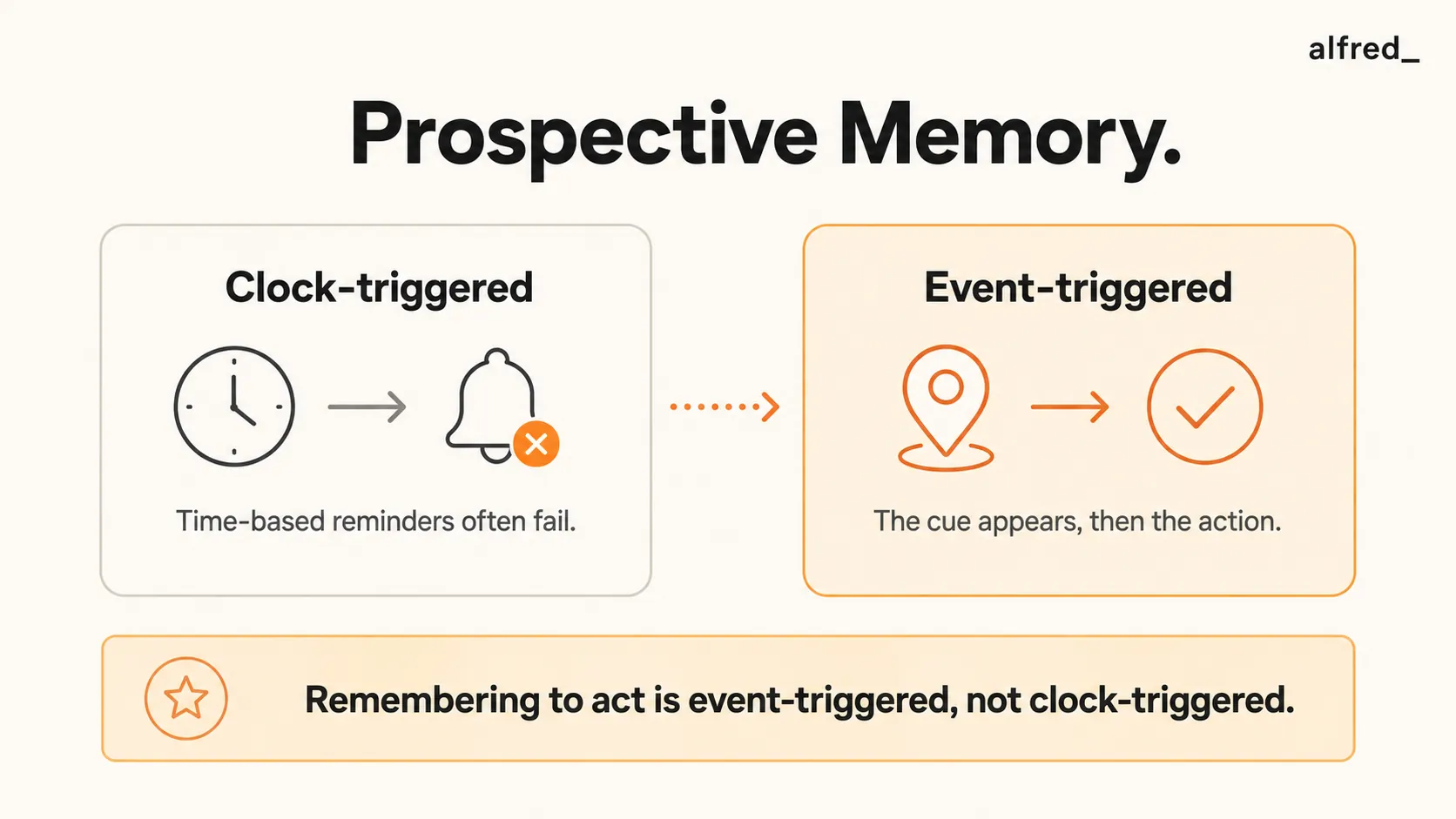
The most important insight from prospective memory research is about how intentions are retrieved: the system is fundamentally event-triggered, not time-triggered. Intentions surface in memory when environmental events match the internal representation of the intended action’s context, not at arbitrary calendar times.
This explains a common failure mode: setting a time-based reminder for 3:00 PM to send a follow-up email. At 3:00 PM, you are in a different meeting, the reminder fires, you dismiss it, and the follow-up never gets sent, because the cue (a notification sound) doesn’t match the context required to execute the action (being at your desk, with the relevant email open, having the context available).
Event-based prospective memory cues work better: “when I see an email from that client, follow up on the outstanding item.” The cue is structurally matched to the execution context in a way that a time-based alarm cannot replicate.
High-Stakes Failure Domains
Dismukes (2012) in Current Directions in Psychological Science documented the professional cost of prospective memory failure. Aviation accidents, medical near-misses, legal malpractice, and financial compliance failures disproportionately involve failures to perform intended actions, not failures of knowledge or technical competence.
The checklist, one of the most effective safety innovations in aviation and medicine, is a prospective memory externalization device. It moves intentions out of working memory and into a reliable environmental cue structure. The professional version of this principle is any system that surfaces commitments at the moment they are actionable: a client follow-up queue that appears when the relevant contact appears in your inbox, action items that resurface the morning before a meeting they relate to.
What Actually Improves Prospective Memory
Research identifies four factors that predict prospective memory success:
- Cue specificity. The more precisely the intended cue matches the environmental event that will trigger the action, the more reliably the intention surfaces. “Follow up with Marcus” is weaker than “when I see Marcus’s reply, send the attachment.” Specific cues outperform vague ones by a wide margin.
- Task uniqueness. Unique, distinctive actions are remembered more reliably than routine ones. This is why interruptions and unusual tasks are more often forgotten than standard workflows.
- Importance. High-stakes intentions receive more monitoring attention and are forgotten less often, to a degree. But importance alone does not reliably prevent forgetting under high workload; it just raises the threshold at which forgetting becomes likely.
- External aids. The single most reliable prospective memory intervention is removing the intention from memory entirely and placing it in an environmental system. Notes, task managers, and briefing systems that surface commitments at relevant moments reduce reliance on an unreliable internal system.