


The Cold-Pressor Experiments
Kahneman, Fredrickson, Schreiber, and Redelmeier published the foundational research in Psychological Science (1993): “When more pain is preferred to less: Adding a better end.” The title describes the finding precisely.
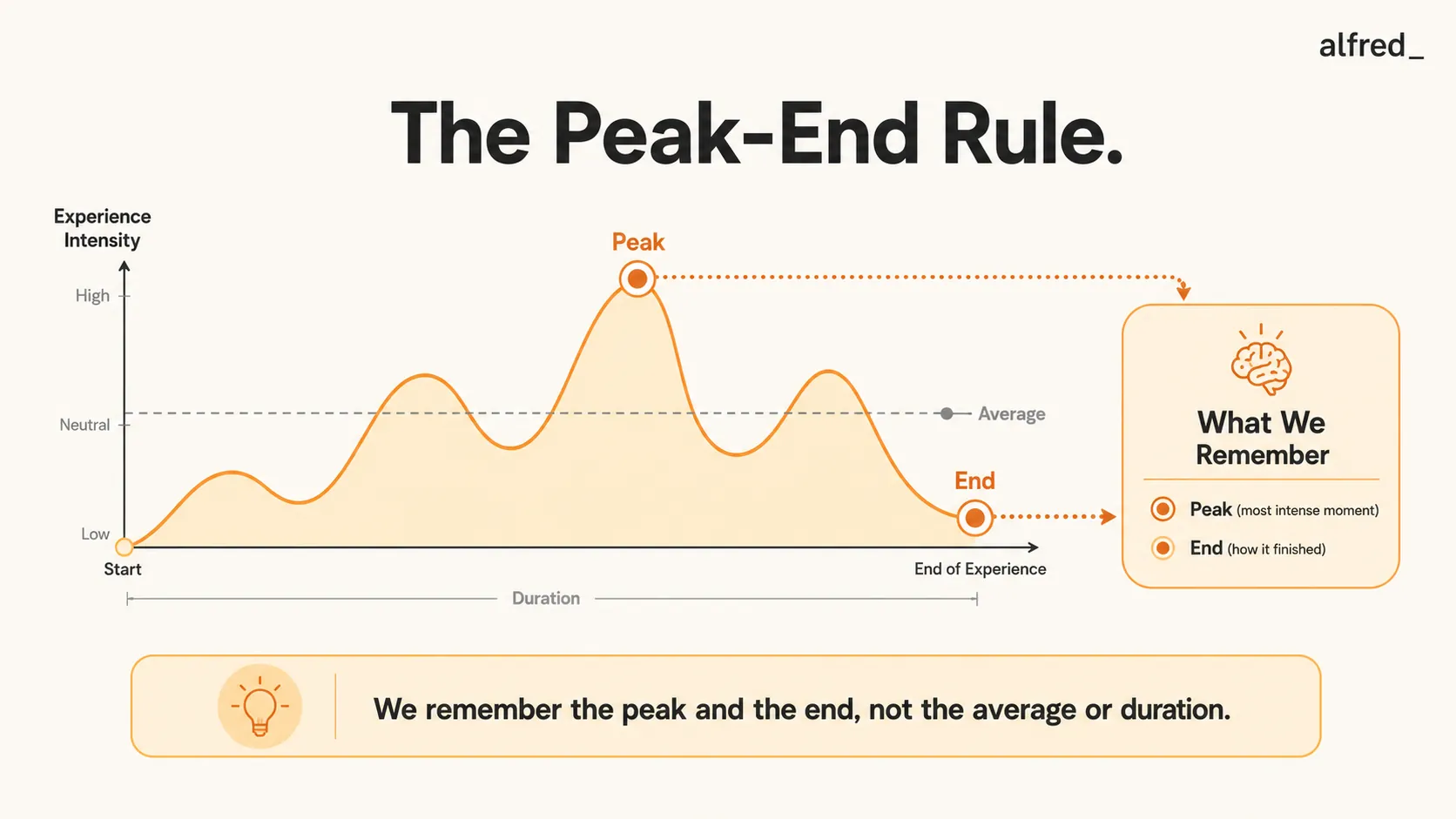
Participants immersed their hand in 14°C water (painfully cold) in two conditions. In the first, they held it for 60 seconds at 14°C and then removed it. In the second, they held it for 60 seconds at 14°C. Then for an additional 30 seconds the temperature was slowly raised to 15°C (slightly less painful, but still uncomfortable). Total discomfort: the second condition involved more pain because it lasted longer.
When asked which experience they’d prefer to repeat, the majority chose the second, the longer one with the better ending. They preferred more total discomfort because the ending was marginally better.
Medical Replication
More likely to return
colonoscopy patients (N=682) randomly assigned to a low-intensity extension at the end of the procedure remembered it as less painful and returned for repeat screening at a significantly higher rate (odds ratio 1.41, P=0.038)
Redelmeier, Katz & Kahneman (2003), Pain, 104(1-2)Redelmeier and Kahneman (1996) tested the effect in real medical settings. In a study of N=154 colonoscopy patients and N=133 lithotripsy patients, they recorded pain intensity in real time and compared it to each patient’s retrospective evaluation. Remembered unpleasantness was predicted by the peak intensity and the pain during the final moments of the procedure, not by how long it lasted.
A later randomized trial put this to a causal test. Redelmeier, Katz, and Kahneman (2003) randomly assigned colonoscopy patients to a standard procedure or to one with a low-intensity extension added at the end, without reducing total discomfort. Patients in the extended group remembered the procedure as less unpleasant, and over a median 5.3 years of follow-up they returned for repeat screening at a significantly higher rate (odds ratio 1.41, P=0.038), a real behavioral consequence of the memory-construction difference.
Duration neglect: total length of the experience had minimal predictive power for retrospective ratings. What predicted ratings was the peak moment and the final moments.
Professional Applications
The peak-end rule has direct implications for any professional context where how something is remembered determines future behavior:
- Meeting design. How a meeting ends predicts how it is remembered and whether participants consider it valuable, not the quality of the middle third. A meeting that ends on a concrete action, a clear summary, and a specific next step is remembered as productive regardless of how contentious the middle was. A meeting that trails off with no closure is remembered as a waste of time regardless of the insights generated.
- Client interactions. The follow-up email, the meeting summary, the final exchange: these are the ending moments of each client interaction. They disproportionately determine how the client retrospectively evaluates the interaction, which determines relationship strength and renewal probability.
- Difficult conversations. The most important part of a difficult performance conversation is not the substance of the feedback but the ending: how the conversation closes, what the person’s final experience is, what they leave with. Ending on a clear, constructive forward path produces a different remembered experience than ending on the most critical point.
- Project closures. Teams remember projects by how they ended. A strong final delivery, a proper retrospective, and explicit acknowledgment of contributions produces a positive project memory regardless of the struggles during execution. A chaotic launch or uncelebrated completion produces a negative memory that affects willingness to engage similarly in the future.