


You said yes to all of it. The extra project, the standing meeting, the favor for a colleague, each one reasonable on its own. Now your week is full and almost none of it is the work that actually matters, and you cannot point to a single bad decision that got you here. That is the trap Greg McKeown’s Essentialism is built to break: not the undisciplined pursuit of bad things, but the undisciplined pursuit of too many good ones. Here is the framework, the three-phase practice behind it, and the decision rule that makes saying no concrete instead of aspirational.
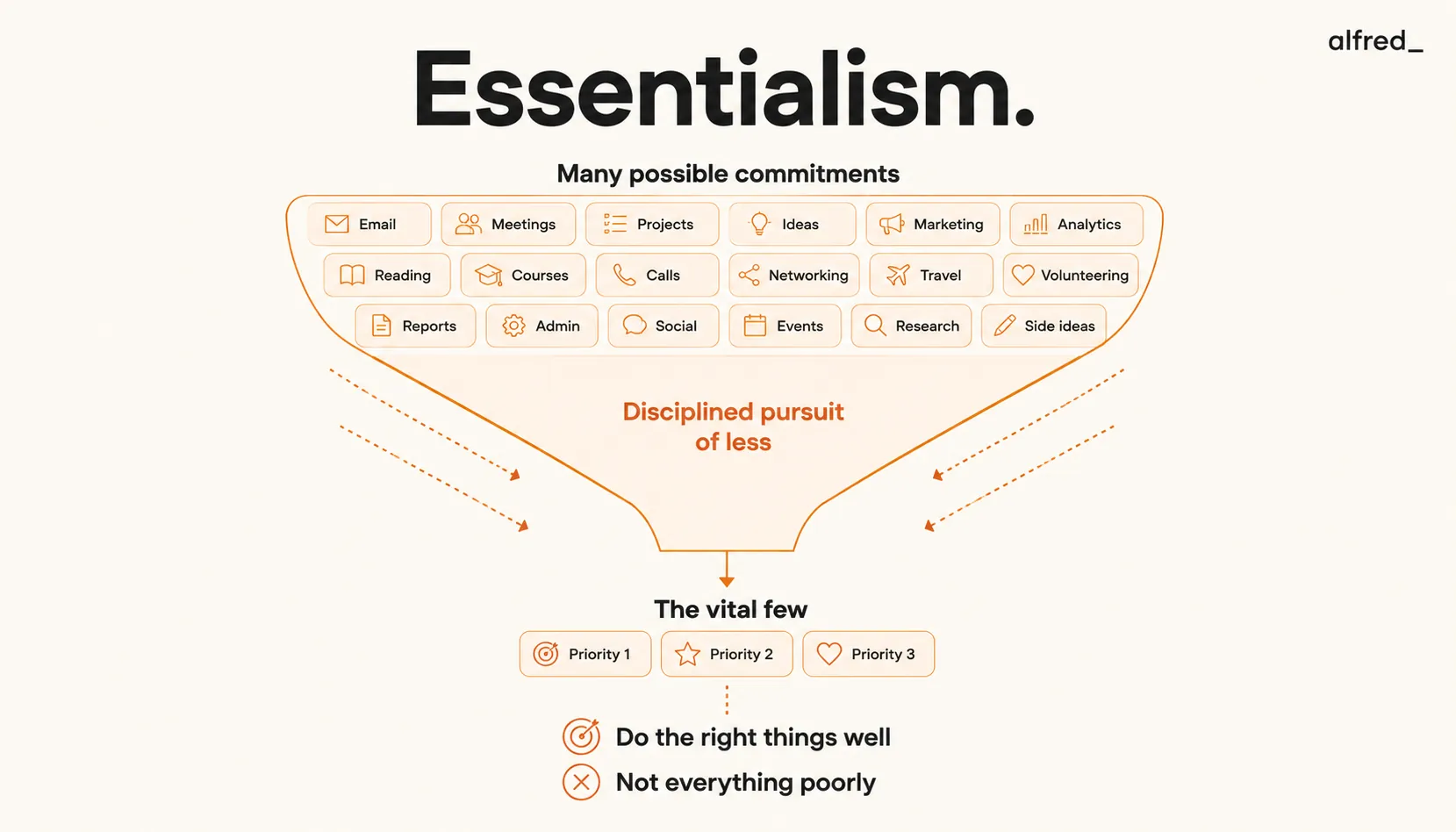
The Essentialist Framework
Greg McKeown published Essentialism: The Disciplined Pursuit of Less (Crown Business, 2014), drawing on research into high-performing executives and his consulting work with companies including Apple, Google, and LinkedIn. The book’s core argument: the non-essentialist mindset (responding to whatever is most urgent, saying yes to avoid disappointment, treating all opportunities as roughly equal) systematically produces less impact than the essentialist mindset, which asks “Is this the very most important thing I could be doing right now?” before every commitment.
McKeown identifies three realities that the essentialist accepts and the non-essentialist ignores. First: individual choice is real. Even in constrained environments, we always have a choice about where our energy goes, and failing to make that choice explicitly is itself a choice, usually in favor of whatever is most urgent rather than most important. Second: almost everything is noise. Only a tiny fraction of all possible activities, commitments, and projects will produce disproportionate results; most will produce trivial results or net negative results when their opportunity cost is counted. Third: trade-offs are real. Choosing to do one thing is always a choice not to do something else, and the non-essentialist’s pretense that everything can be done simultaneously results in doing everything inadequately.
Less but better
McKeown's core formula: the essentialist does less (takes on fewer commitments, attends fewer meetings, pursues fewer projects) but executes what they do take on with more depth, focus, and quality. The output is greater contribution from fewer inputs, not less contribution from fewer inputs.
McKeown, G. (2014). Essentialism: The Disciplined Pursuit of Less. Crown Business.Explore, Eliminate, Execute
McKeown structures the essentialist practice across three phases:
- Explore. Before committing, the essentialist creates space to explore options broadly rather than reacting to whatever arrives first. This requires protecting time for reflection, research, and judgment. The non-essentialist defaults to the first reasonable option; the essentialist asks whether there is a better option, including the option of doing nothing. McKeown argues that the more successful a person becomes, the more options they face, and the more critical it becomes to invest time in evaluating them before committing.
- Eliminate. Identifying what is essential requires actively removing what is not. McKeown proposes a test: “If I wasn’t already doing this, how hard would I work to start?” Work that doesn’t clear a high bar for active re-adoption should be eliminated. Practically, this means learning to say no to good opportunities, not just bad ones. The essentialist’s difficulty is not resisting obviously bad requests; it is declining good requests to protect time and energy for excellent ones.
- Execute. Once the essential few things have been identified, the essentialist removes obstacles to executing them: building routines, creating systems, and clearing the path so that doing the important work requires less energy than navigating friction. McKeown argues that most execution problems are design problems: the environment wasn’t set up to make the essential work easy, so the non-essential work wins by default.
The 90 Percent Rule
McKeown proposes a practical decision tool called the 90 percent rule: when evaluating any opportunity, score it on the single most important criterion for that type of decision. If it does not score at least 90 out of 100 on that criterion, decline it. The rule is designed to force explicit evaluation and prevent the accumulation of 70-percent opportunities: options that are good enough to justify acceptance but not good enough to justify the time and attention they consume.
The practical difficulty is that the rule requires defining the criterion in advance, which requires knowing what matters most, which requires the exploration phase. The 90 percent rule is not a substitute for judgment; it is a structure that forces judgment to be made explicitly and documented rather than defaulted into “yes” under social pressure or in the absence of a clear reason to decline.
When the Non-Essential Stops Arriving by Default
McKeown’s hardest insight is in the Execute phase: most execution problems are design problems. The environment was not set up to make the essential work easy, so the non-essential wins by default. Nowhere is that more true than the inbox. The requests, the noise, the good-enough opportunities all arrive there first and loudest, demanding a response before you have decided whether they deserve one. Essentialism asks you to decline most of them. The trouble is that declining still costs you the attention of reading, judging, and replying, hundreds of times a week.
This is the design problem alfred_ solves. It triages what arrives so the trivial many never reach your attention as decisions you have to make, surfaces only the few things that genuinely warrant a judgment, and handles the routine responses on your behalf. The effect is structural, not motivational: instead of relying on discipline to say no to every good-enough request all day, you change the environment so the non-essential stops arriving as your problem in the first place. That is essentialism’s “less but better” applied to the one surface where most of the more comes from.