


The Availability Heuristic: Why Memorable Events Feel Common
The risks that dominate strategic planning are often the ones that were most recently dramatic, not the ones most likely to occur. The client complaint that generates the most internal discussion is often the most vivid one, not necessarily the most representative one. In each case, ease of retrieval from memory is being used as a proxy for frequency and importance. That proxy is systematically biased.
What is the availability heuristic?
- A cognitive shortcut where people estimate frequency or probability by how easily examples come to mind
- Documented by Tversky and Kahneman (1973): most participants judge K-starting words as more frequent than K-as-third-letter words, which is the reverse of the actual frequency
- Events that are vivid, recent, or personally relevant are overestimated because they are easier to retrieve from memory
- Leads to systematic distortion in risk assessment, performance evaluation, and competitive analysis
Media amplifies availability bias significantly: news coverage systematically over-represents dramatic events, creating a distorted available sample from which frequency judgments are drawn.
The Original Research
Tversky and Kahneman published "Availability: A Heuristic for Judging Frequency and Probability" in Cognitive Psychology in 1973 (Vol. 5, pp. 207–232). The paper appeared in the same year as their work on representativeness, and together these papers established the heuristics-and-biases research program that would ultimately shape behavioral economics.
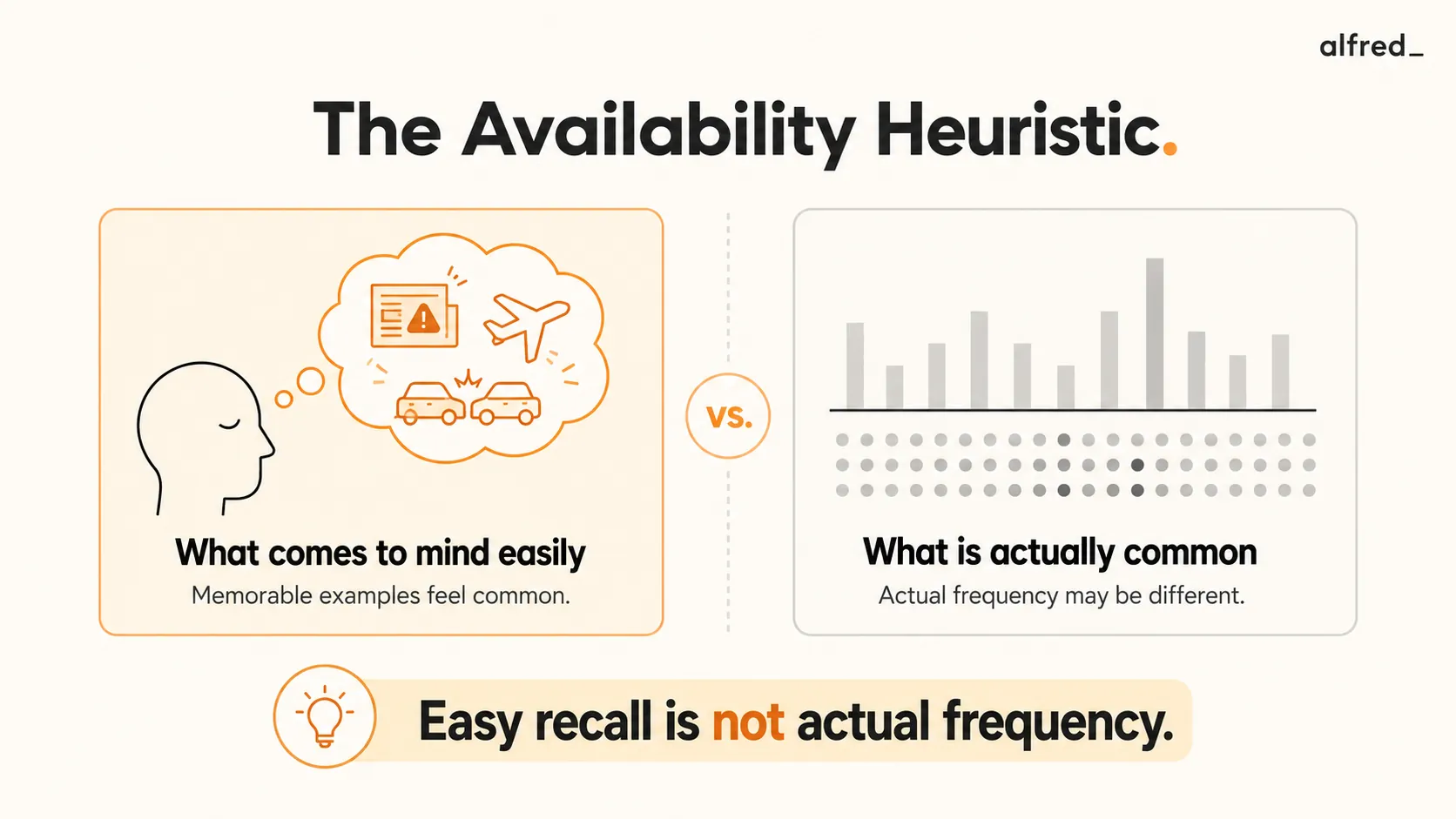
The availability heuristic describes a mental shortcut: when people estimate how frequently an event occurs, or how probable it is, they rely on how easily examples of that event come to mind. Events that are easy to recall (because they are vivid, recent, or emotionally salient) are judged to occur more frequently than events that are harder to bring to mind, even when the actual frequencies are reversed.
The canonical word-frequency study tested five letters (K, N, L, R, and V), asking participants whether each letter appears more commonly as the first letter or as the third letter in English words. For all five letters, most participants chose "first letter." But all five letters actually appear more frequently in the third position than the first. The reason for the systematic error is purely cognitive: words starting with K (kitchen, king, keep) come to mind much more readily than words with K as the third letter (make, bike, like), and this retrieval asymmetry is used as evidence of frequency, producing the wrong conclusion.
What Makes Events Available
The heuristic would produce only random error if ease of retrieval were uncorrelated with actual frequency. The reason it produces systematic error is that retrieval ease is driven by factors that are correlated with memorability but not with frequency:
- Vividness and emotional salience. Events that produced strong emotional responses (a dramatic failure, a striking success, a frightening near-miss) are encoded more durably and retrieved more easily than mundane events of equal or greater frequency. This makes dramatic but rare events feel more common than routine but frequent ones.
- Recency. Events that occurred recently are more retrievable than equally important events from the more distant past. Risk assessments made immediately after a significant failure overweight that type of failure; the same assessment made a year later may underweight it. Recent news coverage systematically distorts which risks feel most prominent.
- Personal relevance. Events that happened to you, your team, or people you know are more available than statistically equivalent events that happened to others. The organizations most cited in risk discussions are those your team has direct experience with, regardless of whether they are the most relevant comparators.
alfred_ surfaces the full span of your inbox, not just what arrived recently and feels most urgent.
Try freeProfessional Consequences
- Risk assessment and strategic planning. Strategic risks that are recent, dramatic, or personally experienced dominate planning attention relative to more probable but less salient risks. A company that recently experienced a cybersecurity breach will over-invest in cybersecurity relative to actuarially more likely operational risks. This availability-driven allocation is not necessarily wrong (recent incidents may signal genuinely elevated risk), but the allocation should be based on updated probability estimates, not on retrieval ease.
- Performance evaluation. Recent events dominate performance impressions relative to equally important events from earlier in the review period. The employee who made a visible mistake last week is evaluated more harshly than one who made an equivalent mistake six months ago, not because recency is evidence of a persistent pattern, but because recency inflates availability. Structured performance documentation that spans the entire review period counteracts this effect.
- Market and competitive analysis. Competitors who have recently made headlines, launched visible products, or disrupted a neighbor market dominate competitive planning regardless of their actual strategic relevance. The availability heuristic makes "the company we've been reading about" more cognitively present than "the company with the best product-market fit in our segment." Systematic competitive analysis anchored to structural data rather than news flow reduces availability-driven distortion.
Try alfred_
See the full picture, not just the recent one.
alfred_ surfaces the full span of your inbox, not just what arrived recently and feels most urgent. Availability bias makes recent, vivid messages feel most important; alfred_'s briefing structure gives you visibility into what matters across the full horizon. $24.99/month.
Try alfred_ freeFrequently Asked Questions
Is the availability heuristic always a bias, or is ease of retrieval sometimes genuinely informative?
Ease of retrieval is a genuinely informative signal in environments where personal experience is a representative sample of the broader distribution. If you have extensive personal experience with a risk domain, your ease of recall of specific instances may be a reasonable proxy for frequency because your sample is large and unbiased. The heuristic becomes systematically biased when the factors that drive retrieval ease (vividness, recency, personal relevance) are poorly correlated with actual frequency in the population you care about. The practical test: is my experience with this domain representative, or is it dominated by a specific type of salient but unusual event? If the latter, availability should be supplemented with base rate data.
How does availability heuristic interact with media coverage?
Media amplifies availability bias significantly. News coverage systematically over-represents dramatic, unusual, and extreme events (plane crashes, violent crimes, corporate collapses) relative to their actual frequency, because these events are newsworthy precisely because they are unusual. Consuming large amounts of news creates a systematically distorted available sample from which frequency judgments are drawn. People who follow news heavily tend to overestimate crime rates, accident rates, and corporate scandal rates, and to underestimate the frequency of quiet success, routine safety, and unremarkable performance. The availability cascade (where media coverage of an event increases further reporting, which increases public concern, which increases further coverage) produces risk perceptions that are driven by the feedback loop rather than by the underlying risk.
What structural practices reduce availability-driven distortion in organizational decisions?
Four practices with evidence: (1) Base rate data: explicitly consulting historical frequency data before making probability estimates, rather than relying on recalled examples. (2) Structured checklist approaches: systematically considering a predefined set of risk categories rather than generating risks from memory, ensuring that less available but real risks appear alongside vivid recent ones. (3) Pre-mortem analysis: generating specific failure scenarios before knowing which are salient from experience, which surfaces risks that haven't yet become available through personal experience. (4) Temporal spread in examples: deliberately seeking examples from the full historical record rather than the most recent period, which reduces the recency component of availability bias.