

The Process Model and the 1998 Study
James Gross published “Antecedent- and Response-Focused Emotion Regulation: Divergent Consequences for Experience, Expression, and Physiology” in the Journal of Personality and Social Psychology in 1998 (Vol. 74, No. 1, pp. 224–237). The paper introduced a framework distinguishing two categories of emotion regulation strategy based on where in the emotion-generation process they intervene.
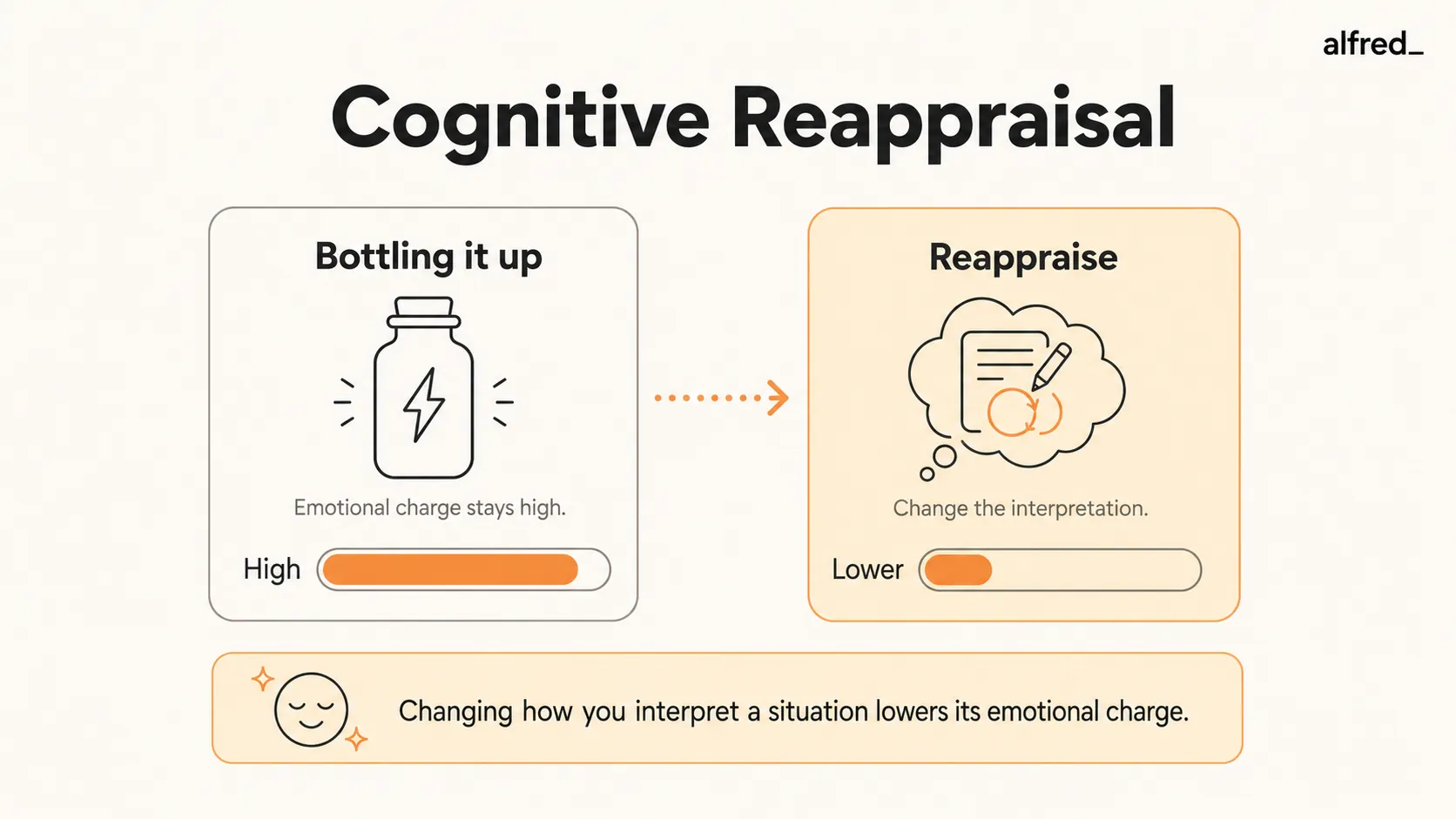
Antecedent-focused strategies intervene before the emotional response is fully generated: by changing the situation, how you attend to it, or how you mentally represent it. Cognitive reappraisal is the primary antecedent-focused strategy: you change the meaning you assign to the situation before the emotion cascade is fully underway. “This difficult feedback conversation is an opportunity to understand what this client actually values” is a reappraisal of a threatening interaction.
Response-focused strategies intervene after the emotional response is already being generated, managing how it is expressed rather than changing its internal intensity. Suppression (“don’t let it show”) is the primary response-focused strategy: you inhibit the behavioral expression of an emotion that is already being experienced internally.
In the 1998 experiment, participants watched a disgust-inducing film while instructed to either reappraise the content (think about it clinically, as if they were a medical professional), suppress any emotional expression (show no emotion on their face), or simply watch the film normally. Reappraisers reported less subjective disgust and showed lower physiological activation. Suppressors showed unchanged subjective disgust (the internal experience was not reduced) but increased sympathetic physiological activation (skin conductance), suggesting that maintaining the suppression was physiologically costly. Suppressors also showed no significant reduction in facial expression compared to the control group despite the effort invested in suppression.
The Memory Finding
Richards and Gross published “Emotion Regulation and Memory: The Cognitive Costs of Keeping One’s Cool” in JPSP in 2000 (Vol. 79, No. 3, pp. 410–424). This paper extended the reappraisal/suppression comparison to memory for emotional events.
Participants watched slides depicting emotional stimuli while using either suppression, reappraisal, or no strategy. Memory for the content of the slides was then tested. Participants who suppressed showed significantly worse memory for the emotional stimuli compared to both reappraisers and the control group. Participants who reappraised showed memory comparable to the control group. Reappraisal did not impair memory.
The mechanism: suppression requires ongoing cognitive effort to monitor and inhibit expressive behavior during exposure to the stimulus. This monitoring occupies working memory capacity that would otherwise support encoding of the content. The cognitive resources that go into maintaining the suppression come at the expense of remembering what happened. Reappraisal operates upstream of the monitoring demand, so it doesn’t create the same resource competition.
Professional Applications
- Difficult conversations and negotiations. Executives who enter emotionally loaded conversations (performance discussions, contract negotiations, board presentations) equipped with prepared reappraisals perform better than those who rely on in-the-moment suppression. Reappraisal reduces the emotional experience, which reduces the need to suppress; suppression manages the expression while leaving the internal experience intact and consuming cognitive resources.
- High-volume email environments. Reactive emotional processing of incoming communications (anger at a critical message, anxiety about a problem email) activates suppression as the default professional response: appear unruffled, respond professionally, don’t show the reaction. The Richards and Gross memory finding predicts that this pattern is impairing memory for what was in the email. Reappraisal before engaging with high-stakes communications (“this complaint is information about what they need”) preserves both emotional regulation and memory for the content.
- Sustained performance under stress. Gross and John (2003) showed in a longitudinal study that habitual use of reappraisal versus suppression predicted significantly better well-being, more positive emotional experience, more social support, and less avoidance of difficult situations. The cumulative effect of choosing suppression as the default emotion management strategy, across hundreds of interactions over months and years, produces the chronic physiological activation and cognitive costs that individual-study findings suggest, at organizational scale.
Key distinction from toxic positivity: Reappraisal does not require self-deception or denial. It involves finding a different, credible meaning, not constructing a false one. The reappraisal must be genuinely believable to produce the regulatory effect. Implausible reappraisals don’t work.