


Situational Leadership: Why One Management Style Never Works
The most common management failure is not using the wrong leadership style. It is applying the same leadership style to every direct report, regardless of their capability and confidence on a given task. Hersey and Blanchard's 1969 framework gives managers a vocabulary for diagnosing what's actually needed before deciding how to manage.
What is Situational Leadership Theory?
- Hersey and Blanchard (1969) proposed that effective leadership requires matching management style to follower readiness on each specific task
- Four readiness levels (R1-R4) combine ability and willingness; four leadership styles (Telling, Selling, Participating, Delegating) map to each
- The most common failure: high-performing ICs become managers and default to Delegating with all reports regardless of readiness
- Readiness is task-specific, not person-specific: the same person may be R4 for presentations and R2 for financial modeling
Use Situational Leadership as diagnostic vocabulary, not a scientifically validated predictive system. Vecchio (1987) found partial empirical support, with the model holding better for newer employees than experienced ones.
The Model
Paul Hersey and Ken Blanchard published "Life Cycle Theory of Leadership" in the Training and Development Journal (1969). The framework has been revised and extended several times; the version most widely used in corporate training maps four leadership styles to four levels of follower development.
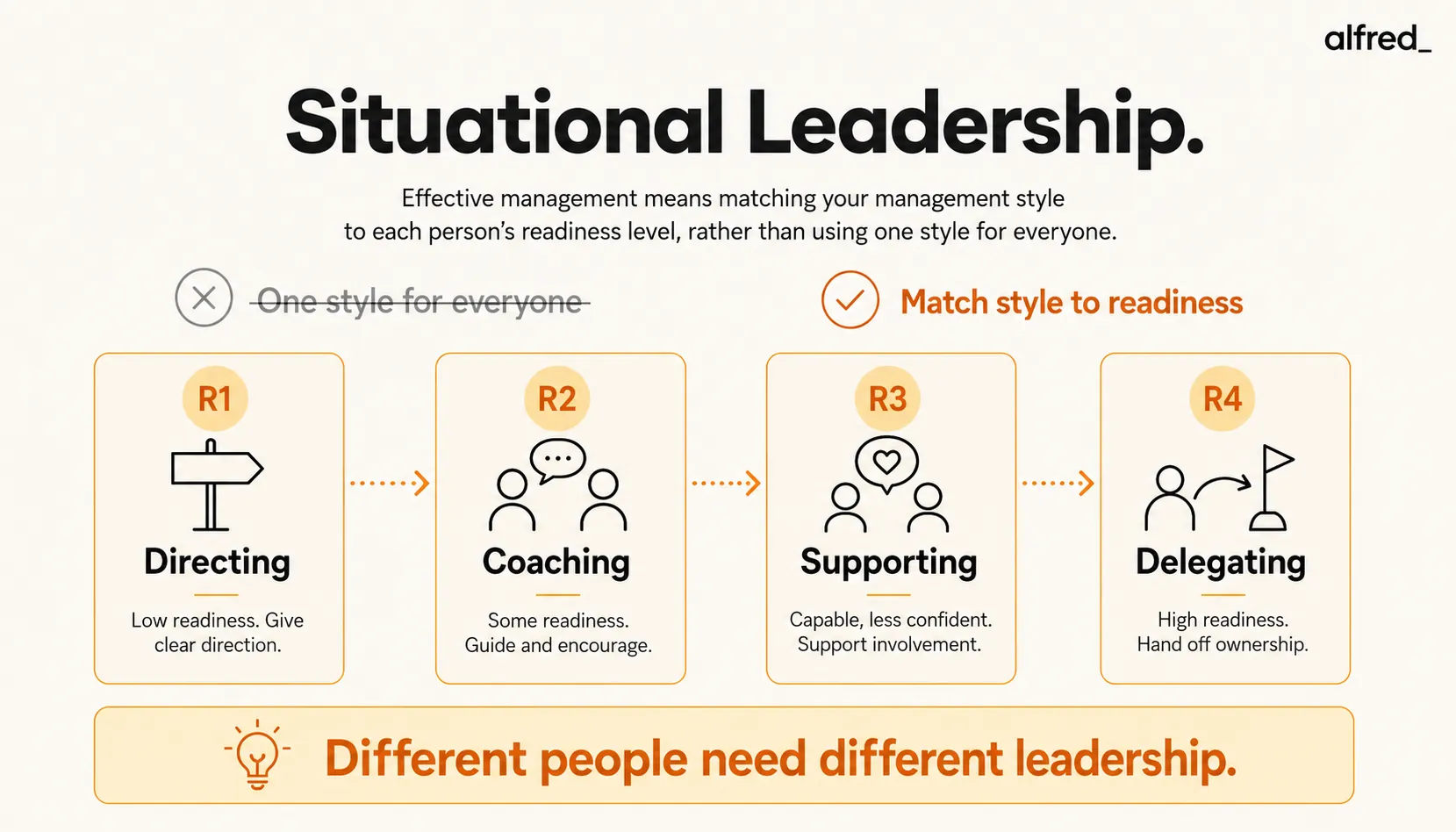
Follower readiness is assessed on two dimensions: ability (skill, knowledge, experience for the specific task) and willingness (motivation, confidence, commitment to perform the task). The combination produces four readiness levels:
- R1: Low ability, low willingness. Unable and lacking confidence or commitment. Needs structure and direction.
- R2: Low ability, high willingness. Motivated but lacking skill. Needs explanation and coaching.
- R3: High ability, low willingness. Capable but uncertain or reluctant. Needs support and participation, not direction.
- R4: High ability, high willingness. Both capable and confident. Needs delegation, not oversight.
The four corresponding leadership styles are S1 (Telling/Directing), S2 (Selling/Coaching), S3 (Participating/Supporting), and S4 (Delegating). Effective leadership, in the model's prescription, requires accurate diagnosis of readiness and style-matching.
Critical Caveat: Mixed Empirical Support
Situational Leadership Theory should be used as a diagnostic vocabulary, not as a scientifically validated predictive system. The empirical evidence is mixed.
Vecchio's 1987 test in the Journal of Applied Psychology found partial support: the model's prescriptions held better for newer employees (where the Telling and Selling styles showed the predicted relationship with performance) than for experienced employees (where the predicted relationships were weaker). A subsequent meta-analysis identified conceptual inconsistencies between different versions of the theory, and the psychometric properties of follower readiness measurement have been questioned.
The framework's wide practical adoption is not the same as empirical validation. Use it as a structured way to think about differentiated management, not as a theory with validated effect sizes.
Try alfred_
See what this looks like in practice
alfred_ applies these principles automatically — triaging your inbox, drafting replies, extracting tasks, and delivering a Daily Brief every morning. Theory becomes system. $24.99/month. 30-day free trial.
Try alfred_ freeThe Most Common Failure Mode
High-performing individual contributors who become managers frequently default to S4 (Delegating) with all direct reports, because that is the style they wanted when they were ICs, and because it feels like respecting autonomy.
This misfires for R1 and R2 reports in three ways: it leaves low-ability individuals without the structure or coaching they need to develop; it is experienced as abandonment rather than autonomy by those who lack confidence; and it produces failure that the manager then attributes to the individual rather than to the management mismatch.
The inverse failure also occurs: micromanaging high-readiness (R4) reports with Telling behavior is experienced as distrust, reduces motivation, and drives departures. Close oversight, the same behavior in both cases, is supportive for R1 and destructive for R4.
Task-Specific, Not Person-Specific
One of the model's more useful refinements: readiness is task-specific, not a fixed characteristic of the person. The same individual may be R4 (high ability, high willingness) for client presentations and R2 (low ability, high willingness) for financial modeling. Effective management requires diagnosing readiness for the specific task being delegated, not applying a blanket assessment of the person.
A senior professional who is being given a novel type of responsibility benefits from more structured support regardless of their overall experience level. The instinct to treat high performers as universally autonomous can deprive them of coaching where they genuinely need it.
Frequently Asked Questions
How do you accurately assess follower readiness without it feeling like an evaluation?
The most practical approach is task-specific conversation rather than explicit assessment: 'Have you done something like this before? What parts feel clear and what parts feel uncertain?' This surfaces ability and willingness information without framing it as a performance judgment. The goal is to calibrate what the person needs for this specific task (direction, coaching, support, or autonomy), not to classify them permanently. Making this a routine pre-delegation conversation normalizes it and removes the evaluative charge.
What happens when you apply the wrong style?
The effects are predictable. Applying Telling to an R4 individual produces resentment and disengagement, as they experience oversight as distrust. Applying Delegating to an R1 individual produces confusion, failure, and loss of confidence, as they experience the absence of support as abandonment. The mismatch in both cases is the same structural error: assuming one style is appropriate regardless of context. The performance problems that follow are often attributed to the individual (lazy, incompetent, difficult) rather than to the management mismatch, which perpetuates the error.
How does Situational Leadership relate to coaching vs. managing?
The S2 and S3 styles overlap with what is usually called coaching in management development contexts. The Situational Leadership framework is useful for clarifying when coaching is the right intervention and when it isn't: coaching (collaborative dialogue, skill development, building self-directed capability) is appropriate when the individual has some task engagement and motivation but needs skill development (R2) or confidence support (R3). It is less appropriate for R1 (needs clear direction and structure before coaching is useful) and unnecessary for R4 (needs delegation and autonomy). The common mistake is applying coaching to R1 situations, because the Socratic dialogue approach is ineffective when the person genuinely doesn't know what to do.
Related Articles
Try alfred_
Create space for the delegation judgment.
Effective situational leadership requires attention and judgment, which requires time. alfred_ handles the execution overhead so the leadership bandwidth goes toward the readiness diagnosis and style-matching that actually determines team performance. $24.99/month.
Try alfred_ Free