

The 1971 Experiment
Deci’s foundational 1971 experiment is among the most replicated findings in motivational psychology. Participants worked on an intrinsically interesting spatial puzzle (the SOMA cube) across three sessions. In the second session, one group was paid a monetary reward for each puzzle they solved; the control group was not.
In the third session, payment was removed for the experimental group. During a break period where participants could freely choose to continue with the puzzle or read magazines, the group that had been paid showed less engagement with the puzzle than the group that had never been paid, and less than their own baseline before payment began.
The conclusion, replicated extensively over subsequent decades: for work that is inherently interesting, adding a monetary reward can reduce intrinsic motivation. The mechanism is a shift in perceived locus of causality: from “I’m doing this because I find it interesting” to “I’m doing this for the money.” When the money stops, the original internal justification has been partially displaced, and engagement drops below its original level.
This effect, called the overjustification effect, has important implications for how organizations design compensation for creative, knowledge-intensive work.
The Three Psychological Needs
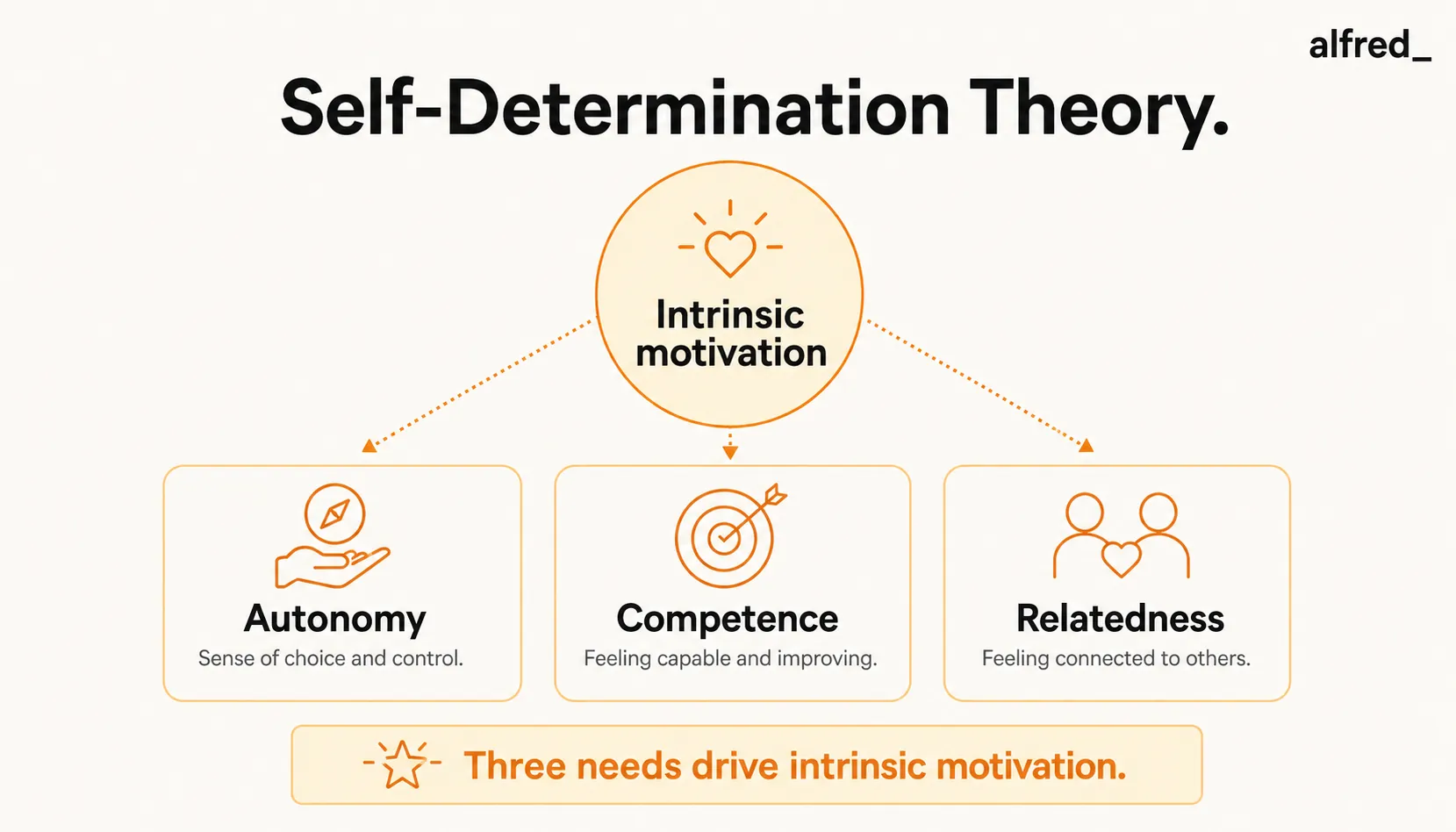
SDT identifies three universal psychological needs whose satisfaction predicts motivated engagement, performance, and wellbeing across cultures and domains:
Autonomy
The need to experience your behavior as self-initiated and self-governed. Not the absence of structure, but the experience that you are acting in alignment with your own values and choices, even within a structured environment. Managers can support autonomy by explaining rationale for requests, acknowledging perspectives, and offering meaningful choices within constraints, not by eliminating all constraints.
Competence
The need to experience effectiveness and mastery. Not just performing well, but feeling that your skills are being used and developed. Work that is far below ability diminishes competence need satisfaction; work at the edge of ability (where deliberate practice occurs) maximizes it.
Relatedness
The need to experience genuine connection with others. Not mere proximity, but a sense of caring and being cared about. In organizational contexts, this is about the quality of relationships with colleagues and managers, not the frequency of team events.
A 2017 meta-analysis by Deci, Olafsen, and Ryan found that managerial support for autonomy was the single strongest predictor of both employee performance and wellbeing in work organizations, more predictive than compensation, team structure, or role clarity. This is not because autonomy is inherently more important than the others, but because it is the most consistently violated in organizational environments.
The Critical Nuance Pink Left Out: Types of Extrinsic Motivation
The most important and most overlooked aspect of SDT is its distinction between types of extrinsic motivation. The research does not argue that external rewards are bad. It shows that their effect depends on how internalized they are:
- External regulation: Acting to obtain a reward or avoid punishment. Lowest autonomy, most controlled. This is what most people picture when they think of extrinsic motivation.
- Introjected regulation: Acting to avoid guilt or gain ego approval. Slightly internalized, but still experienced as pressure rather than choice.
- Identified regulation: Acting because you personally value the goal, even if the activity itself is not enjoyable. “I’m doing this administrative work because I care about the project it enables.”
- Integrated regulation: The activity is fully aligned with your values and self-concept. Behaviorally similar to intrinsic motivation, but the motivation originates externally.
Identified and integrated extrinsic motivation produce similar performance and wellbeing outcomes to intrinsic motivation, especially for complex cognitive tasks. The implication: organizations do not need to make all work intrinsically interesting. They need to help people connect the work they do to goals they personally identify with. The rationale matters.