


The Goal Gradient Effect: Why the Finish Line Makes You Faster
Motivation is not constant through a task. Research across species and domains shows that effort accelerates as a goal approaches completion. This is not willpower or discipline. It is a deep feature of how goal-pursuit systems work. Understanding it explains both why long projects are hardest at the start and how to design work structures that leverage the effect deliberately.
What is the goal gradient effect?
- Effort and motivation increase as a goal approaches completion, documented by Hull (1932) in animal behavior and replicated in humans by Kivetz et al. (2006)
- The loyalty card experiment: customers with a 12-stamp card (2 pre-stamped) completed 10 purchases in 12.7 days vs. 15.6 days for standard 10-stamp card, even though both required 10 purchases
- Even illusory progress accelerates effort: the perceived distance to the goal matters more than objective distance
- The motivational low point in any long project is the beginning, when the goal is most distant, not the middle or end
To leverage the effect: make progress visible (done items, percentage complete, milestones), create sub-goals that are close enough to feel proximate, and start projects even superficially to activate the gradient earlier.
Hull's Original Finding
Clark Hull published "The Goal Gradient Hypothesis and Maze Learning" in Psychological Review in 1932 (Vol. 39, pp. 25–43). The core observation: rats running a straight alley toward food ran progressively faster as they approached the food box. The acceleration was smooth and consistent, not a sudden burst at the end but a continuous gradient from start to finish.
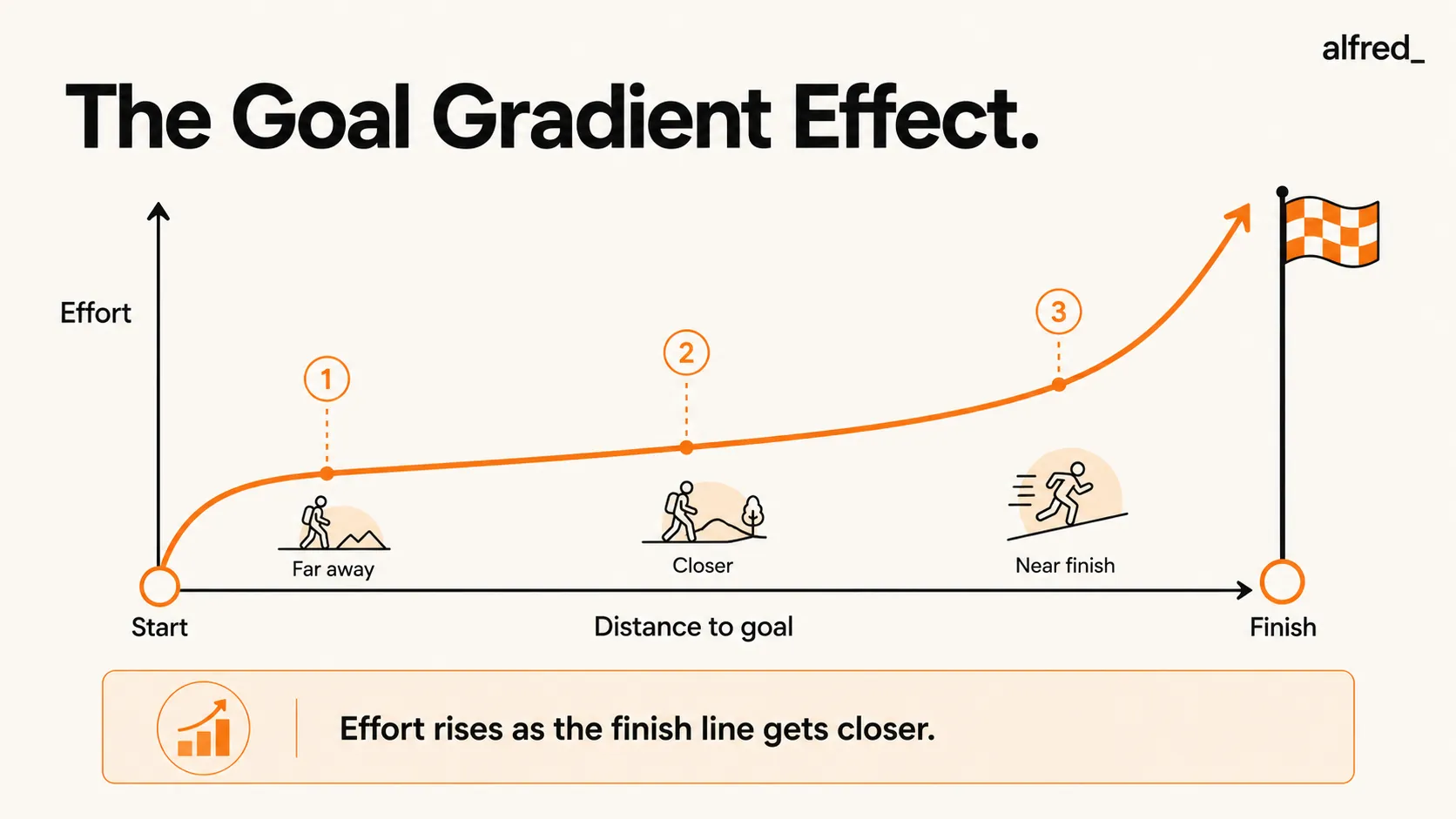
A follow-up study in the Journal of Comparative Psychology (1934) examined the speed gradient more precisely and confirmed the finding across multiple animal subjects. The goal gradient was not noise. It was a reliable feature of goal-directed behavior.
Hull's theoretical explanation was in terms of learning and drive reduction. The contemporary interpretation focuses on motivation dynamics: as the goal becomes more proximate, its psychological salience increases, motivation intensifies, and competing behaviors are more readily displaced.
The Human Replication: Loyalty Cards
Kivetz, Urminsky, and Zheng (2006) published "The Goal-Gradient Hypothesis Resurrected: Purchase Acceleration, Illusionary Goal Progress, and Customer Retention" in the Journal of Marketing Research (43(1), 39–58). The study examined actual purchase behavior using loyalty cards.
The key condition: customers received either a standard 10-stamp card (requiring 10 purchases to earn a free coffee) or a 12-stamp card with 2 stamps already filled in. Both groups needed to make exactly 10 more purchases to complete their card. The difference was purely in perceived progress: one group started at zero of ten, the other at two of twelve.
The customers with the pre-stamped 12-stamp card completed their remaining 10 purchases in an average of 12.7 days. Customers with the standard 10-stamp card took an average of 15.6 days, nearly 3 days longer for the same number of purchases. The illusory head start, which conferred no actual advantage, still accelerated behavior through the goal gradient mechanism.
Try alfred_
See what this looks like in practice
alfred_ applies these principles automatically — triaging your inbox, drafting replies, extracting tasks, and delivering a Daily Brief every morning. Theory becomes system. $24.99/month. 30-day free trial.
Try alfred_ freeProfessional Implications
The goal gradient effect makes several professional behaviors more predictable:
- Procrastination at project start. The lowest motivation point in a long project is the beginning, when the goal is most distant. This is not a discipline failure; it is the goal gradient operating as expected. The implication: starting a project, even superficially, moves the perceived starting point and reduces the initial motivation deficit. Any genuine beginning activates the gradient earlier.
- Deadline acceleration. The familiar pattern of work intensifying near deadlines is partly goal gradient: as completion approaches, motivation increases and competing impulses are more easily overridden. Managers who attribute deadline crunch purely to procrastination are missing the motivational structure that makes deadline proximity genuinely productive.
- Progress visibility for sustained motivation. Making progress visible (tracking done items, showing percentage completion, using milestone markers) moves the goal's psychological proximity earlier in the process. A project that is 60% complete feels closer to done than a project described in terms of remaining work, even with identical objective status.
- Fundraising and campaign design. Goal gradient research is widely used in fundraising: showing campaigns at 85% of a goal produces higher individual contribution rates than showing them at 15%, even when the total needed is identical. The effect transfers to any collaborative goal with visible progress.
Frequently Asked Questions
Does the goal gradient effect apply to goals that take months or years to complete?
The effect is most pronounced for goals with a clear, visible endpoint and a trackable distance metric. For long-term goals, the gradient is flatter in the middle, which is why motivation is most vulnerable in the middle phase of extended projects. The practical design response is to create intermediate sub-goals that are close enough to trigger goal gradient acceleration before the distant main goal becomes relevant. Milestones, sprint structures, and quarterly reviews all function as intermediate goals that maintain the acceleration effect without requiring the main goal to feel proximate.
Can the goal gradient effect be 'hacked'? Does artificial progress actually work?
Yes, with an important condition: the artificial progress needs to feel like genuine forward movement on the actual goal. The Kivetz et al. loyalty card research showed that illusory head starts (pre-stamped stamps that weren't earned) still accelerated behavior. But research on gamification has shown that artificial progress that feels disconnected from actual goal completion doesn't produce the same motivational effect. The person understands that the badge or level doesn't reflect real progress toward what they care about. The design principle: artificial progress markers work when they are psychologically perceived as genuine progress on the thing that matters, even if the objective contribution is minor.
How does the goal gradient explain behavior near completion of a task versus the middle?
The gradient predicts that the middle of a project, the stage where the beginning is no longer close and the end is not yet close, is the motivational low point. This is the 'stuck in the middle' problem that project managers recognize: early enthusiasm fades, and deadline urgency hasn't yet kicked in. The gradient predicts this structurally, not as a character flaw. The practical responses: create visible intermediate milestones that activate sub-goal gradients, restructure work sequences so that each work session ends with some visible progress toward a nearby marker, and break long projects into phases short enough that the phase end is always within a motivationally salient distance.
Try alfred_
Make Progress Feel Like Progress
alfred_'s briefing triage shows your inbox moving toward clear as you work through it, leveraging the goal gradient effect to accelerate effort toward completion rather than leaving the endpoint invisible. $24.99/month.
Try alfred_ Free