

A decision-maker reads your summary for ninety seconds, and in that window either your recommendation lands or it does not. Most summaries waste those seconds: they open with background, walk through methodology, and bury the actual ask in the final paragraph the reader never reaches. By the time the point arrives, attention is gone. An executive summary is not a wind-up; it is the answer first, with the support behind it. Here is how to write one that gets read and acted on, drawing on Bezos’s memo culture and the Pyramid Principle.
Bezos and the Narrative Memo Culture
When Jeff Bezos banned PowerPoint in 2004 and required six-page narrative memos instead, he was encoding a specific discipline about written communication. The memo requirement wasn’t about format preference. It was about thinking quality. “There is no way to write a six-page narratively structured memo and not have clear thinking,” Bezos explained.
“You can hide a lot of sloppy thinking behind bullet points.”, Jeff Bezos
The same critique applies directly to executive summaries. A bulleted executive summary can hide the absence of a clear recommendation: “Key findings: [five bullets]” doesn’t require the writer to have a position. A narrative executive summary that leads with a recommendation forces the writer to have one, and forces the reader to evaluate it rather than extract meaning from a list.
The best executive summaries are structured like Bezos memos: conclusion first, evidence second, context last. This is the inverse of how most people naturally write, building to a conclusion after establishing context. The natural writing order serves the writer’s comfort; the conclusion-first order serves the reader’s time.
Bezos’s principle also contains a test for clarity that applies directly to executive summary drafts: “When you force someone to write their thinking down, you force them to clarify it.” Before submitting an executive summary, apply this test: Has writing it forced me to clarify my recommendation? If the answer is no, if you could have written the same summary without clarifying your thinking, you’re probably writing a description, not a recommendation document.
The Pyramid Principle: Structure That Serves the Reader
Barbara Minto developed the Pyramid Principle at McKinsey in the 1960s and 70s as a structure for all professional communication. The principle is elegant: always start with the key message at the top, supported by arguments below, supported by data below that. The structure is a pyramid with the conclusion at the apex, not a journey that arrives at the conclusion after presenting the evidence.
Pyramid Structure vs. Natural Writing Order
Pyramid (correct)
-
- Recommendation (conclusion first)
-
- Key rationale (3 reasons why)
-
- Supporting detail and data
-
- Context and background
Natural Order (wrong for executives)
-
- Background and context
-
- Analysis and findings
-
- Options considered
-
- Recommendation (buried at end)
The natural writing order serves the writer’s logic: it mirrors how you arrived at the conclusion. The Pyramid Principle serves the reader’s time: it puts what matters most first, so the reader can evaluate the recommendation and decide how much of the supporting detail they need to read.
Applied to executive summaries: Recommendation (one sentence, specific) → Key rationale (2–3 strongest arguments) → Key risks or assumptions (2–3 bullets) → Specific ask (one action). This structure means that an executive who reads only the first sentence of your summary has the most important information. Every subsequent sentence adds supporting context, not new essential content.
What an Executive Summary Must Contain
Five elements, in this order:
- The decision or situation in one sentence. What is this document about? Not “this memo addresses the question of our Q3 budget allocation.” Instead: “We need to decide whether to increase Q3 marketing budget by 15% before the April planning cycle closes.” Specific and time-bounded.
- Your recommendation. Not “here are some options to consider.” Take a position. “We recommend Option A: increase Q3 marketing budget by 15%, funded by reducing Q3 travel.” One recommendation, not a menu.
- 2–3 key reasons why. The most important rationale, not all the evidence. “Because” and then the strongest arguments. If you have seven reasons, present the three strongest. The other four belong in the appendix.
- Key assumptions or risks. What would have to be true for your recommendation to be wrong? What are you assuming? Surfacing this builds credibility. It signals you’ve stress-tested your own thinking rather than presenting only the case for your position.
- The ask. What do you need from the reader? Approve, decide, fund, escalate: one action, with a timeline. “We need a decision by April 3 to execute before the Q3 planning window closes.” Not “your thoughts would be appreciated.”
Walsh’s Preparation Standard for Written Communication
Bill Walsh’s Standard of Performance included a communication principle that applies directly to executive summaries: “Organize communication with logical, sequential building blocks.” Walsh held everyone in his organization to a standard that prioritized the reader’s comprehension over the writer’s convenience.
Applied to executive summaries: every organizational choice should serve the reader’s comprehension, not the writer’s familiarity. You don’t lead with background because you’re most comfortable with it. You lead with the conclusion because that’s what the reader needs. You don’t include all seven reasons because you know them all. You include the three strongest because that’s what the reader can hold and evaluate.
“The reader should never have to work to understand the communication. Every organizational choice serves the reader’s comprehension, not the writer’s convenience.”, Walsh’s Standard of Performance applied to written communication
Walsh also identified preparation as the determinant of performance. An executive summary written in haste, drafted quickly from the full document without a clear recommendation, is a preparation failure. The executive summary is the highest-leverage document in most professional contexts: it’s what decision-makers read, and decisions get made based on it. It deserves preparation proportional to that leverage.
The One-Page Test
Most executive summaries should fit on one page, or one screen. This is not a stylistic preference; it’s a reading-behavior reality. Executives making decisions at scale allocate limited attention to each document in their queue. A two-page executive summary is competing with a one-page executive summary from someone who did the work of editing.
Cal Newport’s process-centric thinking applies here: “What is the one thing the reader needs to do or decide after reading this?” The entire summary should serve that one outcome. If your executive summary requires more than one page to communicate the key message, it usually has one of three problems: too many key messages (choose one), too much context in the summary (move it to the body), or an unclear recommendation (make it clearer).
The one-page test is also a discipline test. Writing a clear one-page executive summary is harder than writing a two-page one. Reducing to the essential requires knowing what’s essential, which requires clarity of thought that not all drafts possess. When in doubt, cut. If a sentence doesn’t directly serve the recommendation or the ask, it probably belongs in the body document, not the summary.
Step-by-Step: Write an Executive Summary That Gets Read and Acted On
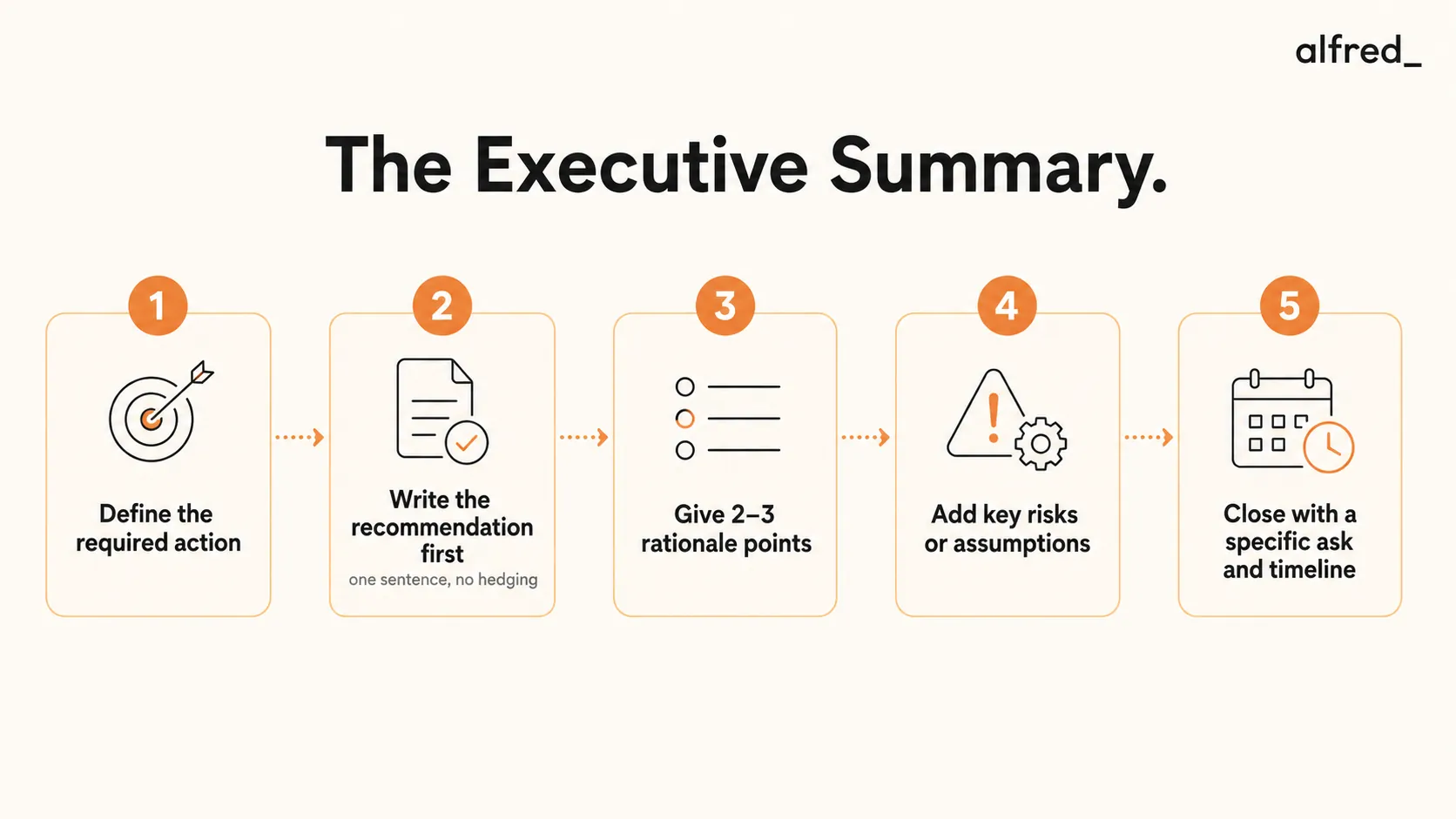
1. Define the Required Action Before Writing a Word
Start by writing the one thing you need from the reader: approve, decide, fund, escalate, or something specific. This is not the last line you’ll write. It’s the first thought you need clarity on. Everything in the executive summary should serve this one outcome. If you can’t identify the single required action clearly, the document isn’t ready to write. The ambiguity in your ask will produce ambiguity in the response.
2. Write Your Recommendation First: One Sentence, No Hedging
Applying Bezos’s conclusion-first discipline: the first sentence of the executive summary is your recommendation. “We recommend [specific action].” Not “we believe there may be merit in considering…” Not “after extensive analysis, we have identified several potential approaches…” A recommendation takes a position. If your first instinct is to hedge, to present options rather than choose one, that’s usually a sign the analysis isn’t complete, not a sign the recommendation should be hedged.
3. Write Your 2–3 Key Rationale Points
The reasons why, not all the evidence. Applying the Pyramid Principle: the executive summary contains the key arguments; the full document contains the supporting data. Identify your three strongest reasons and present those. “Three reasons: [reason 1], [reason 2], [reason 3].” If you have more than three reasons, you need to choose. The executive who reads your summary will hold three arguments in working memory and evaluate them; they will not hold seven. Choosing forces you to identify which arguments are actually strongest.
4. Add Key Risks or Assumptions: 2–3 Bullets
What would have to be true for your recommendation to be wrong? What assumptions is it built on? Surfacing risks and assumptions serves two purposes. First, it builds credibility. It signals that you’ve stress-tested your own position and aren’t hiding the weaknesses. Second, it gives the reader the information they need to calibrate their confidence in the recommendation. Bezos’s clarity test: are the assumptions specific enough that a decision-maker can evaluate whether they agree?
5. Close with a Specific Ask and Timeline
The last element is the ask: one action, specific and time-bounded. “We need approval to proceed by April 3 so we can execute before the Q3 planning window closes.” Not “we welcome your feedback” or “please share your thoughts.” Newport’s process-centric principle: “What is the one thing the reader needs to do?” Name it explicitly. An executive summary that ends with an open-ended request for feedback has not completed its job. It’s transferred the work of deciding what to do back to the reader.
Executive Summary Templates
Project Proposal Executive Summary
EXECUTIVE SUMMARY: [Project Name] RECOMMENDATION We recommend [specific action] at a total investment of [amount], with [expected return/outcome] by [date]. WHY 1. [Strongest reason: specific and concrete] 2. [Second reason: quantified where possible] 3. [Third reason: strategic or risk-related] KEY ASSUMPTIONS • [Assumption 1: what must be true for this to work] • [Assumption 2: what external condition this depends on] • [Primary risk: what could make this wrong] ASK Approve [specific action] by [date] so we can [next step that depends on approval]. Full proposal attached. ### Strategic Recommendation Executive Summary EXECUTIVE SUMMARY: [Strategic Decision] SITUATION [One sentence on what decision needs to be made and by when] RECOMMENDATION [Organization/team] should [specific action] rather than [alternative]. THREE REASONS 1. [Reason: with data point or specific evidence] 2. [Reason: with data point or specific evidence] 3. [Reason: with data point or specific evidence] WHAT WE'RE NOT RECOMMENDING [Option B] because [specific reason]. [Option C] because [specific reason]. RISKS • [Primary risk], mitigated by [mitigation] • [Secondary risk], current probability: [low/medium/high] DECISION REQUIRED [Specific decision] by [date]. This decision enables [next step that depends on it]. ### Status Update Executive Summary (Ongoing Project) EXECUTIVE SUMMARY: [Project Name] Status: [Date] STATUS: [On Track / At Risk / Off Track] HEADLINE [Project] is [on track / at risk] for [milestone] on [date]. [One sentence on the most important thing to know right now.] KEY METRICS • [Metric 1]: [Current] vs. [Target] ([status]) • [Metric 2]: [Current] vs. [Target] ([status]) • [Metric 3]: [Current] vs. [Target] ([status]) WHAT'S WORKING [One specific positive development with implication] WHAT NEEDS ATTENTION [Specific risk or issue]: [what we're doing about it], by [when] ACTION REQUIRED (if any) [Specific ask or decision needed from this reader] by [date]. If no action required: [No decision needed from you at this time. Next update: [date].] ## Common Executive Summary Mistakes ### Starting with Background Instead of the Recommendation This is the most common failure. Context feels necessary because you’ve spent weeks developing it. But your reader doesn’t need your context before your recommendation. They need your recommendation so they know what the context is for. Lead with the conclusion.
Listing Options Instead of Making a Recommendation
“Option A would… Option B would… Option C would…” is an analysis, not an executive summary. Your job in the summary is to have done the analysis and made the call. Presenting options passes the decision work back to the reader. Bezos: “you can hide a lot of sloppy thinking behind bullet points.” A list of options often hides the absence of a clear recommendation.
Writing for Your Own Comfort, Not the Reader’s Comprehension
Walsh’s standard: every organizational choice serves the reader’s comprehension. This means not leading with the history of the project because you’re most familiar with it. Not including every data point because you worked hard to find them. The executive summary is not the place to demonstrate the quantity of your work. It’s the place to demonstrate the quality of your conclusion.
No Explicit Ask
An executive summary without a specific ask is an information document, not a decision document. The single most common reason executive summaries don’t produce action is that they don’t ask for it. “Please let us know your thoughts” is not an ask; it’s an invitation to respond without deciding. “Please approve Option A so we can move forward” is an ask.
How alfred_ Helps You Communicate Up
alfred_’s morning brief is itself an executive summary of your inbox: here’s what matters from your email this morning, here’s what needs your decision, here’s what’s been handled. The structure mirrors the Pyramid Principle: most important first, detail available if you want it.
alfred_’s draft capabilities can create first versions of status update emails from email threads, surfacing the key points from a long conversation and proposing a summary you can send upward. The drafts give you a starting point rather than a blank page; you refine for recommendation clarity and specific ask before sending.
The underlying principle is the same in both cases: your reader’s time is finite and valuable, and the most useful communication you can give them starts with what they need to know and do, not with what you know and did.