

Why Agendas Fail Even When They Exist
Most agendas list topics, not outcomes. “Q3 marketing update” is not an agenda item. “Decide whether to increase Q3 marketing budget by 15%” is. The difference is not cosmetic. It’s structural. A topic tells people what will be discussed. A decision tells people what the meeting is for.
Andy Grove, in High Output Management, identified what he called negative leverage: arriving at a meeting without a clear purpose wastes everyone’s time AND deprives them of alternatives. Every person in a meeting has something else they could be doing. An agenda without a clear outcome steals their time twice: once for the meeting, and once because the meeting produces nothing they couldn’t have gotten from an email.
“You can hide a lot of sloppy thinking behind bullet points.”, Jeff Bezos
Bezos extended this critique to meetings directly. An agenda of bullet points (“Q3 results, hiring plan, product roadmap”) conceals the same vagueness as a bad memo. It creates the appearance of structure while hiding the absence of clear thinking about what the meeting is actually for. The antidote is forcing every agenda item to be a question with an answer, or a decision with a choice set.
Lencioni’s Meeting Type Framework: Agenda Depends on Meeting Type
Patrick Lencioni’s Death by Meeting identifies four distinct meeting types, each requiring a fundamentally different agenda format. The mistake most organizations make is treating all meetings as if they were the same kind of event and writing the same kind of agenda for all of them.
Daily Check-In (5–10 minutes)
No agenda document. The agenda is a single standing question: “What are your top priorities today?” This is a synchronization meeting, not a decision meeting. Writing an agenda for it defeats the purpose. It turns a quick check-in into a structured event with overhead that exceeds its value.
Weekly Tactical (45–90 minutes)
This is Lencioni’s most counterintuitive prescription: do NOT pre-set the agenda. Run the lightning round first, where each person states their top 2–3 priorities for the week in 60 seconds. Then set the agenda from what surfaces. Pre-set agendas prevent real priorities from emerging. The lightning round tells you what actually matters this week; the agenda should be built from that, not from what seemed important when the meeting was scheduled.
Monthly Strategic (2–4 hours)
Maximum of 1–2 topics, sent in advance with reading material. This is deep exploration, not a status update. The agenda should include the topic, the specific question being explored, and any required pre-reading, sent at least a week in advance. If a monthly strategic meeting has five agenda items, it’s not a strategic meeting; it’s a long tactical meeting with an identity crisis.
Quarterly Off-Site
Comprehensive review agenda sent at minimum one week in advance. This meeting should cover the health of the organization, not operational detail. The agenda should include team dynamics, competitive landscape, the stop-doing list (more on that below), and a structured look at long-term direction.
The Anatomy of an Effective Agenda
For standard decision meetings (the kind that don’t fit neatly into Lencioni’s weekly tactical or monthly strategic categories), a well-formed agenda contains five elements:
- Meeting purpose: One sentence: “By the end of this meeting, we will have decided X.”
- Pre-read links or attachments: Everything people need to arrive prepared.
- Time-boxed items with owner: Each item has a duration and a person responsible for driving it.
- Decision(s) to be made: Explicit, not implicit. What are the specific choices on the table?
- Required attendees and why: Everyone in the room should know why they specifically need to be there.
If you cannot fill in these five elements, the meeting may not be ready to be scheduled. The agenda-writing process is itself a filter: if you can’t articulate the purpose and the decision, you’re not ready to gather people.
Bezos’s Written-First Principle Applied to Agendas
When Jeff Bezos banned PowerPoint at Amazon and required the six-page narrative memo instead, he was encoding a principle that applies directly to meeting preparation. “There is no way to write a six-page narratively structured memo and not have clear thinking,” he explained. The act of writing forces clarity that verbal discussion obscures.
For important monthly and quarterly meetings, this principle means requiring a brief written document alongside the agenda: not a deck, not bullet points, but a short narrative that explains the situation and proposes a recommendation. Sending an agenda without any pre-read forces all thinking to happen in the meeting itself, where it is least efficient. People arrive with raw opinions instead of considered positions. The meeting becomes a thinking session rather than a deciding session.
“When you force someone to write their thinking down, you force them to clarify it.”, Jeff Bezos
The agenda plus pre-read combination is the structural solution: the agenda tells people what the meeting will decide; the pre-read gives them everything they need to arrive at that decision informed. The meeting can then start at the conclusion, not the briefing.
Walsh’s Preparation Standard
Bill Walsh built the San Francisco 49ers into a dynasty not by focusing on winning but by focusing on the preparation standards that made winning the natural result. “I directed our focus less to the prize of victory than to the process of improving,” he wrote in The Score Takes Care of Itself. An agenda is preparation made visible: it’s the document that defines what “prepared” means for this meeting.
Walsh held everyone in his organization to explicit preparation standards. The agenda is the meeting’s equivalent of his practice preparation: it defines what each person is supposed to have done, reviewed, or decided before walking in the room. A meeting agenda sent 24 hours in advance with required pre-read is the Walsh Standard of Performance applied to meetings.
“The game is won or lost before it is played.”, Bill Walsh
When the agenda arrives the morning of the meeting, people have no time to prepare. They arrive with their pre-existing knowledge and opinions, which is not the same as being prepared for this specific meeting. Walsh’s principle: the work that happens before the meeting determines what’s possible in the meeting.
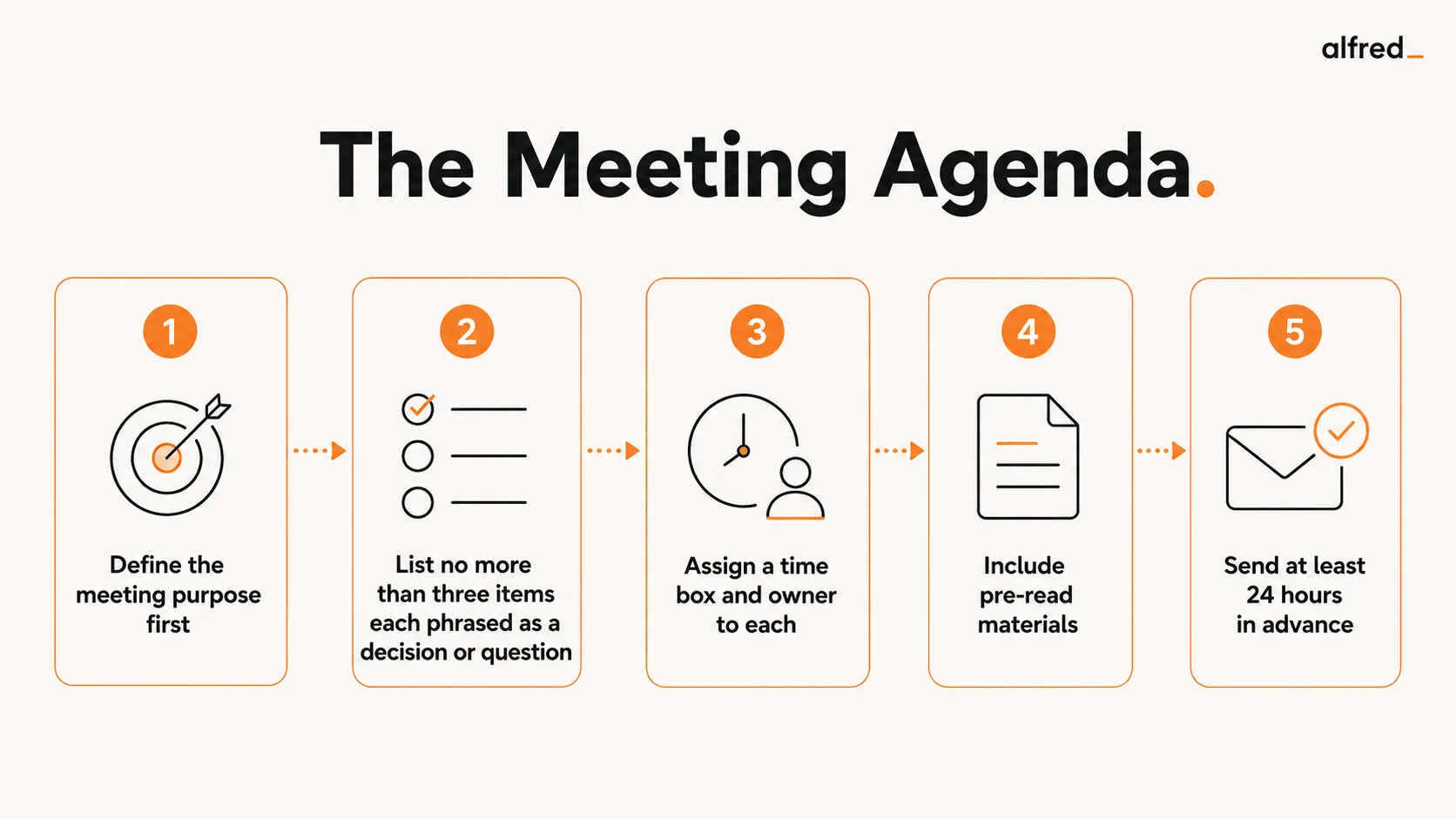
Step-by-Step: Write a Meeting Agenda That Drives Decisions
1. Define the Meeting Purpose First
Before writing a single agenda item, write one sentence that completes this prompt: “By the end of this meeting, we will have [decided / aligned on / resolved]…” This sentence is the agenda’s spine. Every item either serves this purpose or doesn’t belong on the agenda. If you can’t complete this sentence, the meeting may not be ready to schedule.
2. List No More Than 3 Items, Each Phrased as a Decision or Question
Three items is a forcing function. If you have seven agenda items, you have either scheduled a meeting that needs to be split into two, or you have an FYI session masquerading as a decision meeting. Every item should be phraseable as a question with an answer: “Should we expand into the EU market this quarter?” not “EU market expansion.” The question format forces you to clarify what you actually need from the room.
3. Assign a Time Box and Owner to Each Item
Each agenda item needs two things: a duration (15 minutes) and an owner (the person responsible for driving the discussion and bringing it to a conclusion). The time box prevents any single item from consuming the meeting. The owner prevents the facilitator from having to carry all the discussion weight. When people know they own 15 minutes, they prepare differently than when they’re just attending.
4. Include Pre-Read Materials for Anything Requiring Background
Applying Bezos’s written-first principle: if a decision requires context, data, or background knowledge, that material should be provided before the meeting, not presented at the start of the meeting. A data presentation at the beginning of a meeting converts the first 20 minutes from deciding to briefing. Briefings belong in documents, not meetings. Link or attach what people need to read; state explicitly which materials are required vs. optional.
5. Send at Least 24 Hours in Advance
This is Walsh’s preparation standard applied to meetings. Same-day agendas guarantee unprepared participants. Participants who haven’t read the pre-read and thought through the decisions arrive with raw reactions, not considered positions. The 24-hour minimum is not a courtesy. It’s a quality control mechanism. For monthly strategic meetings, one week minimum. For quarterly off-sites, two weeks minimum.
Agenda Templates
Weekly Tactical Agenda (Lightning Round First)
WEEKLY TACTICAL: [Team Name] [Date] | [Time] | [Location/Link] LIGHTNING ROUND (15 min) Each person: 2-3 top priorities this week (60 seconds each) -> Agenda items set from what surfaces below [ITEM 1 - SET AFTER LIGHTNING ROUND] Owner: [Name] | Time: [X] min Decision/Question: [Phrased as a specific question] [ITEM 2 - SET AFTER LIGHTNING ROUND] Owner: [Name] | Time: [X] min Decision/Question: [Phrased as a specific question] Wrap: Action items + owners (5 min) ### Decision Meeting Agenda DECISION MEETING: [Subject] [Date] | [Time] | [Location/Link] PURPOSE: By the end of this meeting, we will have decided [specific decision]. REQUIRED ATTENDEES: [Names and why each person is needed] PRE-READ (required, 10 min): -> [Link to document or attachment] -> [Second document if needed] AGENDA: 1. [Decision framed as question] | Owner: [Name] | 20 min 2. [Second decision if applicable] | Owner: [Name] | 15 min 3. Action items and owners | 5 min DECISION(S) TO BE MADE: [ ] [Specific choice 1] [ ] [Specific choice 2 if applicable] ### Monthly Strategic Agenda (With Pre-Read Requirement) MONTHLY STRATEGIC: [Team/Organization Name] [Date] | [Time] | [Location/Link] PURPOSE: Deep exploration of [topic]. By the end, we will have [decided / aligned on / identified next steps for] [specific outcome]. REQUIRED PRE-READ (complete before meeting): -> [Primary document: 6-page narrative or equivalent] [Link] -> [Supporting data set if needed] [Link] Estimated reading time: 20-30 minutes TOPIC: [1-2 topics maximum] [Topic 1] | [Name leading discussion] | 90 min - Framing question: [Specific question the discussion is meant to answer] - Options on the table: [What the group will be choosing between] Break | 15 min [Topic 2 if applicable] | [Name] | 60 min Synthesis + Next Steps | 15 min ## Agenda Anti-Patterns: Items That Don’t Work Most agenda failures fall into a small number of recurring patterns. Knowing them by name makes them easier to catch before the agenda goes out.
Topics Without Outcomes
“Q3 update,” “Hiring status,” “Product roadmap”: these are not agenda items, they’re subject headings. They tell people what will be talked about without telling them what the meeting is supposed to produce. Replace every topic noun with a question that has an answer.
Too Many Items for the Time Allotted
Eight agenda items in a 60-minute meeting means seven minutes per item. Real decisions cannot be made in seven minutes when they require context, options, and buy-in. Apply Drucker’s pruning test: “What would happen if this item were not on this agenda at all?” If the honest answer is “we’d handle it by email or another time,” remove it.
FYI Items That Don’t Require Attendance
Information that needs to be shared but does not require discussion or decision should be an email, not an agenda item. Every FYI item in a meeting is consuming the most expensive communication medium (synchronous time) to do something that asynchronous communication does better and cheaper.
No Pre-Read for Complex Decisions
Asking people to make complex decisions without providing the relevant information in advance forces all the thinking to happen in real time. This is the meeting equivalent of asking someone to write a memo while you watch. Per Grove’s negative leverage principle, this doesn’t just waste time. It produces worse decisions.
alfred_’s calendar integration can help you prepare meeting briefs and draft agendas from email threads and prior context, so the preparation step happens faster and the agenda arrives earlier.