
How-To Guide

How to Communicate Bad News Professionally

Bad news delayed is bad news compounded. Most professionals know this, and still delay. The way bad news is communicated often matters more than the bad news itself. Done poorly, it destroys trust. Done well, it can build it.

Feb 18, 20267 min read
Quick Answer

How do you communicate bad news professionally?

  • Communicate as fast as possible. Don't wait for perfect information or a complete solution. Bad news delayed is bad news compounded.
  • Choose the right medium: significant bad news deserves a live conversation (video or phone) before any written follow-up.
  • Lead with the news, not the context. The first sentence should contain the actual bad news.
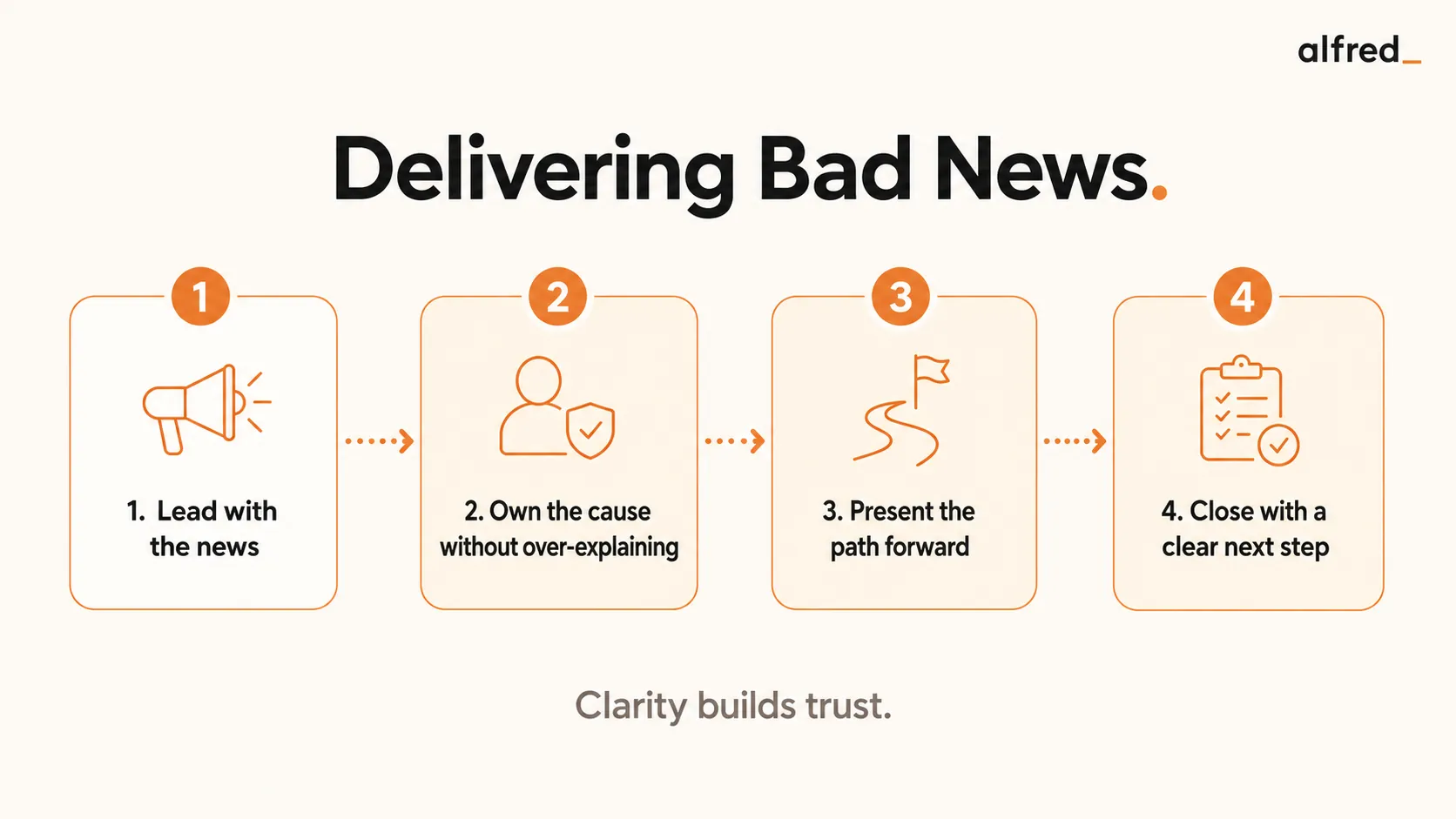
  • Apply the four-element structure: news first, impact acknowledgment, ownership, path forward with options.
  • Follow through on what you offered. The trust is rebuilt or destroyed in the aftermath, not the delivery.

Walsh's principle: communication quality should be highest when the situation is worst, not lowest.

Walsh's Communication Standard Under Pressure

Bill Walsh built a dynasty on the principle that standards of performance should be highest precisely when the situation is most difficult. In The Score Takes Care of Itself, he wrote: "Promote open and substantive communication especially under stress." This is not an aspiration. It was an operational requirement at the 49ers, applied to every form of organizational communication including the hardest kind.

Walsh held his staff to the principle that communication quality should be highest when the situation is worst, not lowest. Under pressure, most people communicate less, more vaguely, and with more hedging. Walsh identified this as a fundamental reversal of what the situation demands. Crisis requires clarity. The bigger the problem, the more precisely it needs to be communicated.

"Organize communication with logical, sequential building blocks — even under pressure, especially under pressure." — Bill Walsh, The Score Takes Care of Itself

Applied to bad news: the discomfort of delivering it does not change the structure it requires. The structure (what happened, what it means, who owns it, what happens next) is the same regardless of the severity of the news. The severity changes the emotional weight, not the communication architecture.

Why Bad News Gets Delayed (and Why That's Wrong)

The instinct to delay bad news comes from understandable places: fear of the recipient's reaction, the hope that the situation will improve before communication is necessary, the desire to have a solution before presenting a problem. These feel like responsible impulses. They are almost always counterproductive.

Every day of delay converts a manageable problem into a crisis. A missed deadline communicated 48 hours before the due date is a problem. A missed deadline communicated on the day it was due is a crisis. A missed deadline communicated after the due date has passed is a breach of trust. The news is the same; the delay changes its nature entirely.

The desire to have a solution before communicating a problem is the most common rationalization for delay. It sounds responsible. It's usually a mistake. The recipient may have resources, context, or alternatives you don't know about, but only if they know about the problem in time to use them. Waiting until you have a solution removes their ability to contribute to finding one.

The Speed Principle

The single most important rule of bad news communication: communicate as fast as possible. Not "when you have complete information." Not "when you have a solution." As fast as possible.

Jim Collins's Level 5 leadership model includes a behavior pattern that's directly applicable here. Level 5 leaders, Collins found, "look in the mirror" for blame and "out the window" for credit. They take personal ownership of failures rather than waiting for failure to become undeniable before acknowledging it. This is the ownership posture bad news requires: not waiting for the situation to force the communication, but communicating early and taking ownership proactively.

"Level 5 leaders look in the mirror to apportion responsibility, never blaming bad luck when things go wrong." — Jim Collins, Good to Great

Andy Grove's leverage principle applies to the timing question: high-leverage communication affects many people or affects someone for a long time. Bad news communicated promptly lets people adjust plans, reallocate resources, find alternatives, and make informed decisions. Bad news communicated late removes all of those options. The leverage is in the timing: early communication multiplies the number of possible responses; late communication forecloses most of them.

The Four Elements of Bad News Communication

Bad news communication has a specific structure that is the inverse of ordinary communication. Where a standard professional communication might build to a conclusion, bad news communication leads with it. Burying bad news in context doesn't soften it. It frustrates the recipient and suggests you're hiding something.

The Four-Element Structure

  • 1. Lead with the bad news. The first sentence should contain the actual news. Not "I wanted to give you an update on the project situation," but "We are going to miss the March 15 deadline by approximately two weeks." The recipient needs to know what happened before they can process anything else you say.
  • 2. Acknowledge the impact. Show that you understand what this means for the recipient specifically, not in general. "I know this affects your ability to present to the board on the 18th." This is not an apology. It's evidence that you've thought about the actual consequences from their perspective.
  • 3. Take ownership. Even when the cause was partially or primarily external, own the outcome. "I should have flagged the risk earlier when we saw the dependency issues in Week 3" is more trust-building than "the vendor delays caused this." The Level 5 posture: look in the mirror.
  • 4. Offer a path forward with options. The path forward converts the conversation from the past to the future. Ideally, offer two or three options rather than one. It gives the recipient agency in determining the next step, and it signals that you've done the work of thinking through multiple solutions.

Bezos's Clarity Test Applied to Bad News

Jeff Bezos's discipline around written communication provides a preparation discipline that is directly applicable to significant bad news: "When you force someone to write their thinking down, you force them to clarify it." For significant bad news, write it before you say it.

This doesn't mean send an email instead of having a conversation. It means write out the bad news communication (even if you plan to deliver it verbally) before you're in the room. The writing process forces you to be precise about four things: what exactly happened, what the impact is, what you're taking ownership of, and what you're proposing as the path forward. Attempting to deliver bad news verbally without this prior written clarity often produces rambling, hedging, and confusion.

"You can hide a lot of sloppy thinking behind bullet points." — Jeff Bezos. Applied to bad news: vague or hedged bad news communication hides the absence of clear thinking about what happened and who owns it.

The Bezos clarity test for bad news: "Is it clear exactly what happened? Is the impact precise and concrete? Is the ownership statement unambiguous? Is the path forward specific enough to act on?" If any element fails this test, the communication isn't ready to deliver.

68%

of employees maintain trust in leaders who communicate bad news promptly and transparently, vs. those who delay or minimize, reflecting the trust premium of direct communication

Source: Edelman Trust Barometer

Try alfred_

See what this looks like in practice

alfred_ applies these principles automatically — triaging your inbox, drafting replies, extracting tasks, and delivering a Daily Brief every morning. Theory becomes system. $24.99/month. 30-day free trial.

Try alfred_ free

Bad News Communication Templates

Missing a Deadline: Email to Client or Manager

Subject: [Project Name]: Deadline Update

[Name],

[Project/deliverable] will not be ready by [original date]. The current estimate is [new date], approximately [X] days later than planned.

I know this affects [specific impact on their timeline/plans]. I should have flagged the risk earlier when [specific early signal]. I didn't, and that's on me.

Here's where things stand and what I'm proposing:

Current status: [One sentence on what's done and what remains]

Options:
1. [Option A: most likely path forward with implications]
2. [Option B: if they need something earlier, what's possible]

I'd recommend Option [X] because [brief rationale]. Let me know which you'd prefer and I'll adjust accordingly.

I'll send you a status update by [specific date] regardless.

[Your name]

Project Failure or Scope Change: Email to Stakeholders

Subject: [Project Name]: Significant Change to Plan

[Name / Team],

I need to share a significant update on [project]: [clear statement of what failed or changed].

What this means: [Concrete impact (which objectives are affected, by how much, and for whom)]

What happened: [Brief, factual account of what caused this. No blame, no hedging, no minimizing]

What we own: [What the team could have done differently and is taking responsibility for]

Path forward:
Option 1: [Description with implications]
Option 2: [Description with implications]
We recommend Option [X] because [reason].

I'm scheduling a call [date/time] to discuss this directly. I'll send a more detailed briefing document before then.

[Your name]

Error That Affected a Client: Acknowledgment and Remediation

Subject: Error in [Deliverable/Communication]: Update and Next Steps

[Name],

I need to flag an error in [specific deliverable/communication from date].

What happened: [Specific description of the error, precise and factual]

Impact: [What it affected, whether anything downstream was affected]

We own this. [Brief statement of how this happened and what should have prevented it]

What we're doing:
1. [Immediate corrective action already taken]
2. [Next step with timeline]
3. [Process change to prevent recurrence]

I'll confirm completion of [step] by [date]. Please let me know if there are other implications I may have missed.

[Your name]

Personnel Decision Follow-Up (After the Live Conversation)

Subject: Following Up from Our Conversation Today

[Name],

I wanted to confirm in writing what we discussed this afternoon.

[Clear statement of the decision (role change, layoff, restructuring, etc.)]

The key dates and next steps:
- [Date]: [Specific action or transition]
- [Date]: [Second step]
- [Date]: [Final step]

[Relevant information about severance, transition support, references, etc. if applicable]

I'm available to talk further if you have questions. You can reach me at [contact].

[Your name]

Step-by-Step: Deliver Bad News Professionally

1

Communicate as Fast as Possible

Don't wait for perfect information. Don't wait for a complete solution. Don't wait for a better moment. The moment you know enough to know there is bad news, that's the moment to communicate it. You can communicate that you don't yet know the full picture; that's better than silence. "We have a problem and we're working on it" is a complete message. "Everything is fine" when it isn't is a trust-destroying message that becomes visible as a lie the moment the news surfaces.

2

Choose the Right Medium

Significant bad news, anything that affects someone's plans, finances, or professional situation significantly, should be delivered live: video or phone call, then followed up in writing to confirm what was discussed. Minor operational bad news in a strong relationship (missed minor deadline, small scope change) can go by email if the relationship is established enough to carry it. Personnel decisions always happen in person or on video, never by email alone. Bezos's principle: some situations need verbal communication to preserve the relationship. Bad news is frequently one of them.

3

Lead with the News, Apply the Four-Element Structure

The first sentence is the news. Not context, not framing, not "I wanted to reach out about something." Apply the four elements: news first, impact acknowledgment second, ownership third, path forward fourth. Don't speculate about causes if you're not certain: "we're still investigating what caused this" is more credible than a confident explanation that turns out to be wrong. Don't apologize for things you didn't cause. Be precise about the scope of your ownership.

4

Follow Through on the Path Forward

The communication is the beginning. The path forward you offered (the remediation, the alternative, the corrective action) needs to actually happen on the timeline you stated. Walsh's preparation principle: "The game is won or lost before it is played." In bad news communication, the trust is rebuilt or lost in the follow-through. Proactively check in with updates rather than waiting to be asked. The person you gave bad news to is watching whether your response matches your words.

Written vs. Verbal: How to Choose

The medium question is not a binary. It's a sequence question for significant news. The sequence is: live conversation first (video or phone), written confirmation second. The conversation allows the recipient to respond, ask questions, and be heard. The written follow-up creates the shared record of what was discussed and what was agreed.

For minor operational bad news in established relationships, email is appropriate as the primary medium. A missed minor deadline communicated the same day, in a relationship where you communicate regularly by email, doesn't need a phone call. The relationship carries the email.

For anything more significant, and when in doubt, default to live first. The cost of an unnecessary phone call is five minutes. The cost of delivering significant bad news by email when a conversation was needed is the relationship.

After the Bad News

Follow through on the path forward you offered. This is where trust is rebuilt or destroyed. Walsh's preparation standard: the standard of performance applies to the aftermath, not just the delivery. Every commitment you made in the bad news communication (update by [date], corrective action by [date], alternative delivered by [date]) needs to happen on that timeline.

Check in proactively after delivering bad news. Don't make the other person chase you for updates. The person you delivered bad news to is watching whether your response matches your words. Proactive follow-through signals that you take the problem as seriously as your communication suggested. Silence after the initial delivery signals that the communication was a performance rather than a commitment.

alfred_ can help you track follow-up commitments made in email threads, so a promise to update someone by a specific date surfaces in your Daily Brief rather than getting buried in your inbox.

Try alfred_

You Just Got Promoted

alfred_ is your AI executive assistant. It handles your email automatically: triaging your inbox, drafting replies you can send with one tap, and tracking follow-up commitments so nothing falls through. The hard conversations need you; the inbox management doesn't. $24.99/month. Works while you sleep.

Communicate with Confidence

Frequently Asked Questions

Should you deliver bad news by email or in person?

For significant bad news, anything that meaningfully affects someone's plans, finances, or professional situation, deliver it live (video or phone) first, then follow up in writing. For minor operational bad news in an established relationship, email is appropriate. The test: how significant is the impact on this specific person? The more significant, the more the medium needs to be live. Personnel decisions always happen in person, never by email alone.

How do you communicate bad news without losing credibility?

Communicate early, own it clearly, and follow through on your remediation. Collins's Level 5 posture, looking in the mirror for blame, is what preserves credibility under bad news. People lose credibility not because they had bad news, but because they delayed it, minimized it, blamed external causes, or failed to follow through on what they promised. The communication structure itself (lead with news, acknowledge impact, own it, offer path forward) is credibility-preserving when executed with Walsh's standard of clarity.

What if you don't have a solution yet?

Communicate the news anyway. 'We have a problem and we're actively working on the path forward. I'll have options for you by [specific date]' is a complete and credible message. What's not credible is withholding the news until you have a solution. By that point, the delay itself has become part of the problem. Bezos's clarity test doesn't require you to have all the answers; it requires you to be precise about what you know and what you don't.

How do you handle it when the recipient gets angry?

Let them. Don't defend, explain, or minimize in the immediate moment. 'I understand' and 'that's a fair reaction' are appropriate responses to anger. What's not appropriate is arguing with the reaction or escalating in kind. After the emotional moment has passed, return to the path forward, that's where you have the most constructive influence. Walsh's principle: self-control especially under pressure. Someone else's anger is pressure; your self-control in that moment is the communication.

Is it ever OK to delay bad news?

Almost never. The edge cases are narrow: when the news is incomplete and a short delay (hours, not days) will produce significantly more accurate information; when the recipient is in a crisis situation and cannot process additional information right now; when the news involves personnel matters that have a legally required process. Outside these narrow cases, delay compounds the problem. The rationalization 'I'm waiting until I have more information' is usually cover for 'I'm uncomfortable delivering this news', which is not a valid reason to delay.

How do you deliver bad news to a client?

Same four-element structure with additional emphasis on the path forward. Clients need to know what happens next, and they need options. Lead with the news, acknowledge the specific impact on their business or project, take ownership (without overly apologetic language that signals legal liability concern), and offer concrete next steps with timelines. For significant client bad news, always call first. Never let a client hear significant bad news for the first time from a written communication. They should have had the conversation first.