

Every yes is a no to something else, usually to the work that actually matters. Most people know this and still cannot say no, because in the moment a no feels like a relationship cost and a yes feels free. It is the reverse: the yes is the expensive one, paid later in nights and weekends and the important work that never got done. Saying no well is not about being difficult. It is a prioritization skill with a learnable structure. Here is the framework, plus templates for the five hardest no’s at work.
Collins: Good Is the Enemy of Great. The Framework for Saying No.
Jim Collins identified the root cause of most organizational mediocrity in Good to Great: “The reason most people never do great work is not laziness. It’s that their time is consumed by good work.” Good commitments are the most insidious because they’re genuinely worthwhile. They don’t feel like distractions. They feel like contributions. But every good commitment crowds out a great one.
“The presence of an ever-expanding to-do list without a robust stop-doing list is a lack of discipline.”, Jim Collins, Good to Great
Collins’s stop-doing list is the structural mechanism for making room for great work. The discipline isn’t doing more. It’s explicitly restricting what you work on. Every quarter, the most effective professionals ask: what do I do that I should stop doing? What am I doing that someone else could do as well? What am I doing that produces good results but crowds out great ones?
The stop-doing list reframes the act of saying no: it’s not a reactive response to requests, it’s a proactive discipline. When you’ve identified what you’re stopping, saying no to related requests becomes straightforward rather than agonizing. The no is already decided. The request just triggered the decision.
Drucker’s Contribution Test
Peter Drucker framed the fundamental question of effective work in The Effective Executive: “What can I contribute that will significantly affect the performance of the institution I serve?” This question is the filter every incoming request must pass.
If a request doesn’t help you make your specific contribution (the thing only you can do, the work that advances your core accountabilities) it fails the test. Not because the request is bad, but because it isn’t your request. Someone else needs to handle it, or it doesn’t get done.
“What would happen if this were not done at all?”, Peter Drucker’s pruning test, applied to every incoming request
Drucker’s pruning test is a useful complement to the contribution test. Before saying a complex no, ask: what would happen if this request were simply not fulfilled? If the honest answer is “not much,” the request is a candidate for a clean decline. If the answer is “something important breaks,” the question shifts to who else can do it, not whether you should.
Grove’s Leverage Test
Andy Grove’s concept of leverage in High Output Management applies directly to request evaluation. A high-leverage activity is one that affects many people or affects someone for a long time. The leverage test for incoming requests: “Is this a high-leverage activity that only I can do?”
If someone else can do it equally well, the right response isn’t simply declining. It’s redirecting. “I can’t take this on, but [Name] is better positioned for this and has relevant context” is more useful than a flat no. You’ve helped the requester find a real solution rather than just removed yourself from the equation.
If the activity has no leverage for you but might for someone more junior, it might be a development opportunity for them, not a task for you. Delegating with context is a more useful response than declining without alternatives.
The combination of Drucker’s contribution test and Grove’s leverage test gives you a two-question filter for any request: Does this help me make my contribution? And is this something only I can do? If the answer to both is no, the decision is clear. If the answer to one is yes, the decision is more nuanced, and the no may need to be a redirect or a negotiated partial yes rather than a clean decline.
The Anatomy of a Professional No
A professional no has four elements, in this order:
The Four-Element Structure
- 1. Acknowledgment: Recognize the legitimacy of the request. “This is a real priority and I understand why you’re asking.” This is not a preamble to soften the blow. It’s a genuine signal that you’ve understood what they need and why they need it.
- 2. Brief explanation: Optional but humanizing. A one-sentence description of your current focus or capacity constraint. “I’m at full capacity on the product launch through end of March.” You don’t owe a detailed justification, but a brief one prevents the no from feeling arbitrary.
- 3. The decline: Clear, not apologetic or hedging. “I won’t be able to take this on.” Not “I’m not sure I can” or “it might be difficult.” Hedging invites negotiation; clarity is kinder.
- 4. Alternative path: Where possible, redirect to someone who can help or suggest an alternative approach. This converts the no from a dead end into useful information. Not always possible, but when it is, it’s the difference between a closed door and a redirected path.
The critical discipline: don’t over-explain. Long explanations invite negotiation. Every additional sentence of justification creates an opening for “but what if we…” A clear, brief no is both more professional and more honest than a long, anxious one.
No Templates by Situation
Declining a Project or Work Request (At Capacity)
[Name], I appreciate you bringing this to me. This is clearly a real priority. I'm at full capacity through [end of month / Q2 / etc.] with [brief description of current focus]. Taking this on now would mean giving both this and my current commitments less than they need. I won't be able to take this on. [Name on your team / another colleague] may have the bandwidth and relevant background. Worth checking with them directly. [Your name] ### Declining a Meeting Invitation (Not the Right Person) [Name], Thanks for including me. I don't think I'm the right person for this one. [Brief reason: I'm not close enough to the decision / someone else owns this area / etc.] [Name] would be better positioned to contribute here and has the relevant context. If there's a specific question you need from me, happy to answer it in advance so [Name] can carry it into the room. [Your name] ### Declining Scope Addition Mid-Project [Name], I understand the appeal of adding [scope item] while we're already in this work. Adding this now would push [deliverable] past [deadline] and increase the risk to the core objectives we agreed on. I don't think that's the right trade. I'd recommend we scope this as a Phase 2 and address it after [delivery date]. I can put together a brief proposal for how that would work. [Your name] ### Declining a Favor Request from a Colleague [Name], I'd normally help with this, but I don't have the capacity right now to do it well. [Alternative if applicable: You might try X / here's a resource that covers this / someone else who knows this area]. Good luck with it. [Your name] ### Declining a Request from Your Manager (With Alternative) [Name], I want to make sure I handle this right. Taking this on now would mean deprioritizing [current project/deliverable]. Here's where I see the trade-off: [brief description of what gets delayed or reduced quality if you take the new request]. I can do either. I want to make sure we're making the same call. Which would you prefer I prioritize? [Your name] ## Walsh: Communication Under Pressure Bill Walsh’s Standard of Performance included “promote open and substantive communication especially under stress.” Saying no to a powerful person, a peer you want to please, or a request that feels urgent is a form of communication under pressure. Walsh’s principle applies directly: this is exactly when clear, honest communication matters most.
Walsh held his staff to a standard of directness. A mealy-mouthed “maybe later” response that never materializes is worse than a clear no. It creates false expectations, wastes the requester’s time, and damages trust more slowly but more permanently than an honest decline. The discomfort of saying no clearly is almost always less than the damage caused by a yes that doesn’t deliver.
“Self-control especially under pressure” was one of Walsh’s core organizational values. Saying no when you want to please someone is a form of professional self-control., The Score Takes Care of Itself
41%
of knowledge workers' time goes to discretionary tasks that offer little personal satisfaction and could be handled competently by someone else, the time that saying no protects for high-leverage work
Harvard Business Review: Make Time for the Work That MattersStep-by-Step: Say No Without Damaging the Relationship
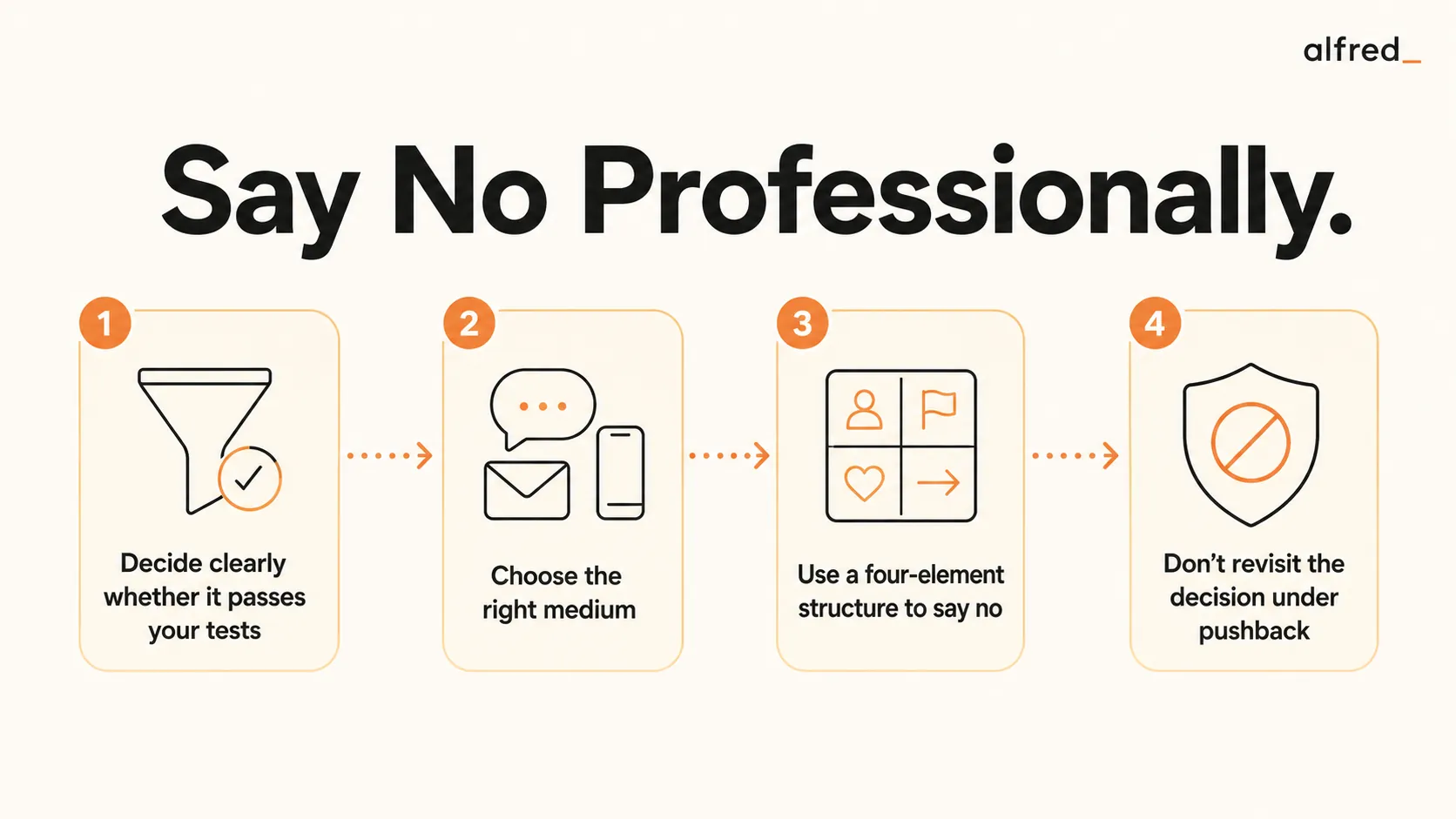
1. Decide Clearly: Does This Pass the Tests?
Apply Drucker’s contribution test: does this help you make your specific contribution? Apply Grove’s leverage test: is this high-leverage work only you can do? If both tests fail, the decision is clear. If one passes, consider whether a redirect or negotiated partial commitment is the right response rather than a flat decline. Don’t let the tests substitute for judgment. They’re filters, not answers.
2. Choose the Right Medium
Important relationships (managers, key clients, close colleagues) deserve a live conversation or call for a significant no, followed by a written confirmation. Low-stakes requests from people you don’t work with closely can be declined by email. The rule of thumb: the more the relationship matters, the more the no should be delivered in a medium where tone is visible and dialogue is possible.
3. Use the Four-Element Structure
Acknowledge the request and its legitimacy. Provide a brief (one sentence) explanation of your capacity or focus constraint. State the decline clearly, no hedging, no “I’m not sure if.” Offer an alternative path if one genuinely exists. Resist the urge to add more sentences. Each additional sentence extends the invitation to negotiate.
4. Don’t Revisit the Decision Under Pushback
A no that turns into a yes after persistent pushing trains people that persistence works. If your no was grounded in a real assessment of your capacity and priorities (Collins’s discipline, Drucker’s contribution test), the pushback doesn’t change the underlying reality. You can acknowledge the pushback empathetically without reversing the decision: “I understand this is important to you and I’m sorry I can’t help with it right now.” That’s different from “OK, I’ll figure it out.”
What Happens When You Can’t Say No to Your Boss
In most cases, you can almost always have the prioritization conversation instead of a direct no. The template: “I can do this. Here’s what I’d need to deprioritize. Which would you prefer?” This is Grove’s principle applied upward: give your manager the data to make a better decision. You’re not refusing. You’re surfacing a trade-off they may not have realized they were asking you to make.
Collins’s answer to “can you do both?” is almost always “which is more important?” Most managers, when given a clear articulation of the trade-off, will make a real prioritization decision rather than demand that both things happen at full quality.
The key is framing. “I can’t do this” invites a power struggle. “Here’s the trade-off. Which do you want me to prioritize?” invites a collaborative decision. The outcome may be the same, but one preserves the relationship and the other tests it.
The No That Preserves the Relationship
The fastest way to damage a professional relationship is not saying no. It’s saying a halfhearted yes that produces a poor outcome. When you say yes to something you can’t do well, you’re not doing the other person a favor. You’re giving them false confidence, consuming time and energy that might have gone to finding a real solution, and ultimately delivering something inadequate.
A clear, early no is a gift. It lets the other person find a real solution while there’s still time. It treats them as an adult who can handle honest information. It preserves your reputation as someone who delivers on their commitments rather than someone who says yes and underdelivers.
alfred_’s inbox management helps you stay on top of requests so no request slips into a silent yes-by-default. When your inbox is clear and prioritized, you see requests early enough to respond with intention rather than react under pressure.