

Why Responding Immediately Is Usually a Mistake
The most effective response to a difficult email is not the fastest one. This isn’t just intuitive wisdom. There’s a cognitive mechanism behind it that Cal Newport’s research on attention residue makes explicit.
An emotionally charged email doesn’t just communicate information. It triggers a state of mind. Reading it activates the same neural circuits that handle threat response. Newport’s research shows that switching your attention to a task (like composing an email reply) while in that state leaves cognitive residue that degrades both the speed and quality of your writing. The reply you write in the first five minutes after reading an aggressive email is almost certainly worse than the reply you’d write an hour later, after the emotional activation has cleared.
Bill Walsh articulated the same principle through the lens of professional standards in The Score Takes Care of Itself. Walsh’s Standard of Performance included explicit guidance on composure: “Show self-control, especially under pressure.” His observation was that performance under pressure, on the field and in communication, was a skill that could be built deliberately, not a fixed trait. Responding to a difficult email immediately is the equivalent of making a decision on the field in the first second of surprise. Walsh would say: wait. Process. Then act.
Peter Drucker offers a third frame. In The Effective Executive, he wrote that effective executives “do not start with their tasks. They start with their time.” Time is not just a resource for Drucker. It’s perspective. The same situation looks different with an hour’s distance than it does in the moment of receipt. Use the time before responding not as avoidance, but as a tool for better judgment.
The difference between a reactive response (written in the heat of the moment) and a deliberate response (written after the emotion has passed) is enormous, and rarely reversible. An email, once sent, cannot be unsent.
The Wait Rule
The wait rule is a simple heuristic for determining how long to wait before responding:
Wait Rule by Difficulty Level
- Mildly difficult email (mildly passive-aggressive, slightly demanding, moderately critical): wait at least 1 hour before responding. Draft a reply during your next email processing window.
- Genuinely upsetting email (angry, unfair, threatening, highly critical): wait until the next morning. Sleep clears the emotional activation more effectively than any amount of deliberate waiting within the same day.
- Email that could have legal or major professional consequences: wait and consult before responding. Some emails warrant a conversation with a manager, HR, or counsel before you put anything in writing.
The wait rule is not passive. You are not ignoring the email. You’re making a deliberate choice to respond when your cognitive state is better suited to producing the reply that serves you and the situation.
Understanding What the Sender Actually Wants
Most difficult emails contain two distinct things: a surface complaint and an underlying need. Responding only to the surface complaint (the literal words) misses what the sender actually wants, which produces a reply that solves nothing.
Understanding the underlying need changes the response entirely. Consider these examples:
Surface Complaint vs. Underlying Need
- “This is completely unacceptable.” Surface complaint: frustration with a specific outcome. Underlying need: to feel heard AND to receive a clear resolution path. A reply that only defends the outcome fails on the underlying need.
- “Why wasn’t I included in this decision?” Surface complaint: exclusion from a specific decision. Underlying need: acknowledgment of their perspective AND clearer communication going forward. A reply that only explains the decision omits the acknowledgment.
- “This isn’t what we agreed to.” Surface complaint: misaligned expectations. Underlying need: clarity on what was agreed AND a path to resolution. A reply that only defends your understanding without offering a path forward will escalate.
- “I need this by tomorrow.” Surface complaint: a demand. Underlying need: certainty that something important will be handled. A reply that addresses the feasibility of the demand without acknowledging the urgency misses the emotional register.
The exercise: before drafting your reply, write down in one sentence what the sender wants beneath the surface complaint. That sentence tells you what your reply needs to accomplish, regardless of whether the surface complaint is fair or accurate.
The Four Parts of a Difficult Email Response
Walsh’s communication framework from The Score Takes Care of Itself emphasized “open and substantive communication especially under stress” and organizing communication with “logical, sequential building blocks.” The four-part structure below operationalizes this for email:
The Four-Part Framework
- Acknowledge the frustration, without necessarily agreeing with the complaint. “I understand this has been frustrating” is different from “You’re right to be frustrated.” Both acknowledge; only one concedes.
- State your understanding of the situation briefly, not defensively. What happened, from your perspective, in two sentences. Not a paragraph of justification.
- Offer the path forward: specific, actionable, and forward-looking. Not “we’ll look into it” but “I’ll have a resolution for you by Thursday at 5 PM.”
- Invite dialogue if appropriate. “Happy to talk through this directly if that would help” closes the email without closing the door.
This structure accomplishes several things simultaneously. It shows you’ve heard the sender (acknowledgment). It establishes your understanding without being defensive (brief factual framing). It moves toward resolution rather than justification (path forward). And it preserves the relationship (invitation to dialogue).
Difficult Email Response Templates
Template 1: Responding to a Frustrated Client Complaint
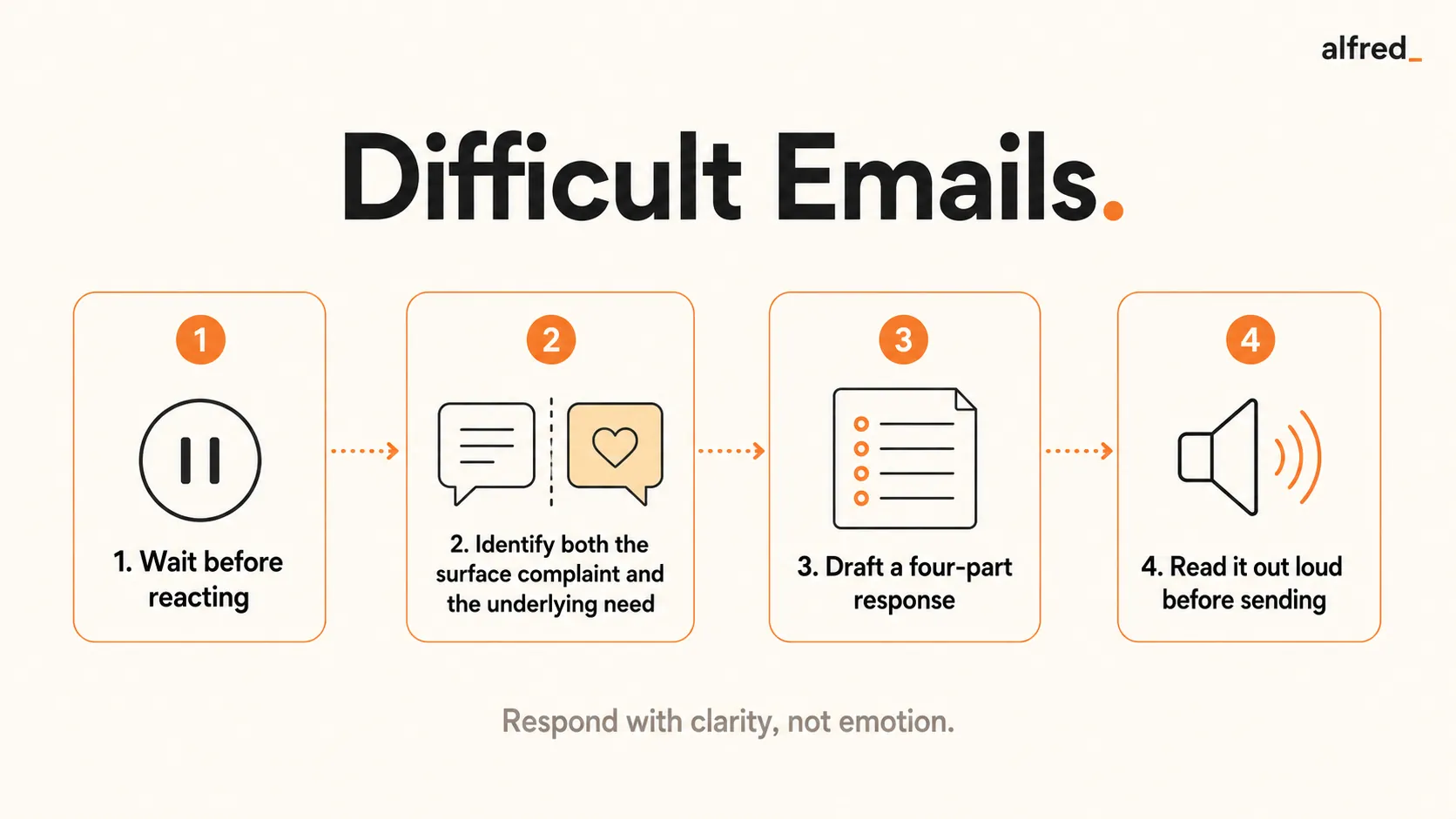
Subject: Re: [original subject] Hi [Name], I understand your frustration, and I want to address this directly. [Two sentences stating your understanding of what happened, factually, without defending or blaming.] Here's what I'm going to do: [specific action] by [specific date and time]. You'll hear from me directly when it's done. If you'd like to talk through this, I'm available [specific time options]. I want to make sure we're aligned. [Your name] ### Template 2: Responding to an Unfair Criticism from a Colleague Subject: Re: [original subject] Hi [Name], Thanks for raising this. I want to make sure I understand your concern correctly before I respond. My understanding of the situation is [brief factual summary, 2 sentences]. If I'm missing context, I'd genuinely like to know. [If applicable: I'd like to talk through this directly rather than continue over email. Do you have 15 minutes this week?] [Your name] ### Template 3: Responding to an Unreasonable Demand Subject: Re: [original subject] Hi [Name], I hear the urgency here and I want to be direct with you about what's possible. [What you can do, specifically, by when.] [What you can't do, briefly, without extensive justification.] I want to find a solution that works. Here's what I can offer: [specific alternative]. Let me know if that works or if we need to talk through other options. [Your name] ### Template 4: Responding When You Need to Say No Subject: Re: [original subject] Hi [Name], I appreciate you thinking of me for [request]. I'm not going to be able to [specific thing]. [Brief honest reason, one sentence]. [If possible: here's an alternative that might help / here's someone better positioned to assist.] I hope the [project/situation] goes well. [Your name] ## Step-by-Step: Respond to a Difficult Email Professionally 1 ### Don’t Respond Immediately. Apply the Wait Rule. Close the email. Set a reminder to respond in one hour (mildly difficult) or tomorrow morning (genuinely upsetting). This is not avoidance. It’s preparation. Your emotional state at the moment of receipt is the worst state for composing a reply that serves your interests and the relationship. The wait costs you nothing; a reactive reply can cost you everything.
2. Identify the Surface Complaint AND the Underlying Need
Before drafting, write down: (1) What is the sender literally saying? (2) What do they actually want? The gap between these two questions tells you what your reply needs to accomplish. A reply that addresses only the surface complaint without the underlying need will not resolve the situation. Write both down explicitly before you start typing.
3. Draft the Four-Part Response
Acknowledge the frustration. State your understanding of the situation (briefly, without defensiveness). Offer the path forward (specific and actionable). Invite dialogue (if appropriate). Check that each part is present. A reply that jumps to “here’s what I’m going to do” without acknowledgment misses the relational element. A reply that only acknowledges without offering a path forward leaves the situation unresolved.
4. Read Your Draft Out Loud Before Sending
Read the entire reply out loud. Tone that’s invisible in silent reading becomes obvious when spoken. Listen for: defensiveness (“I already told you…”), aggression (“To be clear…”), sarcasm (“As I mentioned previously…”), and excessive hedging (“I was just trying to…”). If any sentence makes you wince, rewrite it. Send only when you can read the entire email without pausing on anything.
What Not to Do
- Don’t CC their manager to make a point. This escalates the conflict, damages the professional relationship, and signals that you couldn’t resolve the issue directly. Use it only as a genuine last resort.
- Don’t use “per my previous email.” Everyone knows what it means, and everyone knows it’s passive-aggressive. If you need to reference a previous communication, quote it directly without the editorial.
- Don’t apologize for things you didn’t do wrong. Over-apologizing in difficult emails reads as admission of fault and can be used against you. Acknowledge the situation; don’t confess to it.
- Don’t write a three-paragraph defense of your actions. A long defensive reply signals that you feel guilty or cornered. Brief factual statements are more credible than lengthy justifications.
- Don’t forward the email to vent to a colleague. It will be screenshotted. It will be seen. It will make the situation worse. If you need to process the email emotionally, do it verbally with a trusted colleague, not in writing.
56%
of email recipients correctly read a message's tone (sarcasm, seriousness), yet senders expect to be understood 90% of the time. Most difficult emails are miscommunication, not malicious intent.
When Email Is the Wrong Medium
Some difficult conversations should not happen by email, not because email is weak, but because some situations need verbal communication to preserve the relationship while resolving the issue.
Pick up the phone or request a video call when:
- The disagreement is genuinely complex, with multiple interrelated issues that will take more than three email exchanges to resolve
- Tone matters more than content, when the relationship is strained and written words will be read through a lens of suspicion
- You need to understand the other person’s emotional state, not just their position
- The email thread is escalating, with each reply more charged than the last
Jeff Bezos understood this deeply. His insistence on written communication (the six-page memo, the narrative structure) was about ensuring clarity of thought before a meeting, not replacing human conversation. Bezos’s principle: written communication forces clarity. But clarity alone doesn’t defuse all conflicts. Some situations need the human channel of voice and real-time response.
When you shift from email to a call, say so in your reply: “I’d rather talk through this directly than continue over email. Can we find 20 minutes this week?” This signals maturity and a desire to resolve, not to escalate.