

The high-stakes meeting is usually decided before anyone speaks. The person who walks in knowing the room, the objective, the likely objections, and the one outcome that matters runs the conversation; everyone else reacts to it. Yet most people prepare by skimming the agenda in the elevator and hoping to think on their feet. Hoping is not a strategy when the meeting actually counts. Here is the preparation framework that turns an important meeting from something you survive into something you steer.
Walsh’s Preparation Philosophy: The Meeting Is Won Before It Starts
“I directed our focus less to the prize of victory than to the process of improving, obsessing about the quality of execution and the content of thinking. I knew if I did that, winning would take care of itself.” (Bill Walsh, The Score Takes Care of Itself)
Bill Walsh spent more time preparing for games than coaching them. His preparation was legendary in its specificity: scripting the first 25 offensive plays, rehearsing situational responses, anticipating defensive adjustments. The game was the performance; the preparation was the practice. And the practice was what he could control.
Applied to professional meetings: the outcome of the meeting is determined before the meeting starts. Preparation is the performance. A meeting participant who arrives having thought through the purpose, formed a position, read the materials, and anticipated the perspectives of others will outperform one who shows up to “see what comes up,” regardless of intelligence or domain expertise.
Walsh’s phrase, adapted: “The meeting is won before it starts.” Professionals who internalize this don’t ask themselves “what should I do in this meeting?” They ask “what do I need to do before this meeting to make it go well?” The answer to the first question depends on the answer to the second.
Grove’s Negative Leverage Warning
Andy Grove’s concept of negative leverage (actions that harm rather than help, and harm many people simultaneously) applies with particular force to meeting preparation.
Grove’s preparation test: “What would I do differently in this meeting if I’d spent 30 minutes preparing?” If the answer is “a lot,” you haven’t prepared. If the answer is “not much,” you’re ready.
Arriving unprepared to a meeting has negative leverage because the cost is not borne by the unprepared person alone. Every other attendee’s preparation is partially wasted. The meeting’s collective output is reduced. And the opportunity cost is real and permanent: whatever else eight prepared people could have been doing instead of managing an underprepared participant.
For a meeting with eight people: one unprepared attendee can degrade the output of eight hours of collective preparation. Grove’s math is unsparing. The most courteous thing you can do before an important meeting is prepare for it, not for your sake, but for everyone else’s.
Bezos’s Written-First Preparation
Jeff Bezos’s written communication philosophy at Amazon has a direct application to meeting preparation. For important meetings, particularly those involving complex decisions or significant stakes, the requirement to write forces clarity that verbal preparation does not.
“There is no way to write a six-page narratively structured memo and not have clear thinking.” (Jeff Bezos)
Applied to meeting preparation: write a one-page preparation document for any meeting where you need to present, decide, or persuade. The act of writing reveals the gaps: the places where your position isn’t actually formed, where you haven’t thought through the objections, where you’re unclear about what you need from the meeting.
When you’re the meeting organizer, Bezos’s principle goes further: for important meetings involving complex decisions, write and distribute a preparation memo 24+ hours in advance. This memo replaces the first 20 minutes of most meetings, specifically the deck presentation that everyone reads while pretending to listen. Attendees read the memo in the first 10 minutes of the meeting (in Bezos’s practice), then spend the remaining time in real discussion. The quality of that discussion is categorically higher when everyone has the same information and has had time to form views.
Lencioni: Know Your Meeting Type Before Preparing
Patrick Lencioni’s Death by Meeting identifies four meeting types, each requiring fundamentally different preparation:
Lencioni’s Four Meeting Types and Their Preparation Requirements
- Daily Check-In (5-10 min): No special preparation. Know your top 3 priorities for the day. Keep it administrative and brief.
- Weekly Tactical (45-90 min): Review your priorities and progress for the week before the lightning round. Know what’s on track, what’s at risk, and what cross-functional issues exist. Come with specific asks, not vague updates.
- Monthly Strategic (2-4 hours): Read any pre-distributed documents, form a clear position on the topic under discussion, and be prepared to engage in real conflict. Lencioni’s “mining for conflict” principle: strategic meetings require genuine debate, not polite consensus. Come with a view and be willing to defend it.
- Quarterly Off-Site (1-2 days): Comprehensive review of goals, team health, competitive position, and organizational issues. Preparation is substantial: review the prior quarter’s performance, the strategic plan, and any issues that have been deferred to this conversation.
The most common preparation failure Lencioni identifies: treating every meeting as the same type. Showing up to a monthly strategic meeting with the same surface-level preparation you’d bring to a weekly tactical is not insufficient preparation. It actively degrades the meeting by dragging strategic discussion toward the tactical level, or making the meeting useless because you have no real position to contribute.
The Preparation Checklist
For any important meeting (strategic, client, board, performance, or high-stakes decision), work through these six elements before arriving:
Six-Element Pre-Meeting Checklist
- 1. Purpose: What decision or output is this meeting producing? If you can’t name it, the meeting may not have a clear purpose, which is important to know before you walk in.
- 2. Position: What is your view on the key question? Have a position and don’t just show up to listen. Contribution requires a view. If you’re genuinely uncertain, that itself is a position: “I don’t have enough information to decide, and here’s what I need.”
- 3. Pre-read: Have you read and synthesized any materials sent in advance? Skimming doesn’t count. Read, form a view, note what surprises you or what you disagree with.
- 4. Questions: What 2-3 questions do you need answered to leave satisfied? Write them down. If you can’t name them, you’re not clear enough about your purpose in the meeting.
- 5. Constraints: What can you commit to in this meeting? What decisions require approval you don’t have? Know your authority before you’re asked to commit.
- 6. Objections: What pushback will you face on your position? How will you respond? Anticipating objections is not pessimism. It’s preparation that makes you more credible and more persuasive.
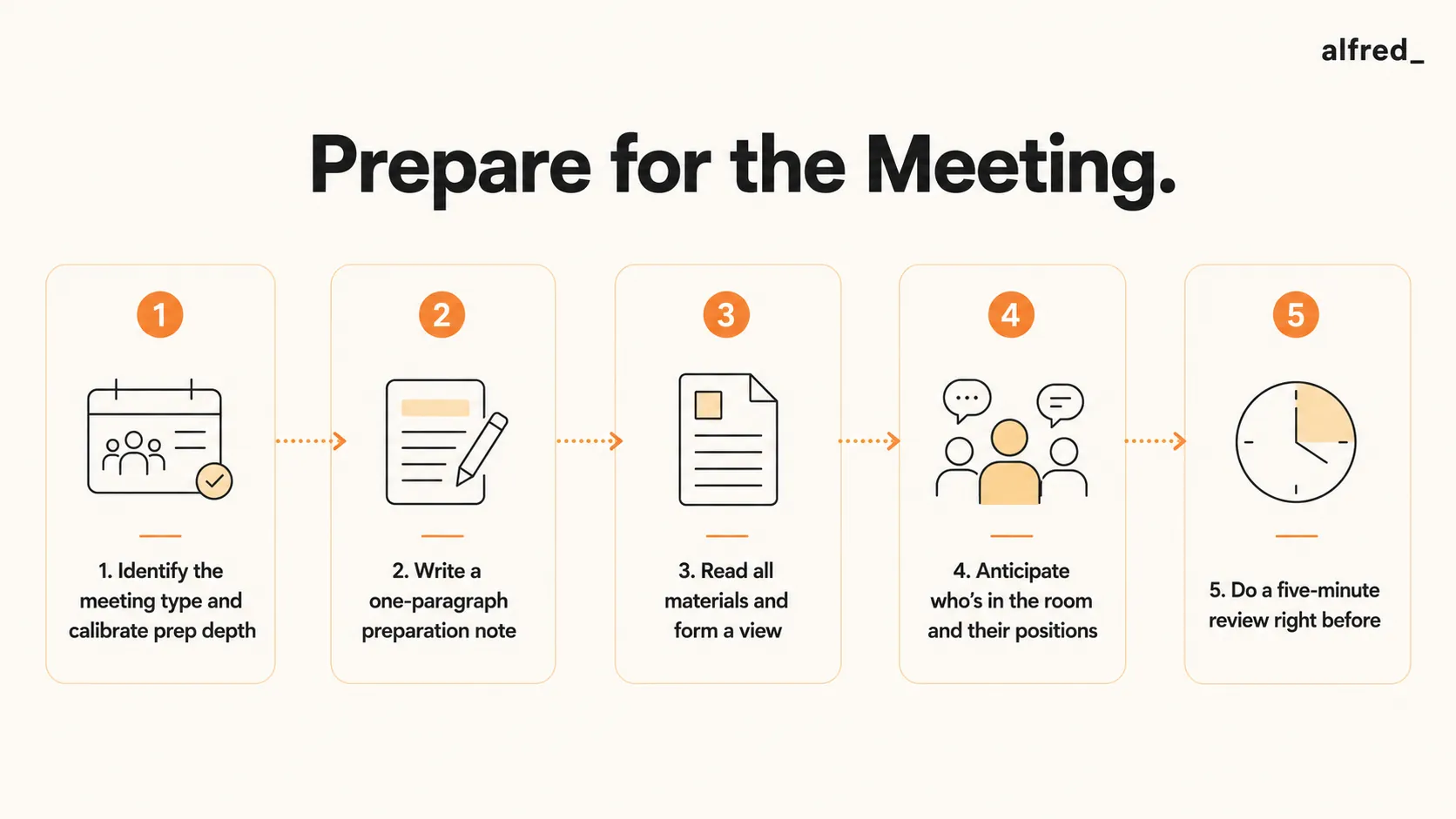
Step-by-Step: Prepare for an Important Meeting
1. Identify the Meeting Type and Calibrate Preparation Depth
Using Lencioni’s framework, determine what kind of meeting this is. A daily standup requires 60 seconds of preparation. A monthly strategic session requires 60 minutes. Calibrate accordingly. The mistake to avoid: applying the same preparation depth to every meeting (either always shallow or always exhaustive). The depth should match the type and stakes.
2. Write a One-Paragraph Preparation Note
Following Bezos’s written-first principle: write out the purpose, your position on the key question, and your 2-3 must-answer questions. This takes 5-10 minutes and is the most valuable preparation activity available. The act of writing reveals whether your thinking is actually clear. If you find yourself unable to write a coherent paragraph, you need more time with the materials, not just more time in the meeting.
3. Read All Pre-Distributed Materials and Form a View
Read every pre-distributed document. Don’t just absorb: take a position on the material as you read. Note what you agree with, what you disagree with, what surprises you. A meeting attendee who arrives having read the materials but formed no view is not meaningfully more prepared than one who didn’t read them. The value of reading is in the position it produces, not the reading itself.
4. Anticipate: Who’s in the Room and What Are Their Positions?
Think through the other attendees. What are their likely positions on the key questions? Where will there be agreement? Where will there be tension? Who are the decision-makers and what do they care most about? Anticipating the perspectives in the room transforms you from a reactive participant into a deliberate contributor. You can engage with positions before they’re made, rather than formulating your response in real time.
5. Do a 5-Minute Review Immediately Before the Meeting
In the 5 minutes before the meeting, reread your preparation note. Reactivate the context: who’s in the room, what’s the purpose, what’s your position, what questions do you need answered. Preparation done days ago and not reviewed just before the meeting is only partially available when you walk in. The 5-minute review closes the gap between preparation and performance. alfred_ can surface your relevant email context from the past 30 days in the minutes before any meeting, so your context is complete, not just current.
When You’re the One Running the Meeting
Meeting organizers have additional preparation responsibilities, and the quality of their preparation determines the ceiling of what the meeting can accomplish.
Organizer Preparation Requirements
- Define the expected output before writing the agenda: Grove’s requirement is to write the expected output (a decision, a list of action items, an alignment on direction) at the top of the agenda. Every agenda item should clearly connect to that output.
- Send the agenda at least 24 hours in advance: Attendees cannot prepare without it. A same-day agenda is functionally an agenda-free meeting.
- For complex decisions: write and send the memo 24+ hours ahead: Bezos’s approach. Attendees read the memo in the first 10 minutes of the meeting, then spend the remaining time in real discussion, not watching a deck presentation while formulating their first views.
- Have a clear first question ready: The meeting’s opening question determines the quality of the conversation that follows. A vague opening (“So, let’s discuss Q2”) produces a vague conversation. A specific one (“We need to decide whether to expand the marketing budget by $200K or reallocate it to the sales team: what’s everyone’s read?”) produces a focused one.
$1.4 trillion
the estimated annual cost of meetings in the United States. An unprepared participant who degrades a meeting imposes a real, measurable cost on everyone in the room.
How alfred_ Helps With Meeting Prep
For meetings with clients, stakeholders, or any relationship where email history is relevant context, alfred_ provides a significant preparation advantage: it can surface the relevant email threads from the past 30-60 days before an upcoming meeting.
Before an important client meeting, the question “what have we discussed in the past month that’s relevant to this conversation?” normally requires manual inbox searching, which is time-consuming and incomplete. alfred_’s monitoring of your email means the relevant threads are surfaced automatically, without the search. Your context is complete, not just current.
After the meeting, alfred_ drafts the follow-up email with the action items and decisions. The follow-up email, sent within 24 hours, is itself a preparation for the next meeting: it creates a written record that both parties can review and ensures that commitments made in the meeting become tracked action items rather than good intentions that fade by the following week.