

There is a gap between the feedback you think you give and the feedback your team actually receives, and it is wider than you would guess. Most managers rate themselves as generous with feedback; most employees say they get too little, too vague, too late to act on. The problem is not frequency. It is that most feedback is either a vague compliment that teaches nothing or a criticism delivered without the structure that turns it into change. Here are the frameworks that close that gap, from SBI to Grove’s maturity-based styles to Walsh’s model of feedback as teaching.
Walsh: Teaching Is the Primary Management Activity
“Great leaders are, above all, great teachers.”, Bill Walsh, The Score Takes Care of Itself
Bill Walsh built the San Francisco 49ers’ dynasty on a simple conviction: his primary job was teaching, not game-day decision-making. The game was the outcome; the teaching was the process. And the process was what he could control.
Applied to feedback: feedback is teaching. The question is not “did I say it?” but “did they learn it?” A manager who gives the same feedback three times without it landing hasn’t given feedback three times. They’ve given it once and failed to teach twice. The responsibility for the communication doesn’t transfer to the recipient just because words were said.
Walsh’s Standard of Performance is the context that makes feedback effective. When you’ve established explicit behavioral standards for every role (what excellence looks like, what’s non-negotiable, how work should be done), feedback is no longer a personal opinion. It’s a measurement against a shared standard. “Your communication with the client team isn’t meeting the standard we’ve established” lands differently than “I think you could communicate better with the client team.” The first is developmental. The second is subjective.
Grove’s TRM-Based Feedback Styles
Andy Grove’s Task-Relevant Maturity framework applies to how you deliver feedback, not just how you delegate work. The same feedback delivered in the wrong style for a person’s TRM level can fail, or actively backfire.
Feedback Style by TRM Level
- Low TRM: Directive and specific. “Here’s what happened: [specific behavior]. Here’s why it’s a problem: [specific impact]. Here’s what to do differently: [specific alternative].” People at low TRM need clear instruction, not open-ended coaching questions. They don’t yet have sufficient context to diagnose their own gaps reliably.
- Medium TRM: Coaching orientation. “What do you think happened in that situation?” before “Here’s my read.” People at medium TRM have enough context to analyze their own performance meaningfully, and being asked to do so develops their judgment. Provide your view after hearing theirs, not instead of it.
- High TRM: Outcome-focused and brief. “The deliverable landed well” or “it didn’t, and here’s the impact.” High-TRM people have the context to work backward from an outcome assessment to their own behavior analysis. Over-specifying the behavioral feedback feels condescending and damages trust.
“How often you monitor should not be based on what you believe your subordinate can do in general, but on his experience with a specific task and his prior performance with it.”, Andy Grove, High Output Management
The SBI Model: Structure That Makes Feedback Land
The most reliable structural framework for feedback delivery is Situation-Behavior-Impact (SBI), developed by the Center for Creative Leadership. It works because it separates observable fact from interpretation, which is the primary reason feedback fails to land: it sounds like a judgment rather than an observation.
The SBI Framework in Practice
- Situation: The specific context where the behavior occurred. “In Tuesday’s client call” or “During the team presentation last Thursday.” The situation anchors the feedback to a concrete event rather than a general pattern (even if it is a pattern, address one instance first).
- Behavior: The observable, specific action: what was actually visible or audible. “You didn’t have the Q3 numbers when the client asked for them” is behavioral. “You seemed unprepared” is an interpretation. The distinction matters: interpretations trigger defensiveness; behavioral descriptions invite problem-solving.
- Impact: The concrete effect of that behavior on the team, the client, the organization, or the work. “The client had to follow up separately, which added a day to the turnaround” is a specific impact. “It reflected poorly on us” is vague. Specific impacts communicate why the behavior matters, which is what makes the feedback worth changing for.
Worked example: instead of “You need to be better at managing client expectations,” use SBI: “In the call with Apex on Tuesday [Situation], when they asked about the integration timeline, you gave an estimate that was 3 weeks shorter than what engineering has scoped [Behavior]. They’re now planning around that date, and we’ll need to have a difficult conversation when we reset their expectations [Impact].”
Positive Feedback: Grove’s High-Leverage Tool
Most managers significantly underinvest in positive feedback. The implicit assumption is that people know when they’re doing well, so positive feedback is either redundant or soft. Grove’s leverage framework challenges this directly.
High leverage, Grove argues, is an action that affects many people or affects someone for a long period. Specific, timely positive feedback is one of the highest-leverage managerial acts available. A manager who catches someone doing something exceptional, names it specifically, and explains its impact can motivate that person for weeks. The investment is a two-minute conversation; the return is sustained high performance and deepened engagement.
“Let talented members of your organization know you believe in them. It’s more than a courtesy; it’s a management tool.”, Bill Walsh, The Score Takes Care of Itself
Walsh’s instruction to himself: “Let talented members of your organization know you believe in them.” This is not softness; it’s strategic. A team that knows their manager sees their good work performs differently than one that only hears about problems. And the SBI framework applies equally to positive feedback: “In the board presentation on Monday [Situation], you handled the unexpected question about margin compression by walking them through the unit economics from first principles [Behavior]. The CFO specifically commented to me afterward that you impressed him [Impact].”
The Timing Principle: 24-48 Hours
Feedback should be delivered as close to the behavior as possible, within 24-48 hours for most situations. The reasons are practical:
- Memory: Both you and the person have clearer recall of the specific event within 48 hours. Feedback delivered two weeks later is working from reconstructed memories that have already been filtered through subsequent events.
- Relevance: Feedback is most actionable when the behavior is fresh and can be applied to upcoming similar situations. Feedback on a presentation from three weeks ago can’t change that presentation.
- Defensiveness: Delayed feedback often arrives with accumulated emotional weight. The manager has been sitting on it, so it arrives with more intensity than the behavior warrants. Prompt feedback arrives at the right temperature.
For significant developmental feedback (the kind that requires a real conversation, not a quick comment), schedule a dedicated conversation rather than adding it to the end of another meeting. The structure signals importance. “I want to make time to talk about something specific. Can we find 20 minutes this week?” is different from “Oh, and one more thing before you go…” Both deliver feedback. Only one delivers it with the gravity that makes it stick.
Step-by-Step: Give Feedback That Drives Change
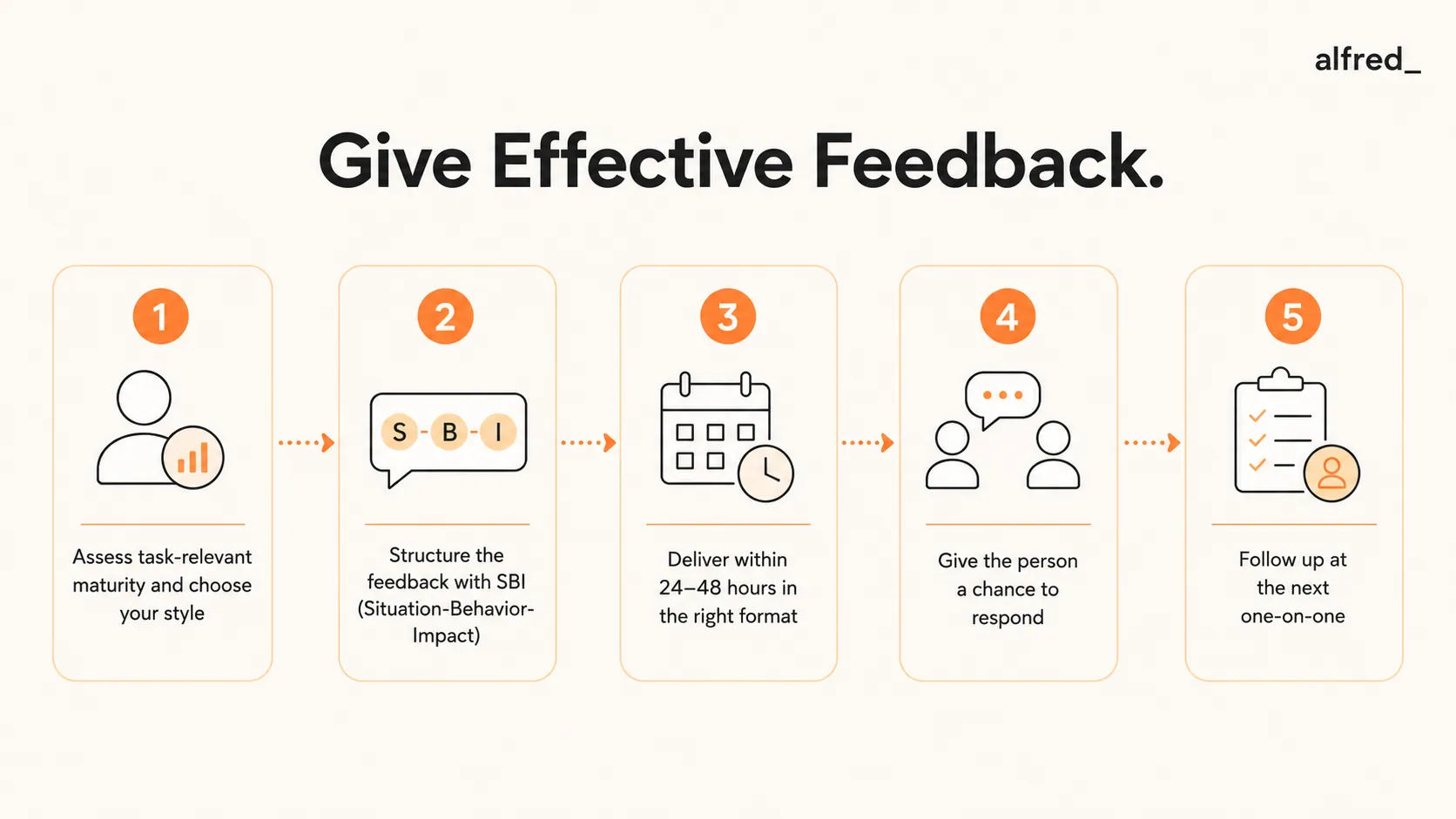
1. Assess TRM and Choose Your Style
Before delivering feedback, ask: what’s this person’s TRM for this type of situation? Low TRM means they need directive, specific feedback with explicit alternatives. Medium TRM means they benefit from being asked to analyze their own performance first. High TRM means outcome-focused feedback that trusts them to work backward to the behavior. Using the wrong style for the TRM level is the most common reason feedback fails to produce change.
2. Use SBI to Structure Your Feedback
Identify the specific Situation, the observable Behavior (not an interpretation), and the concrete Impact. Write it out before the conversation if the feedback is important. The act of writing SBI feedback forces you to be precise and reveals whether you’re describing observable behavior or making an interpretation. If you can’t identify the specific behavior, you’re not ready to deliver the feedback.
3. Deliver Within 24-48 Hours, With the Right Format for the Significance
For minor behavioral feedback: same day or the next morning. For significant developmental feedback: schedule a dedicated conversation within 48 hours. Don’t bury important feedback at the end of a rushed meeting. The format signals the significance. A dedicated 20-minute conversation communicates that this is real; a 2-minute add-on communicates that it might not be.
4. Give the Person a Chance to Respond
After delivering the feedback, invite a response: “What’s your read on this?” or “Is there context I’m missing?” Feedback is a conversation, not a verdict. The response often reveals context that changes the picture. The behavior you observed may have had a cause you didn’t know about. Or it confirms the behavior needs to change and gives you the person’s own commitment to doing so. Either outcome is more useful than a monologue.
5. Follow Up at the Next One-on-One to Close the Teaching Loop
At the next one-on-one, check whether the behavior has changed. This is Walsh’s teaching loop: feedback without follow-up is information delivered. Feedback with follow-up is development delivered. The follow-up also signals that the feedback was serious: that you noticed and that it mattered. Without it, feedback becomes just words, and people learn to discount the next round.
Common Feedback Failures
- Too vague: “Great job” or “needs improvement” are not actionable. The person can’t replicate the behavior they don’t understand, and can’t change the behavior they haven’t had specified.
- Too late: Feedback on behavior from three weeks ago is working from degraded memory and has lost immediate actionability. It also feels like the manager has been sitting on it, which adds emotional weight that distorts the conversation.
- Wrong setting: Significant developmental feedback given in public, or at the end of a rushed meeting, communicates that the manager didn’t care enough to give it proper context. The setting is part of the message.
- All negative, no positive: Demotivating and distorts reality. Teams that only hear about problems begin to believe they only produce problems. Grove’s leverage argument: positive feedback is high-leverage, not just nice.
- Verdict rather than conversation: Delivering feedback as a final judgment rather than an opening for dialogue closes down rather than opens up. The best feedback conversations end with the recipient having a clearer view of what to do differently and genuine buy-in on doing it.
3.6x
more likely to be motivated to do outstanding work when a manager gives daily rather than annual feedback, per Gallup's employee engagement research
Gallup: How Effective Feedback Fuels PerformanceFeedback vs. Coaching vs. Performance Management
These three practices are related but distinct. Conflating them is one of the most common feedback failures: treating a performance management situation as a feedback moment lets serious problems fester unaddressed.
- Feedback: Specific, behavioral, real-time or near-real-time. Addresses a specific behavior in a specific situation. Developmental in intent. Can be positive or constructive. Delivered by the manager in conversation or in writing.
- Coaching: Ongoing conversation about growth, patterns, potential, and development trajectory. Future-focused. Often happens in one-on-ones over multiple sessions. Explores the “why” behind patterns, not just the specific behavior.
- Performance management: Formal process when behavior doesn’t improve after repeated feedback and coaching. Documented, structured, with explicit expectations and consequences. Not punitive in intent, but clear about the stakes of continued non-improvement.
A manager who gives the same feedback three times without escalating to coaching has failed the employee. A manager who moves to formal performance management without having given clear feedback and coaching first has also failed them, and created legal and ethical exposure for the organization. The sequence matters: feedback first, coaching if feedback isn’t producing change, performance management if coaching isn’t either.