

Psychology

The Hot-Cold Empathy Gap:
Why Your Plans Don't Survive Monday Morning

The Sunday evening plan is made in a cold state: calm, rested, clear. Monday morning arrives in a hot state: behind on email before 9 AM, a crisis in the first hour, back-to-back meetings through noon. The cold-state plan collides with the hot-state reality and loses. This is not a discipline failure. It is a predictable cognitive error.

Feb 19, 20266 min read
Quick Answer

What is the hot-cold empathy gap?

  • The hot-cold empathy gap, documented by George Loewenstein, is the systematic inability to predict how visceral states (fatigue, urgency, frustration) will change behavior when planning from a calm (cold) state
  • Over-commitment, capacity misestimation, and priority drift are all professional manifestations. Commitments are made in calm cold states and violated in hot execution states.
  • Awareness of the gap reduces but does not eliminate it. The more reliable solution is structural: pre-commit cold-state decisions, use decision rules rather than in-the-moment judgment.
  • Adding 30–50% to cold-state estimates is a practical heuristic for closing the gap when making capacity commitments

Projection bias (Loewenstein, O'Donoghue and Rabin, 2003) extends this: people project current affective states into predictions about future preferences. People who are calm overestimate how calmly they will handle a frustrating situation.

The Research

George Loewenstein documented the hot-cold empathy gap across a series of studies. The core finding: people in a neutral, calm (cold) state are systematically unable to accurately predict how visceral states (hot) (hunger, physical pain, sexual arousal, intense emotion, fatigue, urgency) will change their preferences and behavior.
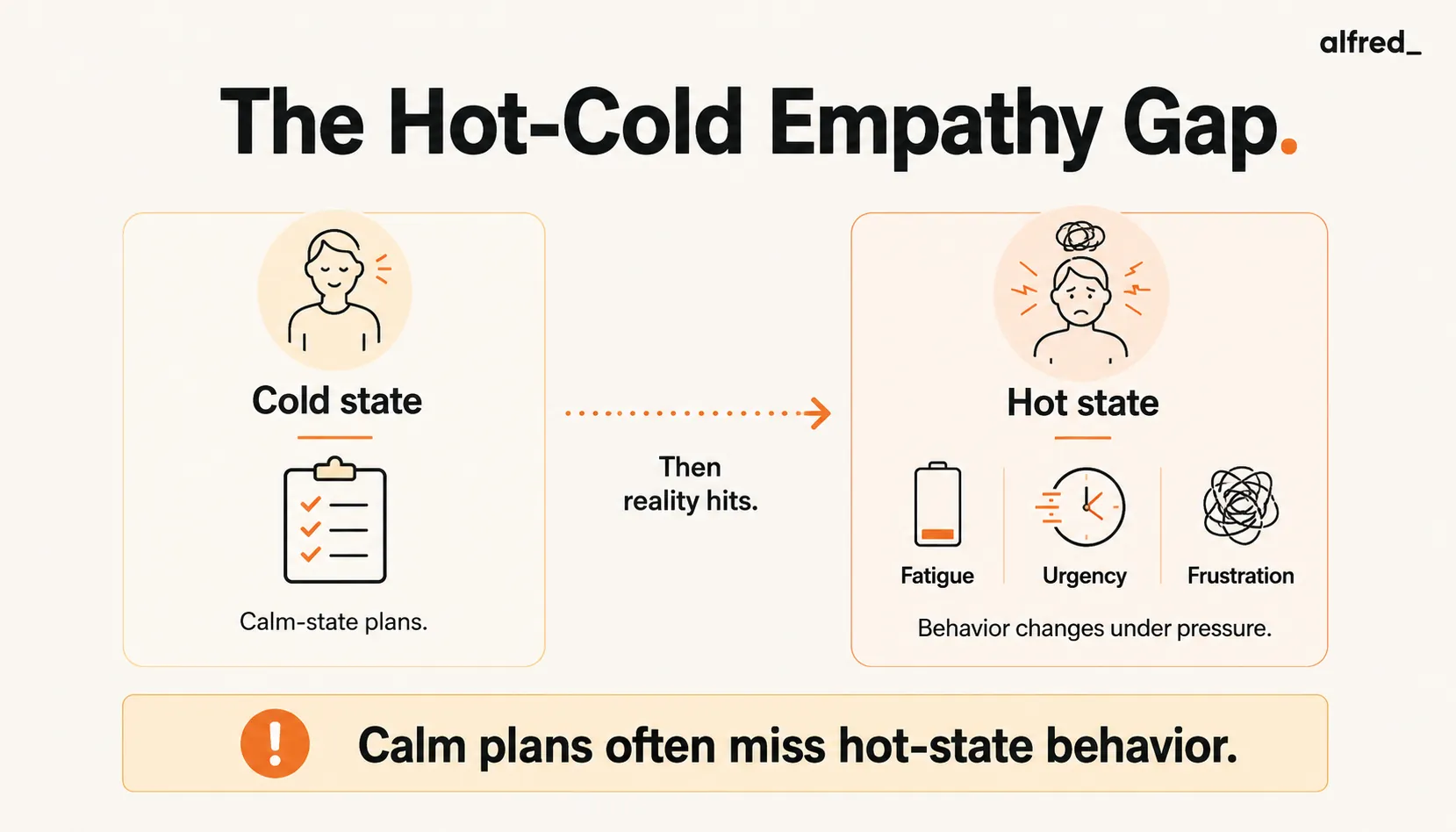
In a cold state, we intellectually know that hunger affects food choices, that urgency affects decision quality, that fatigue affects patience. But we systematically underestimate the magnitude of these effects when predicting our own future behavior. The prediction feels accurate because it is made with full awareness of the coming state, but awareness is not the same as visceral understanding.

Loewenstein and colleagues (2003) in the Quarterly Journal of Economics extended this to "projection bias": the tendency to project current affective states into predictions about future preferences. People who are cold overestimate how much they will want a warm coat in summer. People who are calm overestimate how calmly they will handle a frustrating meeting. The current state bleeds into prediction of the future state in a predictable direction.

Try alfred_

See what this looks like in practice

alfred_ applies these principles automatically — triaging your inbox, drafting replies, extracting tasks, and delivering a Daily Brief every morning. Theory becomes system. $24.99/month. 30-day free trial.

Try alfred_ free

Professional Manifestations

The hot-cold empathy gap produces several recognizable patterns in professional behavior:

  • Over-commitment. Commitments are made in calm, future-oriented cold states: a presentation accepted in a low-workload week, a deadline agreed to in a client call when no competing priorities are salient. The hot-state execution environment in which these commitments must be honored is systematically underestimated at the time of agreement.
  • Capacity misestimation. Asking a team member to estimate how long a task will take in a calm planning meeting produces estimates that don't account for the hot-state conditions under which the work will actually be done: interruptions, competing demands, the emotional load of other projects. This is not individual laziness or poor planning; it is the systematic effect of cold-state prediction of hot-state experience.
  • Priority drift. The priorities set in a Monday morning planning session (the important but not urgent work that a cold mind correctly identifies as highest value) are vulnerable to the urgency-hot-state that replaces that cold planning by Tuesday. The urgent displaces the important not because urgency is more valuable but because it is more viscerally compelling in the hot state.
  • Negotiation underperformance. Entering a negotiation in a hot state (anxious, fatigued, urgency-pressured) produces different decisions than the same negotiation conducted in a cold state. This is well-documented; what is less recognized is that the hot-state decisions will feel correct in the moment while diverging substantially from what cold-state reasoning would have produced.

Managing the Gap

Several strategies reduce the damage from hot-cold empathy gap failures:

  • Make cold-state decisions structurally durable. The cold-state plan is more reliable than hot-state improvisation. But its durability depends on it being structurally enforced rather than left as an intention that the hot state can override. Pre-committed calendar blocks, automated response protocols, and explicit decision rules ("I don't add new projects in the last month of a quarter, ever") are cold-state constraints that survive into hot states.
  • Plan for the hot state explicitly. When making commitments, deliberately imagine the hot-state conditions under which they will be executed: What else will be on my plate? What will the team's energy level be? What crises are likely? Adding 30–50% to cold-state estimates is a practical heuristic for closing the gap.
  • Recognize hot states before making decisions. A simple protocol: when fatigued, urgency-pressured, or emotionally activated, delay commitments when possible. "I'll confirm that tomorrow" is a useful sentence that creates space for cold-state review before a hot-state decision becomes binding.

Frequently Asked Questions

Is the hot-cold empathy gap the same as the planning fallacy?

They overlap but are distinct. The planning fallacy (Kahneman and Tversky) is specifically about underestimating task duration, attributing past overruns to exceptional circumstances rather than systematic optimism. The hot-cold empathy gap is broader: it is about any prediction of hot-state experience made in a cold state. The planning fallacy is one specific instance of this gap (the cold-state planner underestimates the hot-state execution environment), but the empathy gap also applies to over-commitment, negotiation decisions, capacity estimates, and any prediction about future affective states.

Can you compensate for the hot-cold gap by being more self-aware?

Partially. Research shows that awareness of the hot-cold gap reduces its magnitude but does not eliminate it. You can intellectually know that urgency will compress your judgment, but you cannot fully simulate the visceral experience of urgency from a cold state. That is definitionally what the gap is. The more reliable compensation is structural: pre-commit decisions in cold states, use rules rather than in-the-moment judgment for recurring decision types, and create review checkpoints (a trusted colleague, a structured process) that impose cold-state perspective on hot-state decision environments.

Does meditation or emotional regulation training close the gap?

The evidence suggests that practices that increase interoceptive awareness (awareness of internal states) and reduce reactivity to visceral cues can narrow the gap. This works not by enabling accurate cold-state prediction of hot-state experience, but by reducing the intensity of hot-state activation and increasing the ability to recognize when you are in a hot state before making decisions. This is a meaningful improvement, but it addresses the hot side of the equation rather than the cold side's predictive limitation. Both improvements together (reduced hot-state reactivity and better cold-state structural planning) produce more reliable follow-through than either alone.

Try alfred_

Preserve the cold-state plan through the hot-state day.

alfred_ maintains the cold-state priorities and commitments made during clear-headed planning, surfacing them through the hot-state urgency of the workday rather than letting operational demands erase what careful thinking established. $24.99/month. 30-day free trial.

Try alfred_ free