


The Original Finding
Baumeister, Bratslavsky, Muraven, and Tice published the ego depletion hypothesis in 1998 in the Journal of Personality and Social Psychology. The key study: participants who resisted eating tempting cookies (a self-control exercise) subsequently gave up more quickly on a difficult puzzle than participants who had not exerted self-control. The conclusion: self-control draws on a shared, depletable resource.
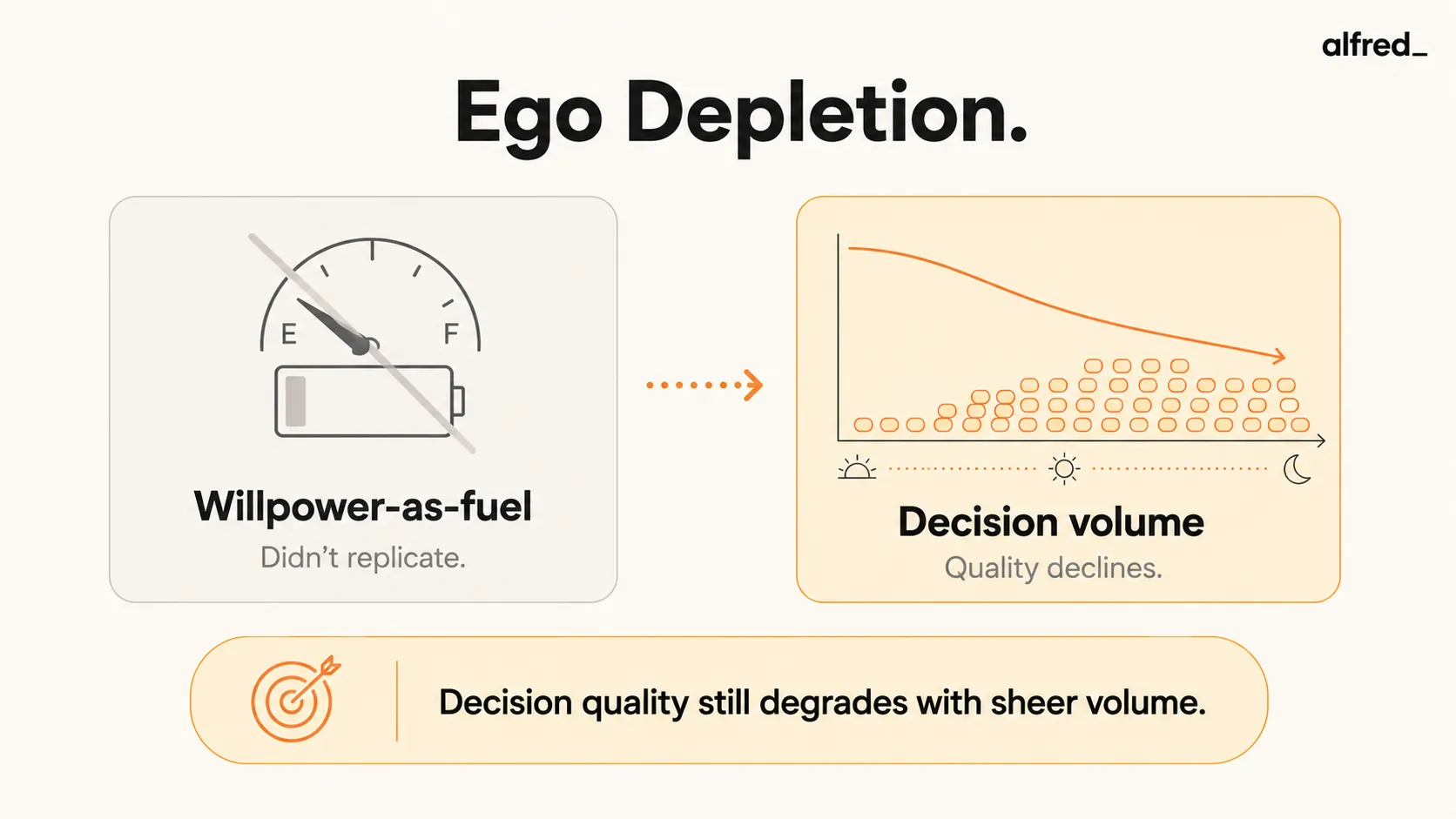
The glucose hypothesis followed: the resource was proposed to be blood glucose. Studies appeared to show that consuming sugary drinks restored depleted self-control. The framework was coherent, intuitive, and had immediate practical implications: schedule important decisions early, don’t make consequential choices when tired or hungry.
The concept spread rapidly. By the mid-2010s, ego depletion had over 2,000 citations. The “judge effect,” research appearing to show that Israeli judges granted fewer paroles as the day progressed, was cited as real-world evidence. Time magazine covered it. It appeared in management best-sellers.
The Replication Failures
The problems emerged systematically. In 2016, Hagger et al. coordinated a preregistered, multilab replication across 23 independent laboratories with N=2,141 participants. The result: effect size d=0.04, not statistically significant. This is approximately zero.
In 2019, Dang et al. conducted an independent replication across 36 laboratories with N=3,531 participants. Again: a near-zero effect. The glucose-depletion mechanism has been specifically tested and found lacking. Consuming sugar does not reliably restore self-control performance in controlled studies.
The Israeli judge effect was also subsequently challenged: the original analysis did not account for case ordering, break timing, and case complexity in ways that alternative explanations could explain the pattern. It is not reliable evidence for ego depletion.
What Does Survive
The replication failures do not mean that self-control is unlimited or that decision quality never degrades. Several related findings have better empirical support:
- Beliefs about willpower predict performance. Research from Carol Dweck’s lab shows that people who believe willpower is limited show performance decrements after demanding tasks. People who believe willpower is not a limited resource do not. If ego depletion is real, it may be real primarily as a self-fulfilling expectation, not a physiological constraint.
- Decision quality degrades with volume. Even without the strict depletion mechanism, making many consecutive decisions of any kind appears to degrade the quality of subsequent decisions through accumulating task-switching costs, cognitive fatigue, and motivational drift. The “schedule important decisions early” recommendation survives, just with a different mechanism.
- Emotional labor depletes differently than cognitive effort. Regulating emotional expression is distinctly tiring and does appear to impair subsequent performance in related domains. This is more specific than the global depletion claim, but it supports protecting high-stakes interactions from following emotionally demanding ones.
The Practical Conclusion
The mechanism is wrong; the recommendations are largely still worth following. Protecting the beginning of the day for the highest-stakes cognitive work, reducing the number of low-stakes decisions that occupy attention, and not scheduling critical conversations immediately after emotionally demanding ones: all of these are supported by evidence independent of the glucose-depletion story.
The more important correction is about mindset: if you believe willpower is a finite fuel, you will act as though it is, and your behavior will reflect that belief. The research on growth mindset applied to self-regulation suggests that treating willpower as a trainable capacity, rather than a depletable resource, produces better outcomes in the long run.