


Quick Definition
Habit Loop the three-component cycle that drives habitual behavior: an environmental cue triggers a routine, which produces a reward, training the brain to repeat the sequence. Framework popularized by Charles Duhigg in The Power of Habit (2012), grounded in Ann Graybiel's MIT neuroscience research on the basal ganglia. Research by Wood, Quinn and Kashy (2002) found that 40 to 45 percent of daily behavior is habitual rather than deliberate.
The Neuroscience: Basal Ganglia and Chunking
Ann Graybiel and colleagues at MIT documented the neural basis of habit formation through research beginning in the early 1990s. A key paper series used recordings in rats running T-maze tasks to show how neural activity in the striatum changes as a behavior becomes habitual.
Early in training, neural activity was distributed throughout the maze run and involved significant prefrontal cortex involvement. The rat was actively learning. As the behavior became habitual, a distinctive pattern emerged in the basal ganglia: activity increased at the beginning of the behavioral sequence (the cue) and at the end (the reward delivery), with reduced activity in between. The behavior had been “chunked” into a single automated unit stored in the striatum, running with minimal conscious supervision.
40–45% of daily behavior
Research by Wood, Quinn & Kashy (2002) in JPSP found that approximately 40-45% of participants' daily behaviors were habits (performed in the same location in response to the same contextual cues) rather than deliberate decisions.
Wood, W., Quinn, J.M. & Kashy, D.A. (2002). Journal of Personality and Social Psychology, 83(6), 1281–1297.Graybiel reviewed this research in “Habits, rituals, and the evaluative brain” (Annual Review of Neuroscience, 2008, 31, 359–387). The central finding is that habit formation involves a shift in neural control from prefrontal to striatal systems: from deliberate, effortful processing to automated, context-triggered responses. This shift conserves cognitive resources (prefrontal activity is metabolically expensive) but makes the behavior resistant to conscious interruption.
The Habit Loop: Cue, Routine, Reward
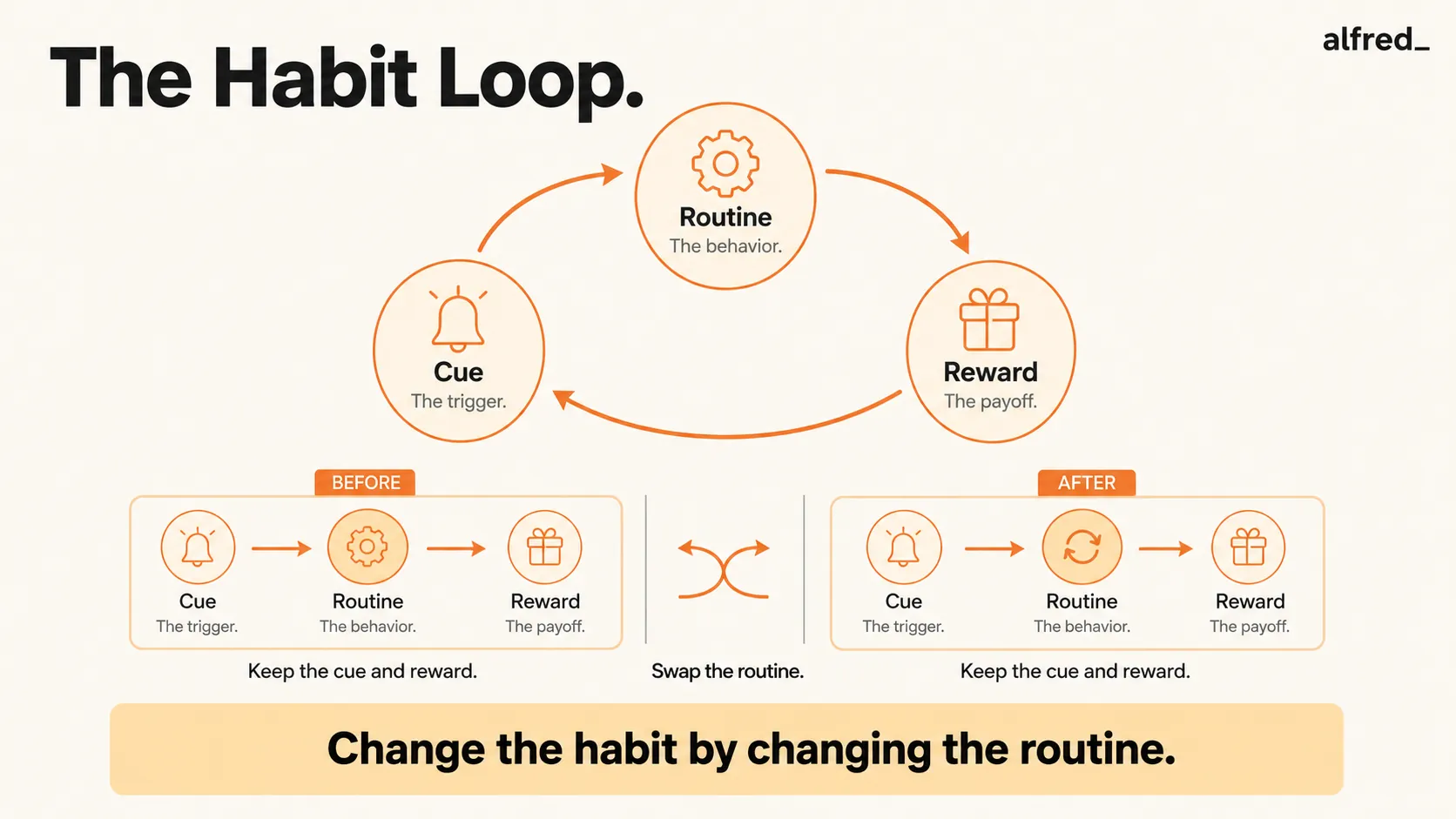
Charles Duhigg translated the neuroscience into a practical framework in The Power of Habit (Random House, 2012). The three-component model describes how habitual behaviors form and are maintained:
- Cue. An environmental trigger that initiates the habitual routine. Cues can be times of day, locations, other people, preceding actions, or emotional states. The critical feature is consistency: the same cue reliably precedes the same routine across many repetitions.
- Routine. The behavior itself, the habitual action triggered by the cue. This can be physical, cognitive, or emotional. The routine runs automatically when the cue is present, with minimal deliberate initiation.
- Reward. The outcome that the brain associates with completing the routine. Rewards train the habit loop by activating dopaminergic circuits that encode “this sequence is worth repeating.” Rewards can be physical, emotional, or social, and they do not need to be large or deliberate to shape the habit.
Duhigg added a fourth element implicit in the research: the craving that anticipates the reward. As the habit solidifies, the cue begins to trigger a craving for the reward before the routine is executed. This craving is the motivational engine of the habit, the mechanism that makes habits feel compulsive and makes them difficult to change even when the person consciously intends to.
Building and Changing Habits
- Designing cues. Effective habit building starts with identifying or creating a reliable cue. Implementation intentions (“when I arrive at my desk, I will open my priority list before email”) exploit the cue-routine structure by specifying both the trigger and the behavior. The specificity of the cue matters: “after lunch” is weaker than “when I sit down at my desk after returning from lunch.”
- The golden rule of habit change. Duhigg’s synthesis of the change research produced what he calls the golden rule: to change a habit, keep the cue and the reward but change the routine. The craving associated with the cue cannot be easily suppressed, but it can be redirected toward a different routine that delivers a similar reward. This is more effective than attempting to eliminate the cue or stop the craving.
- Context and habit performance. Because habits are cued by context, changing context disrupts habitual routines, sometimes helpfully and sometimes not. Research by Wood and colleagues showed that people who moved to a new location significantly changed their habitual behaviors, even habits they had maintained for years, because the contextual cues that triggered them were no longer present. This explains why vacations and relocations can be powerful windows for habit change.