

Everyone credits Google for OKRs, which is a little like crediting the band that covered the song. The framework is seventy years old, and the parts most companies get wrong are precisely the parts that were figured out first and quietly dropped along the way. The lineage runs from a 1954 management book, through the company that built the microprocessor, to a venture capitalist’s slide deck that reached a forty-person startup. Each step sharpened the idea and added a new way to break it. Here is where OKRs actually came from, and why knowing the history is the fastest way to stop misusing them.
Drucker: Management by Objectives (1954)
Peter Drucker introduced Management by Objectives in The Practice of Management (1954). The historical context matters: MBO was a deliberate alternative to the prevailing management model of the time, which was Taylorist command-and-control. Workers were told what to do and measured on compliance with instructions.
Drucker’s argument was humanistic as much as operational: people perform better when they understand the organizational goal they are contributing to and have genuine input into how they will contribute to it. MBO asked managers and their reports to jointly define objectives and then allowed workers to direct their own effort toward those objectives. The manager’s job shifted from directing tasks to defining goals and removing obstacles.
Drucker was also explicit about what MBO was not: it was not a performance evaluation system, and objectives should not be tied to compensation. When they were, he predicted (correctly) that the framework would be gamed and would produce the opposite of its intended effect.
Grove: The Intel Reformulation (1970s)
Andy Grove joined Intel as one of its founding employees and eventually became CEO. He was deeply influenced by Drucker but found MBO as typically practiced too vague: objectives without measurable outcomes were aspirations, not commitments.
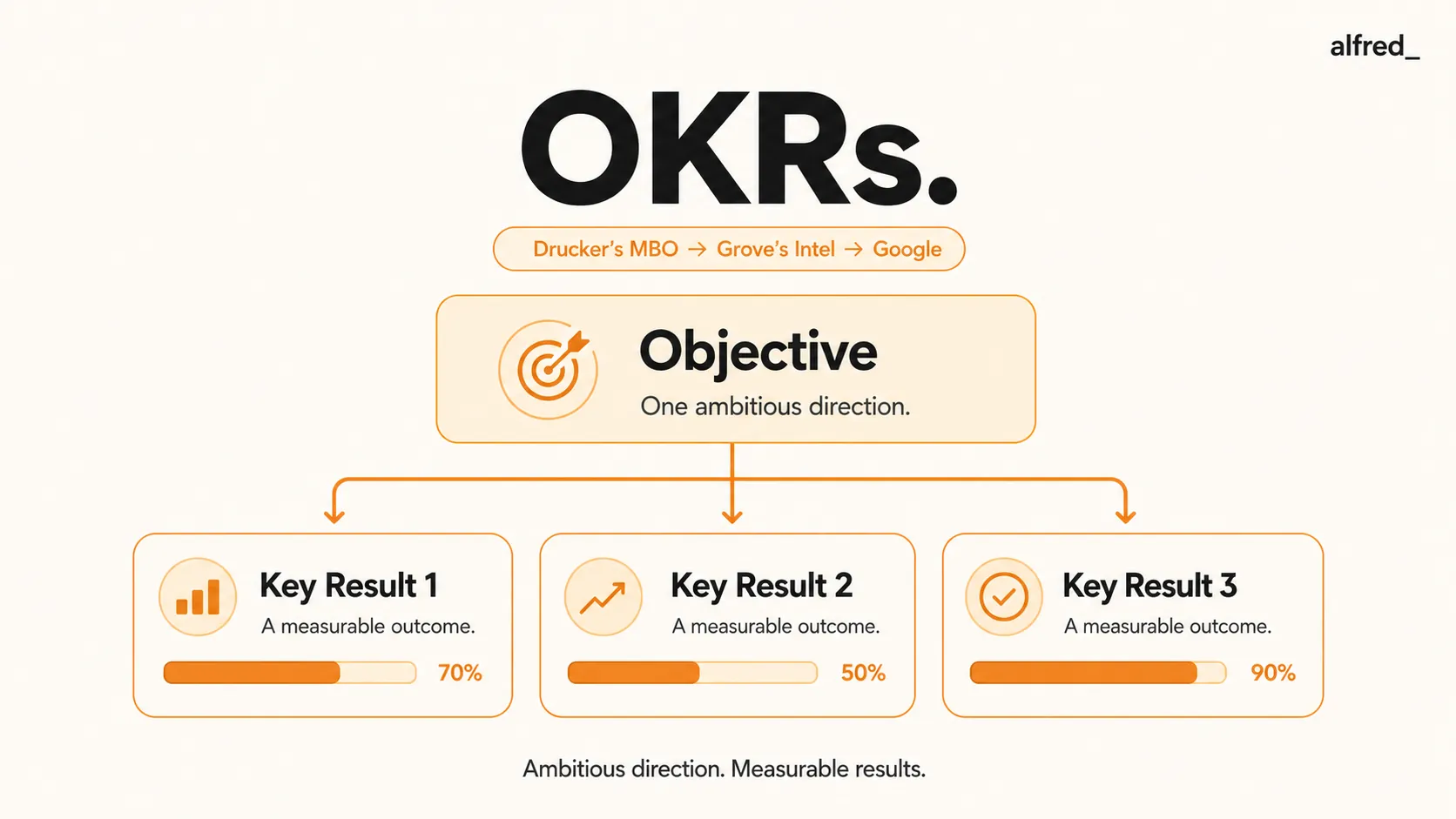
Grove’s innovation was the addition of Key Results: the quantifiable, time-bound evidence that an objective had been achieved. An Objective answers “what do we want to accomplish?” Key Results answer “how will we know we accomplished it?” Specifically, with numbers that cannot be argued with.
Grove described Intel’s version of OKRs in High Output Management (1983). He also established two operating principles that are regularly abandoned by organizations that adopt the framework:
- OKRs should not be connected to compensation. Grove agreed with Drucker that tying objectives to pay transforms them from a coordination tool into a negotiation tool: people set objectives they know they can achieve rather than ones they are genuinely trying to reach.
- Scoring below 100% is not failure. If every OKR is fully achieved every cycle, the objectives were not ambitious enough. Grove expected roughly 70% achievement as a sign of appropriately aspirational goal-setting.
Doerr: Google (1999)
John Doerr was a venture capitalist at Kleiner Perkins who had worked at Intel under Grove. In 1999, he presented OKRs to Larry Page and Sergey Brin’s nascent Google in a deck that has since become legendary in the management consulting world.
Google adopted OKRs at roughly 40 employees and has used them since. The framework spread from Google outward to the tech industry and then to the broader professional world, aided by Doerr’s 2018 book Measure What Matters. Most organizations that now use OKRs learned about them from Google’s example rather than from Drucker or Grove.
This matters because Google’s public OKR culture omits some of the original constraints, particularly Drucker’s and Grove’s warnings about compensation linkage and the expectation of partial achievement. Organizations that adopt OKRs via the Google lineage without understanding the original intellectual context tend to reproduce the failure modes both Drucker and Grove explicitly anticipated.
The Evidence on Whether It Works
The most rigorous evidence comes from research on MBO, the parent framework, rather than OKRs specifically.
56% vs 6%
average productivity gain from MBO adoption when CEO was highly committed vs low commitment, from a 1991 meta-analysis of 70 studies
Rodgers & Hunter (1991), Journal of Applied PsychologyThe Rodgers and Hunter meta-analysis (1991) is the most-cited evidence on MBO effectiveness. It examined 70 studies of MBO adoptions across public- and private-sector organizations. The finding: CEO commitment to the framework was the single strongest predictor of results, more than the quality of objective-setting or the structure of the process. Organizations where the CEO was visibly committed to the framework showed an average 56% productivity gain. Organizations where commitment was low showed a 6% gain.
The practical implication is stark: OKRs are not a self-executing system. Their effect size depends almost entirely on whether leadership treats them as a real coordination mechanism or as a compliance requirement. The same framework produces 9x different results based on organizational commitment.
Common Failure Modes
Both MBO and OKRs consistently fail in the same ways, each of which Drucker or Grove predicted:
- Tied to compensation. When OKR achievement determines bonuses, objectives become conservative. People set goals they know they will achieve. The aspirational function of the framework disappears.
- Too many objectives. Grove was clear: one to three objectives per cycle, each with two to five key results. More than this diffuses attention and produces the appearance of alignment without the reality.
- Purely top-down. Drucker’s original insight was that worker participation in defining objectives produces both better objectives (people closest to the work know what is achievable and important) and higher motivation. OKRs that are simply cascaded downward without genuine input from the people executing them lose the motivational mechanism.
- Disconnected from daily work. OKRs that are set quarterly and reviewed quarterly with no connection to weekly priorities become an annual bureaucratic exercise. The Rodgers and Hunter finding implies active, ongoing CEO engagement, not a quarterly check-in.
Where OKRs Quietly Die: The Daily Gap
Of all the failure modes above, the last one is the quiet killer. An OKR is, by definition, important and rarely urgent. That is exactly the kind of work that loses every single day to the inbox, the meeting that materialized, the request that felt like it could not wait. The quarter ends, the key results are at 30 percent, and nobody can point to the day they decided to neglect them. They were simply out-shouted, every morning, by work that was louder but mattered less.
This is the gap alfred_ is built to close. By triaging the reactive tier, handling routine email, and surfacing only what genuinely needs you, it keeps the urgent-but-trivial from consuming the hours your key results actually depend on. The framework gives you the objective; protecting the important-not-urgent time to pursue it is the part that breaks, and the part alfred_ takes off your plate. An OKR you never get to is just a forecast you watched come up short.