

Hindsight Bias:
Why Everything Seems Obvious After the Fact
After a project fails, the warning signs seem obvious. After a competitor launches a category-defining product, the market need seems like it was always visible. These retrospective certainties are not wisdom. They are a systematic memory distortion that corrupts every post-mortem, performance evaluation, and historical account of decision-making.
What is hindsight bias?
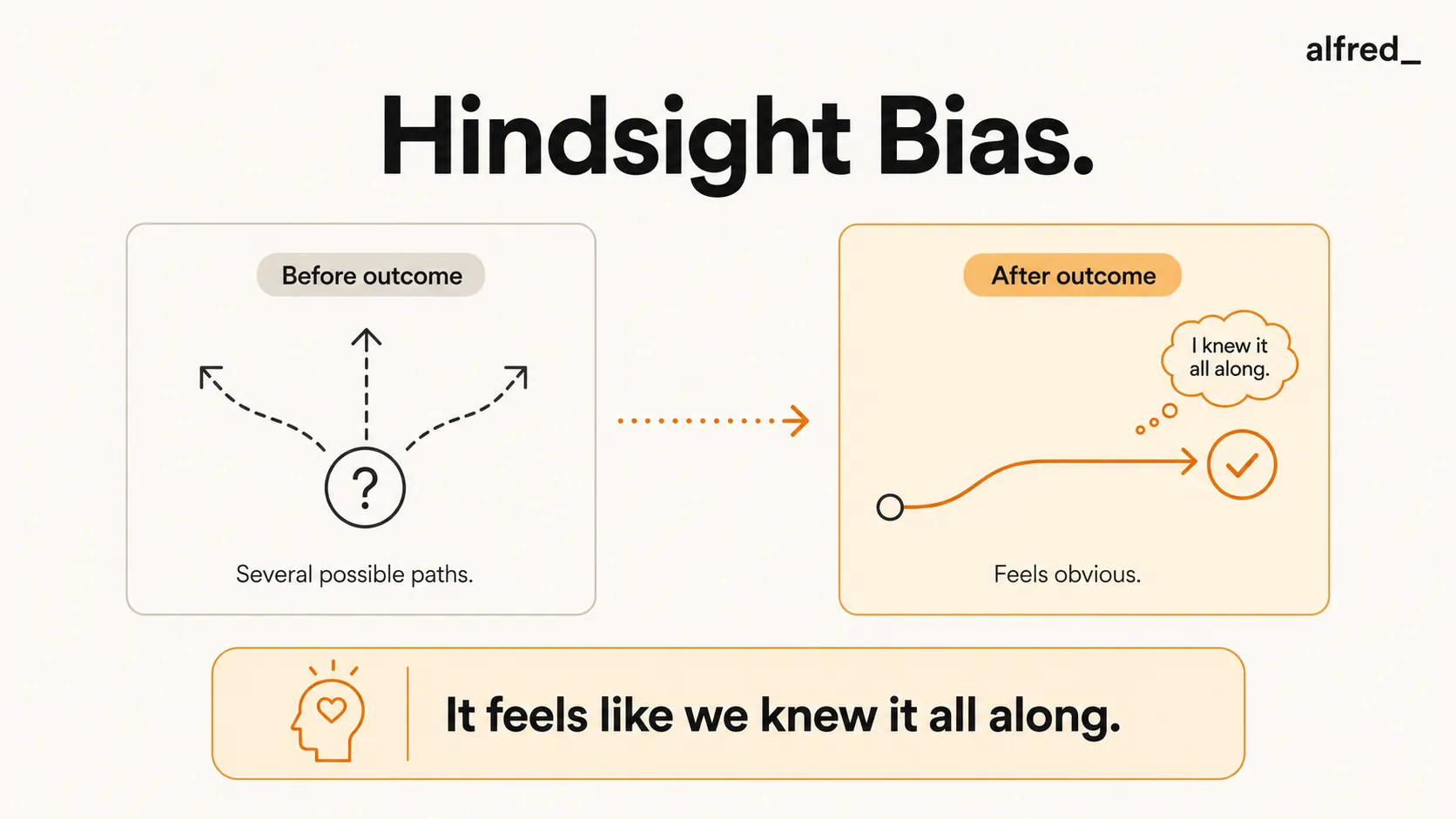
- Hindsight bias is the tendency to believe, after learning an outcome, that you would have predicted it, even when you could not have. Fischhoff and Beyth (1975) demonstrated this through systematic memory distortion of recalled probability estimates.
- It corrupts post-mortems by making failures seem more predictable than they were, inflating blame attributions and producing false learning ("we should have seen it coming")
- The most reliable corrective is the prospective record: documented probability estimates made before outcomes were known, against which post-hoc attribution can be calibrated
- Decision journals and pre-mortems both create the documented baseline that prevents hindsight bias from rewriting organizational memory
Hindsight bias is strongest for moderate-probability events (40–60% probability), precisely the genuinely uncertain decisions where good judgment matters most and post-hoc evaluation is most distorted.
Two Founding Studies
The hindsight bias was established by two 1975 papers that used different methodologies but documented the same phenomenon.
Fischhoff and Beyth published "I Knew It Would Happen: Remembered Probabilities of Once-Future Things" in Organizational Behavior and Human Performance (Vol. 13, pp. 1–16, 1975). Their study used a within-subjects design with a genuinely prospective measurement: before President Nixon's 1972 diplomatic visits to China and the Soviet Union, participants estimated the probability of 15 possible outcomes (such as "Nixon will meet Mao at least once" or "The US and China will establish a formal diplomatic relationship"). After the trips occurred, participants were re-contacted and asked to recall their original probability estimates.
The result: participants systematically misremembered their prior estimates as having been closer to the actual outcome. Those who learned that an event had occurred recalled having assigned it higher probability than they actually had. Those who learned it hadn't occurred recalled having assigned it lower probability. The memory distortion was not random. It was systematically biased in the direction of what actually happened. Participants were not lying; they genuinely misremembered, as indicated by their confidence in their recall.
Fischhoff published "Hindsight ≠ Foresight: The Effect of Outcome Knowledge on Judgment Under Uncertainty" in the Journal of Experimental Psychology: Human Perception and Performance (Vol. 1, pp. 288–299, 1975). This paper used a different design (between-subjects, with historical vignettes) and showed that simply knowing the outcome of an ambiguous historical event (such as a 19th-century battle between British and Gurkha forces) inflated participants' judgments of how predictable the outcome was in hindsight, compared to participants who did not know the outcome.
Try alfred_
See what this looks like in practice
alfred_ applies these principles automatically — triaging your inbox, drafting replies, extracting tasks, and delivering a Daily Brief every morning. Theory becomes system. $24.99/month. 30-day free trial.
Try alfred_ freeWhy It Matters for Organizational Learning
Hindsight bias corrupts organizational learning through three specific mechanisms that compound each other:
- Post-mortem distortion. When a post-mortem is conducted after a failure, participants who know the outcome reconstruct the decision-making process in a way that makes the failure seem more predictable, and therefore more attributable to specific decision errors, than it was. The post-mortem produces confident, specific causal attributions for an outcome that was genuinely uncertain at the time. These attributions feel insightful but are partly artifacts of outcome knowledge rather than genuine analysis of decision quality.
- Unfair performance evaluation. Managers evaluating a decision made months earlier, whose outcome is now known, systematically rate the decision quality lower when the outcome was bad, even when the decision process was sound given the information available at the time. This is outcome bias in combination with hindsight bias: the manager knows the outcome, reconstructs the prior situation as more clearly pointing to that outcome, and attributes the bad outcome to poor judgment rather than to genuine uncertainty.
- False learning. Organizations that use post-hoc outcome attribution to generate lessons, such as "we should have known X," are learning spuriously. The lesson encodes a hindsight-inflated certainty about what was knowable, which corrupts future decision processes by setting unrealistic standards for anticipating uncertainty. The lesson "we should have seen it coming" produces decisions that are over-fitted to the last failure pattern, not genuinely more robust to future uncertainty.
Correcting for Hindsight in Decision Reviews
The most reliable corrective for hindsight bias in organizational settings is the prospective record: documented probability estimates made before outcomes were known, against which post-hoc attribution can be calibrated.
Decision journals (brief records of what was known, what was uncertain, and what probabilities were assigned to different outcomes at the time a decision was made) provide the baseline for genuinely outcome-calibrated review. Without the prospective record, the post-mortem team is working from reconstructed memory, and hindsight bias will systematically distort what that memory produces.
The pre-mortem (prospective failure analysis conducted before execution begins) also partially counteracts hindsight bias by creating a documented record of anticipated failure scenarios. When the actual failure occurs, the pre-mortem record shows what risks were visible in advance, preventing the hindsight inflation of "that risk was always obvious."
Frequently Asked Questions
How does hindsight bias affect project post-mortems specifically?
Hindsight bias produces at least two systematic distortions in post-mortems. First, participants overestimate how predictable the failure was. The warning signs that are now visible in retrospect feel like they should have been visible and acted upon at the time, which they often weren't. Second, the post-mortem generates blame attributions that are inflated by outcome knowledge: the person who made the decision that preceded the failure is evaluated against a standard of clarity that only outcome knowledge provides. Structurally, post-mortems conducted without prospective records of what was known and uncertain at decision points will consistently over-assign blame and under-attribute genuine uncertainty. The corrective is to reconstruct the decision situation with explicit attention to what information was available at the time, and to have records that support that reconstruction.
Is hindsight bias stronger for surprising outcomes than for expected ones?
Research shows a nuanced pattern. For highly surprising outcomes (outcomes that would have been assigned very low probability in advance), hindsight bias is very strong: knowing the outcome makes it seem much more predictable than it was. For outcomes that were always highly likely, hindsight bias is weaker because the foresight probability was already high. The maximum distortion occurs with moderate-probability outcomes: events that were genuinely uncertain (40–60% probability) become, in retrospect, highly predictable. The surprise of uncertainty is erased from memory. This means that genuinely uncertain decisions, where good judgment is most valuable, are also the decisions where post-hoc evaluation is most distorted.
How do you structure a post-mortem to minimize hindsight bias?
The most effective structural intervention is to require participants to reconstruct the decision situation as it existed at the time, using only information that was available before the outcome was known. In practice: require participants to document what they knew and what they believed about probabilities before outcome knowledge is discussed. Separate the outcome discussion from the process discussion, then evaluate decision quality before examining outcome quality. Use any prospective records that exist: meeting notes, risk registers, email threads from the decision period. Ask explicitly: 'Would this decision look poor to a knowledgeable person who didn't know the outcome?' If yes, it reflects genuine decision error. If not, the apparent error is outcome bias rather than process error.
Try alfred_
Create the prospective record that makes post-mortems accurate.
alfred_ automatically logs what was communicated, what was deferred, and what was acted on, creating the timestamped prospective record that makes post-mortem analysis accurate rather than hindsight-inflated. The record of what you knew and when you knew it is the corrective that hindsight bias requires. $24.99/month.
Try alfred_ free