

Psychology

Groupthink: Why Cohesive Teams Make Catastrophic Decisions

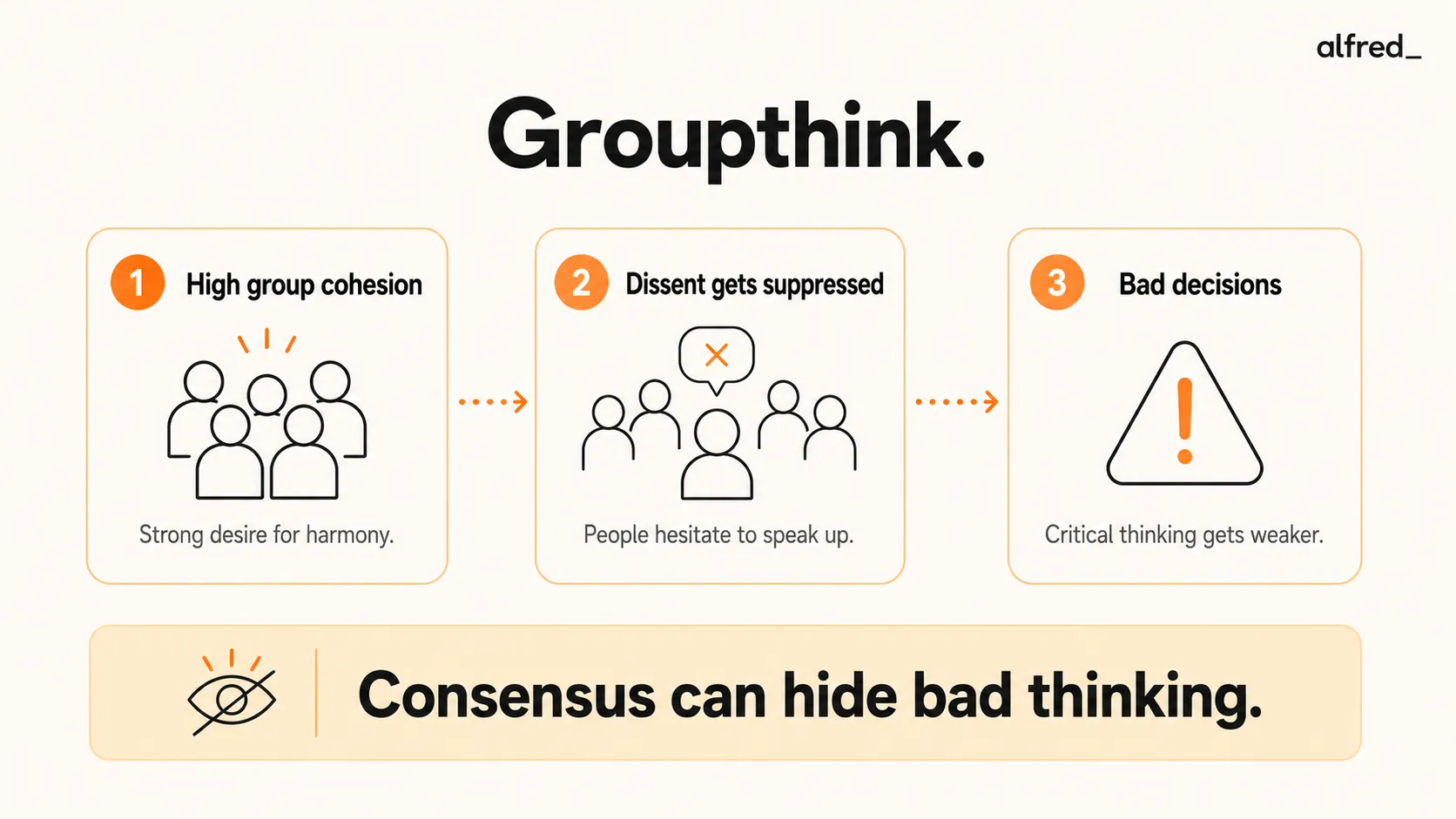
The groups that make the worst decisions are often not the dysfunctional ones. They are the cohesive, high-morale teams where relationships are strong and consensus comes easily. It is precisely in those groups that the pressures suppressing dissent are strongest, and the mechanisms for catching errors are most thoroughly disabled.

Feb 19, 20266 min read
Quick Answer

What is groupthink and how does it happen?

  • Groupthink: when strivings for unanimity override realistic appraisal of alternatives, coined by Irving Janis (1972) after analyzing the Bay of Pigs, Pearl Harbor, and Vietnam War escalation
  • Three antecedents: high group cohesiveness, structural faults (insulation, homogeneity, no impartial leader), and provocative situational context (high stakes under time pressure)
  • Eight symptoms: illusion of invulnerability, collective rationalization, belief in group morality, stereotyped outgroups, pressure on dissenters, self-censorship, illusion of unanimity, self-appointed mindguards
  • Prevention requires structural change, not exhortation: devil's advocates, outside experts, second-chance meetings, and pre-mortems

The most dangerous configuration: a cohesive group with a strong-willed leader who signals their preferred outcome before deliberation begins. Healthy consensus is reached after engaging dissenting views, not by suppressing them.

Janis's Original Framework

Irving Janis coined the term "groupthink" in Victims of Groupthink: A Psychological Study of Foreign-Policy Decisions and Fiascoes (Houghton Mifflin, 1972; revised and expanded as Groupthink: Psychological Studies of Policy Decisions and Fiascoes in 1982). The framework emerged from Janis's analysis of three foreign policy disasters in which capable, experienced decision-makers reached conclusions that were subsequently recognized as obvious failures.
The three cases Janis analyzed in depth were the Bay of Pigs invasion of Cuba (1961), the failure to anticipate and prepare for the Japanese attack on Pearl Harbor (1941), and the Johnson administration's systematic escalation of the Vietnam War between 1964 and 1967. Each case involved a highly cohesive group of advisors making decisions under conditions where the eventual failure was, in retrospect, foreseeable, and where dissenting evidence or views existed within the group but failed to surface in deliberation.

Janis identified three antecedent conditions that promote groupthink: high group cohesiveness, structural faults of the organization (including insulation from outside experts, lack of impartial leadership, and membership homogeneity), and provocative situational context (high-stakes decisions under time pressure or threat).

The Eight Symptoms

Janis identified eight symptoms that collectively characterize a groupthink episode. They operate as a system: each reinforces the others.

  • Illusion of invulnerability. Group members share an excessive optimism that encourages extreme risk-taking and suppresses warning signals that might interrupt the shared narrative of success.
  • Collective rationalization. Members collectively construct justifications for their chosen course, dismissing warnings and contradictory data rather than reconsidering assumptions.
  • Belief in the inherent morality of the group. Members assume the group's objectives are inherently ethical, which allows them to disregard the ethical consequences of their decisions.
  • Stereotyped views of outgroups. Opponents, critics, and adversaries are viewed as too weak, unintelligent, or evil to merit genuine engagement, foreclosing negotiation or alternative analysis.
  • Pressure on dissenters. Members who raise doubts or challenge the emerging consensus are pressured (directly or implicitly) to get with the program. The pressure is social and relational, not necessarily explicit.
  • Self-censorship. Individual members who have doubts choose not to express them, because they perceive their views as deviant from the apparent consensus and are unwilling to disrupt the group's cohesion.
  • Illusion of unanimity. The silence of self-censoring members is interpreted as agreement, creating an apparent consensus that does not reflect the group's actual range of views. Silence becomes a misleading signal.
  • Self-appointed mindguards. Certain members take it upon themselves to protect the group from information that would challenge the consensus, filtering communications, discouraging outside consultation, and suppressing contradictory evidence before it reaches the full group.

Try alfred_

See what this looks like in practice

alfred_ applies these principles automatically — triaging your inbox, drafting replies, extracting tasks, and delivering a Daily Brief every morning. Theory becomes system. $24.99/month. 30-day free trial.

Try alfred_ free

Prevention in Practice

Janis's own prescriptions for preventing groupthink are structurally focused, not motivationally focused. Exhorting a group to be more critical does not dismantle the cohesion pressures that produce self-censorship. Structure must change.

  • Assign a formal devil's advocate. Designate one member to argue against the emerging consensus as a formal role. This normalizes dissent and reduces the social cost of raising objections, because the objector is playing a role rather than expressing personal deviance.
  • Invite outside experts who are not invested in the consensus. External reviewers who have not participated in building the plan do not share the cohesion pressures that suppress internal dissent.
  • Hold a second-chance meeting after initial consensus. After a decision appears to be settled, hold a separate meeting whose explicit purpose is to surface any residual doubts, creating a formal space in which raising concerns does not disrupt the primary deliberation.
  • Run a pre-mortem. Ask the group to imagine that the decision has been implemented and has failed, then work backward to identify what went wrong. This makes it psychologically easier to articulate failure scenarios that groupthink dynamics would otherwise suppress.

Frequently Asked Questions

Does groupthink only affect high-stakes political or military decisions, or does it operate in ordinary organizations?

Janis's original analysis focused on foreign policy fiascoes, but the antecedent conditions he identified (high cohesiveness, structural insulation, and situational stress) appear in ordinary organizational teams. Product teams making feature decisions, executive teams allocating strategy, and boards approving acquisitions all operate under conditions that can produce groupthink dynamics. The research that followed Janis has identified groupthink patterns in business failures including NASA's Challenger and Columbia disasters, financial institution collapses, and failed product launches. The scale differs; the mechanism is the same.

Is groupthink more likely when the leader is dominant or when members are strongly bonded?

Both conditions contribute, but they operate through different mechanisms. A dominant leader who signals their preferred outcome before deliberation begins suppresses dissent through direct pressure and reduces members' motivation to search for alternatives, because the decision appears already made. Strong member bonding creates self-censorship and illusion of unanimity even without explicit leadership pressure. Members protect the relationship and the group's morale by withholding objections. The most dangerous configuration combines both: a cohesive group with a strong-willed leader who signals preferences early. Janis specifically recommended that leaders withhold their own preferences until after the group has had a genuine deliberation.

How do you distinguish healthy consensus from groupthink?

Healthy consensus is reached after genuine engagement with dissenting views and contradictory evidence. Groupthink consensus is reached by suppressing or never surfacing those views. The diagnostic question is not 'did we reach agreement?' but 'what did we do with the views that disagreed?' If dissenting voices were heard, engaged, and ultimately failed to persuade, that is healthy consensus. If dissenting voices were not heard because people self-censored, if contradictory evidence was rationalized away rather than examined, or if the decision-maker signaled preference before genuine deliberation began, those are groupthink indicators regardless of whether the outcome appears smooth.

Try alfred_

Surface What Isn't Being Said

alfred_'s briefing structure surfaces threads and action items that have been deferred, ignored, or not yet surfaced in group communication, creating visibility into what the team is not discussing, not just what it is. This is the informational antidote to the mindguard problem. $24.99/month.

Try alfred_ Free