


Psychology

Expectancy Theory:
Why Smart People Stay Unmotivated

The most common management response to unmotivated high performers is to increase compensation or improve working conditions. These interventions address only one of the three components of motivation, and often the wrong one. Victor Vroom's 1964 model explains why.

Feb 19, 20266 min read
Quick Answer

What is expectancy theory (VIE model)?

  • Motivation = Expectancy × Instrumentality × Valence; the relationship is multiplicative, so any zero produces zero motivation
  • Expectancy: "If I work hard on this, will I actually be able to do it?" (belief effort leads to performance)
  • Instrumentality: "If I do this well, will it produce the reward I expect?" (belief performance leads to outcomes)
  • Valence: "Is the reward something I actually care about?" (value placed on the expected outcome)

Van Eerde and Thierry's 1996 meta-analysis of 77 studies confirmed the components correlate with effort, performance, and preference. Most management interventions target only valence (compensation) while ignoring expectancy and instrumentality.

The VIE Model

Victor Vroom published Work and Motivation in 1964, proposing that motivational force is a function of three separable beliefs, and that the relationship between them is multiplicative, not additive.
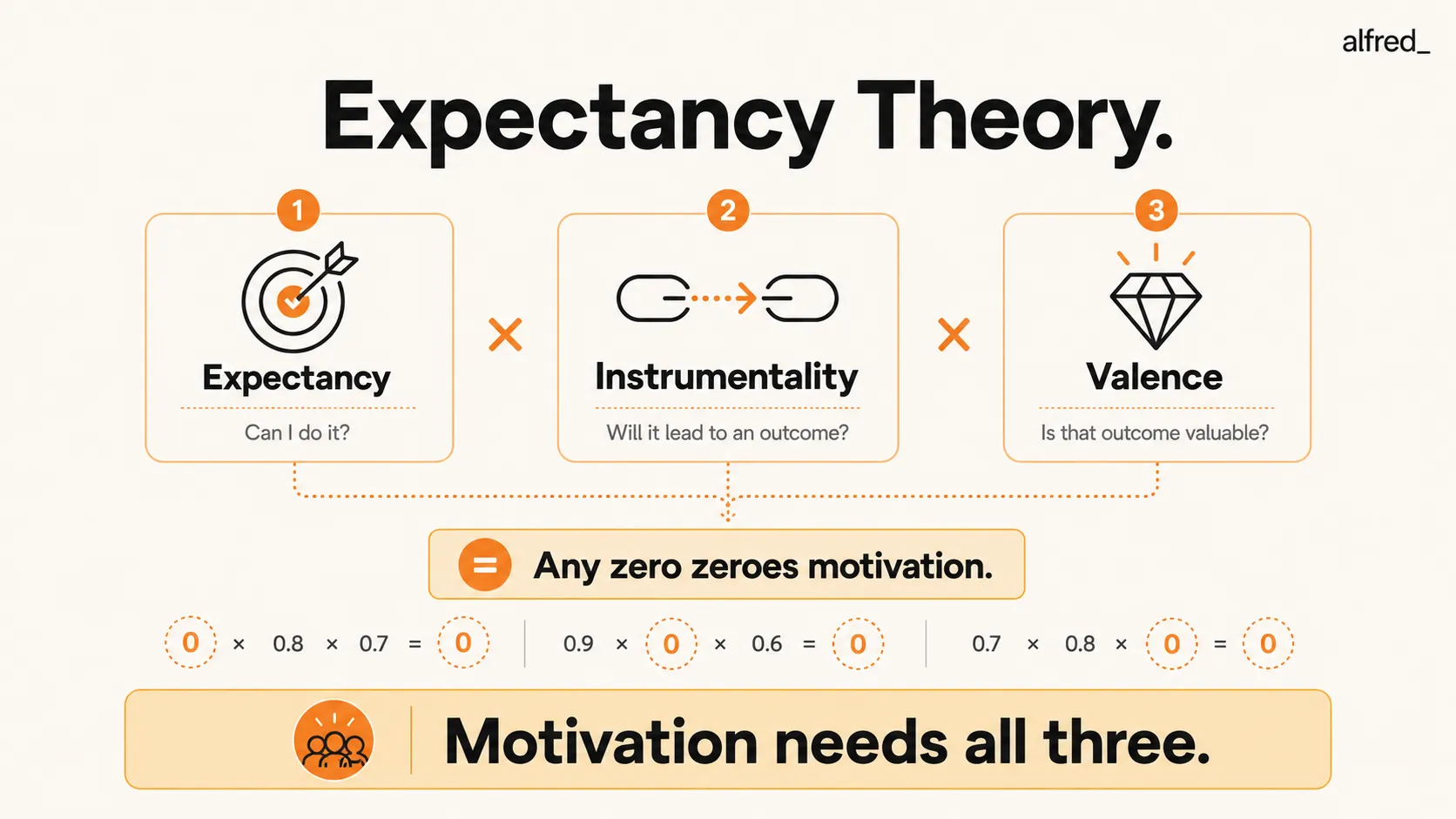
Expectancy is the belief that effort will lead to performance. "If I work hard on this, will I actually be able to do it well?" A person who believes they lack the capability or resources to succeed, regardless of effort, has zero expectancy. That zero collapses the entire motivation equation.

Instrumentality is the belief that performance will lead to outcomes. "If I do this well, will it actually produce the reward or recognition I expect?" A person who has been promised a promotion that never materialized, or whose high-quality work goes unacknowledged, has low instrumentality. They have learned that performance does not reliably produce outcomes.

Valence is the value placed on the expected outcome. "Is the reward I expect to get something I actually care about?" A person offered a bonus in a currency they don't value (public recognition for someone who prefers privacy, team activities for someone who values individual achievement) has low valence.

The multiplicative structure is the key insight: Motivation = Expectancy × Instrumentality × Valence. Any zero produces zero motivation, regardless of how high the other two factors are.

The Evidence

Van Eerde and Thierry's 1996 meta-analysis in the Journal of Applied Psychology examined 77 studies testing the VIE model. The components, especially valence and instrumentality, showed consistent correlations with effort, performance, and job preferences. The model's components are real and separable.

The multiplicative form has mixed empirical support; some studies find additive combinations predict behavior as well. But the diagnostic insight survives: you need to assess all three components to understand a motivation problem, and a deficiency in any single one can fully explain apparent underperformance from a highly capable person.

Try alfred_

See what this looks like in practice

alfred_ applies these principles automatically — triaging your inbox, drafting replies, extracting tasks, and delivering a Daily Brief every morning. Theory becomes system. $24.99/month. 30-day free trial.

Try alfred_ free

Common Misdiagnoses

Most management interventions for unmotivated performers target the wrong component:

  • Compensation increases for low-instrumentality problems. If the issue is that the person doesn't believe performance leads to reward, because promises have been broken, recognition is inconsistent, or politics determine outcomes, adding more money to the valence side does nothing. The problem is trust in the mechanism, not the size of the potential reward.
  • Training for low-expectancy problems that are actually resource problems. A person who believes they can't succeed may need not training but different tools, clearer briefs, or a smaller initial scope. Sometimes low expectancy reflects realistic assessment of an insufficient environment rather than insufficient capability.
  • Motivational speeches for valence problems. If a person genuinely doesn't care about the reward being offered, no amount of inspiration about the importance of the work changes that. Understanding what outcomes the individual actually values, and whether those are achievable through the current role, is the only intervention that addresses valence.

Diagnosing the Problem

The practical use of expectancy theory is diagnostic. When a capable person is underperforming or disengaged, three questions surface the root cause:

  • "Do you believe you can do this well if you try?" Tests expectancy. If no: address capability, resources, or task fit.
  • "Do you believe that doing this well will lead to the outcomes we've discussed?" Tests instrumentality. If no: address credibility, history, and the reliability of the reward mechanism.
  • "Are the outcomes we're offering actually ones you want?" Tests valence. If no: understand what this person actually values and whether the role can deliver it.

Frequently Asked Questions

How does expectancy theory differ from self-determination theory?

Both address what drives motivated behavior, but from different angles. Expectancy theory is primarily about cognitive beliefs: the rational calculation of whether effort is worth expending. Self-determination theory focuses on the quality of motivation: whether it originates from internal values (autonomous motivation) or external pressure (controlled motivation). The two frameworks are complementary: expectancy theory explains why high performers can be demotivated despite clear incentives (the mechanism is broken), while self-determination theory explains why some incentives produce engagement while others produce compliance. In practice: expectancy theory helps diagnose unmotivation; self-determination theory guides how to design work for sustainable engagement.

Is it ethical to use expectancy theory to 'manipulate' employee motivation?

The distinction is between manipulation and alignment. Expectancy theory is most ethically powerful when used to understand and address genuine mismatches between what an employee needs and what the environment provides. If someone has low instrumentality because historical promises weren't kept, the ethical response is to change the reward mechanism and rebuild trust, not to convince them that a broken system works. The theory is manipulative when used to create false beliefs (e.g., convincing someone that performance leads to outcomes when it doesn't). Used honestly, it is a diagnostic tool for creating environments where capable people can reasonably believe their effort will produce valued outcomes.

Why do high performers sometimes have lower expectancy than lower performers?

High performers often have more accurate self-assessment of task difficulty. They know what excellent output actually requires, the timeline, the resources, the precision, and are more likely to accurately predict that current conditions will fall short. This is not low confidence; it is calibrated realism. The management implication: dismissing concerns from high performers as 'lack of confidence' misses what is often valuable information about resource or environmental constraints. Low expectancy in a high performer is a signal worth investigating, not reassuring away.

Try alfred_

Raise the expectancy that follow-through is possible.

When professionals believe that careful email management and diligent follow-up won't make a meaningful difference (low expectancy), they stop trying. alfred_ handles the overhead that makes follow-through feel possible, raising the expectancy that effort leads to results. $24.99/month.

Try alfred_ Free