


The Research Foundation: Self-Determination Theory
Edward Deci and Richard Ryan developed self-determination theory (SDT) over several decades, beginning with Deci’s 1971 experiments on the effects of monetary rewards on intrinsic motivation (Journal of Personality and Social Psychology, 18(1), 105–115). The full theory was formalized in Intrinsic Motivation and Self-Determination in Human Behavior (Plenum Press, 1985).
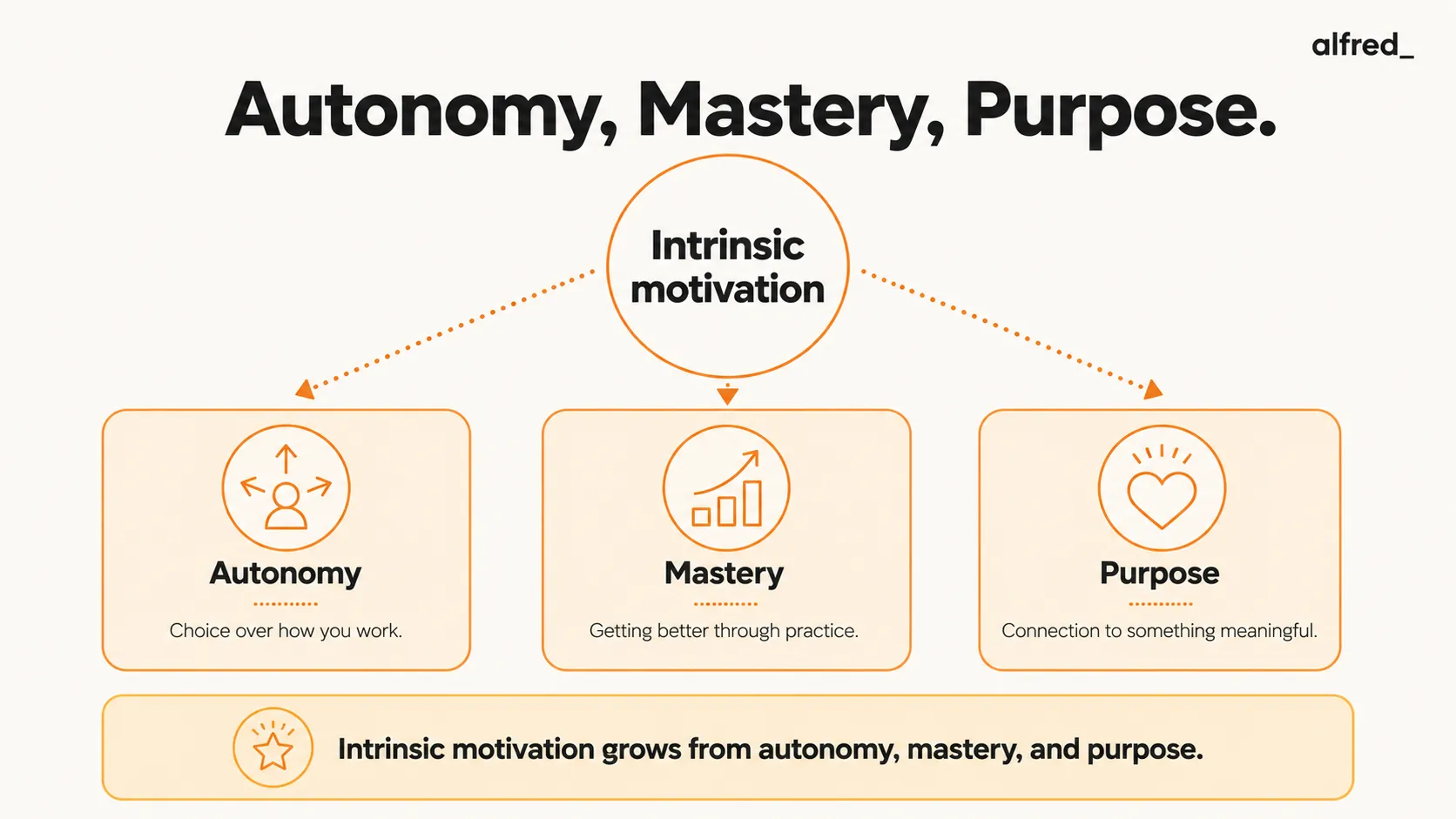
SDT proposes three universal psychological needs whose satisfaction promotes intrinsic motivation, engagement, and wellbeing:
- Autonomy: the experience of volition and self-direction in one’s actions. Autonomy does not require working alone or without constraints; it requires that the constraints feel chosen rather than imposed.
- Competence: the experience of effectiveness, growth, and mastery in engaging with the environment. This requires challenge calibrated to current ability: too easy produces boredom; too hard produces anxiety. Neither supports competence need satisfaction.
- Relatedness: the experience of meaningful connection with others. In organizational contexts, this involves feeling that one’s work is valued and that the work community is authentic.
128 studies meta-analyzed
Deci, Koestner & Ryan (1999) meta-analyzed 128 studies in Psychological Bulletin, finding that tangible, performance-contingent rewards reliably undermined intrinsic motivation. The effect was organized by reward type: verbal rewards (praise) could enhance intrinsic motivation; tangible performance-contingent rewards reliably reduced it.
Deci, E.L., Koestner, R. & Ryan, R.M. (1999). Psychological Bulletin, 125(6), 627–668.Pink’s Synthesis: Drive
Daniel Pink synthesized the SDT research for organizational audiences in Drive: The Surprising Truth About What Motivates Us (Riverhead Books, 2009). Pink renamed the three dimensions: autonomy (from SDT’s autonomy), mastery (from SDT’s competence), and purpose (not a direct SDT construct, but drawing on relatedness and the broader meaning literature).
Pink’s core argument was that “Motivation 2.0” (the incentive-and-punishment model suited to routine, algorithmic work) is mismatched to “Motivation 3.0” (the intrinsic motivation required for creative, judgment-intensive, and knowledge work). The practical upshot: for complex cognitive work, the conditions that produce high performance are autonomy over how the work is done, challenge calibrated to grow mastery, and clear connection to meaningful purpose.
Pink described the FedEx Day experiment at Atlassian (employees given 24 hours to work on anything they wanted, then present results) as an illustration of autonomy’s productivity effects. Similar experiments at Google (20% time) and other technology companies produced significant innovation output from autonomy-supporting structures.
Professional Applications
- When not to use performance bonuses. The meta-analytic evidence from Deci et al. (1999) is organized by reward type: verbal performance feedback (praise, recognition) tends to support autonomy and can enhance intrinsic motivation. Tangible, performance-contingent rewards (especially for tasks the person finds intrinsically interesting) reliably undermine it by shifting the experienced locus of causality from internal to external. For routine, uninteresting work, performance bonuses may increase output; for complex, interesting work, they may reduce it.
- Autonomy over method, not just goals. The autonomy research is specific: what matters is experienced autonomy, meaning the sense that one is choosing how to work rather than having methods dictated. Setting the direction (goal) while allowing flexibility in method tends to satisfy autonomy need; specifying both direction and method does not. The management implication is distinguishing between what needs to be specified (outcomes, quality standards, timelines) and what can be left to individual choice (approach, schedule, collaboration style).
- Mastery and calibrated challenge. Competence need satisfaction requires appropriate challenge: not “stretch” so great it produces anxiety, and not task difficulty so low it produces boredom. The mastery trajectory is one of progressively increasing challenge, with feedback that makes the growth visible. Development assignments calibrated to the edge of current ability, and framed as growth opportunities rather than tests, create the conditions for mastery need satisfaction and the sustained engagement that follows from it.