

The Multitasking Myth
For decades, multitasking was treated as a professional virtue. Job descriptions demanded it. Performance reviews rewarded it. The ability to juggle competing priorities was the hallmark of a capable knowledge worker.
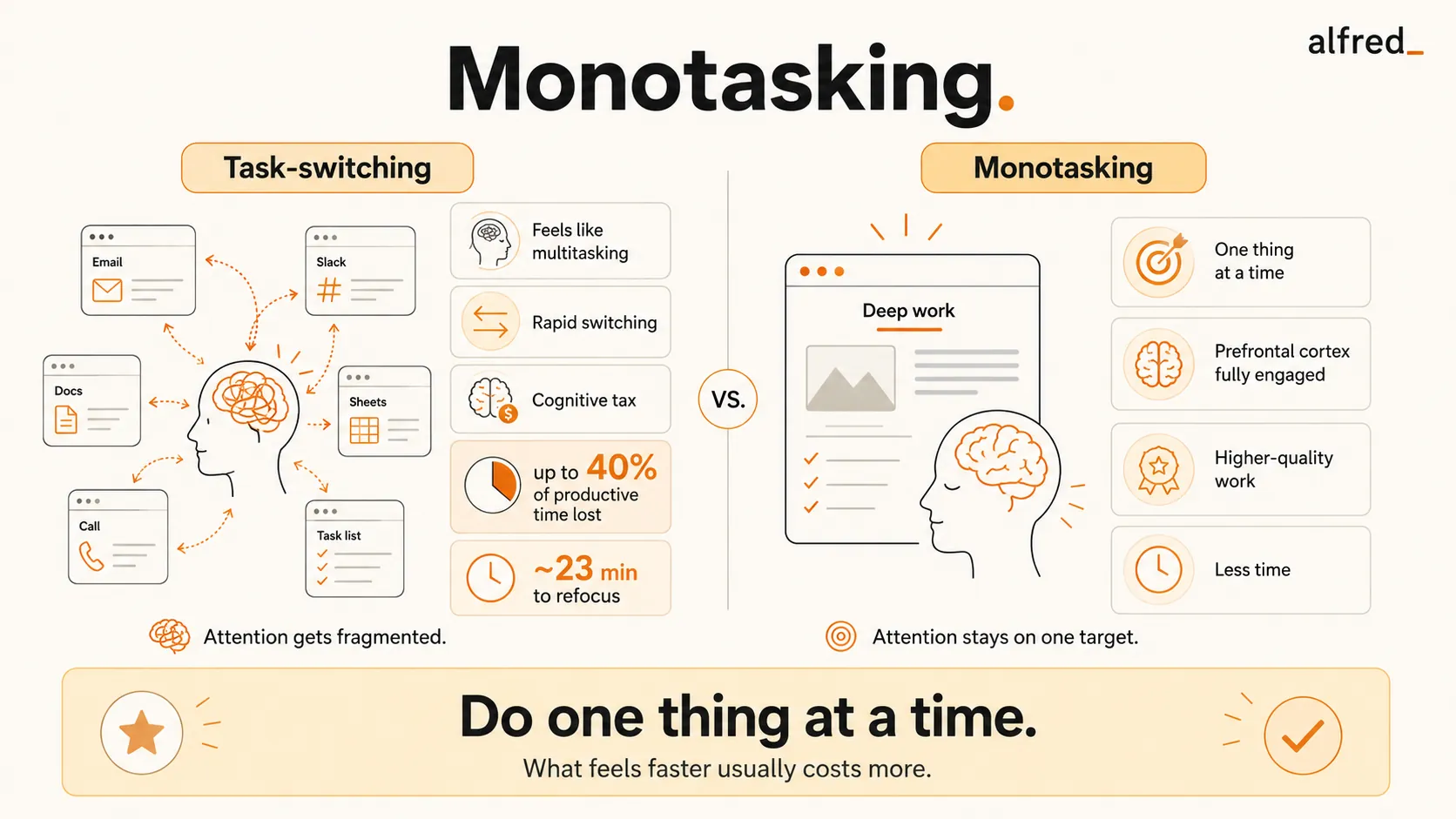
Then neuroscience caught up. Research from the American Psychological Association found that switching between tasks can cost as much as 40% of productive time. The brain doesn’t process multiple complex tasks simultaneously. It alternates between them, paying a cognitive tax with every switch.
40%
of productive time is lost to task-switching
What the Research Actually Shows
A landmark Stanford study by Clifford Nass found that people who regularly multitask with media performed worse on every measure of cognitive control. They were slower at switching tasks, worse at filtering irrelevant information, and had more difficulty organizing working memory.
The finding was counterintuitive: heavy multitaskers weren’t better at multitasking. They were worse at everything.
Subsequent research has confirmed the pattern. A University of London study found that multitasking during cognitive tasks reduced participants’ IQ scores by an average of 10 points, roughly the equivalent of staying up all night. Gloria Mark at UC Irvine found that it takes an average of 23 minutes and 15 seconds to fully return to a task after an interruption.
23 min
average time to refocus after an interruption
Why Monotasking Works
Monotasking, dedicating your full attention to a single task before moving to the next, works because it aligns with how the brain actually processes information. Your prefrontal cortex handles executive function, and it processes tasks sequentially, not in parallel.
When you monotask, you eliminate the switching cost entirely. Your brain builds momentum on a single problem, moving from shallow processing to deep engagement. This is where insight happens, where complex problems yield to sustained attention.
Cal Newport calls this state “deep work”, professional activities performed in a state of distraction-free concentration that push your cognitive capabilities to their limit. Monotasking is the prerequisite for deep work.
The Cost of Context Switching
Every time you switch tasks, your brain must:
- Disengage from the current task’s rules and goals
- Load the new task’s rules and context into working memory
- Suppress the now-irrelevant information from the previous task
- Orient to where you left off on the new task
This process, called “attention residue” by researcher Sophie Leroy, means part of your cognitive capacity remains allocated to the previous task even after you’ve switched. The more complex the previous task, the greater the residue.
For knowledge workers who switch contexts dozens of times per day, checking email between deep work, responding to Slack during a project, taking a call in the middle of writing, the cumulative cost is staggering.
How to Practice Monotasking
1. Time-block your calendar
Assign specific tasks to specific time blocks. During a block, that task is the only thing that exists.
2. Batch reactive work
Check email and messages at scheduled intervals rather than continuously. Two or three times per day is usually sufficient.
3. Close everything else
Close unrelated browser tabs, silence notifications, and remove visual distractions. Your environment should support single-tasking.
4. Use a capture system
When unrelated thoughts arise mid-task, write them down and return to your current work. This prevents the impulse to switch.
Monotasking in a Multitasking World
The hardest part of monotasking isn’t the technique. It’s the environment. Open offices, always-on messaging, and cultures that reward responsiveness over thoughtfulness all push toward fragmented attention.
The solution isn’t to ignore your responsibilities. It’s to be deliberate about when you’re available and when you’re focused. Communicate your working patterns to your team. Set expectations about response times. Protect blocks of uninterrupted time the way you’d protect an important meeting.
Tools that help manage your calendar, email, and tasks can reduce the cognitive overhead of coordination, freeing you to spend more time in focused, single-task mode.
“People can’t multitask very well, and when people say they can, they’re deluding themselves.”
Earl Miller, MIT Neuroscientist