

The meeting is on the calendar, you already know it is pointless, and yet you let it happen anyway, because canceling feels ruder than wasting eight people’s hour. That instinct is backwards. Holding a meeting that produces nothing is the rude act; canceling it well is the considerate one. Done right, canceling is not a social failing but a sign you take other people’s time seriously. Here is when canceling is the correct call, how to communicate it so it builds trust instead of eroding it, and four templates you can send today.
When Canceling Is the Right Call
Canceling a meeting isn’t avoidance. It’s judgment. Peter Drucker’s pruning test from The Effective Executive applies directly: “What would happen if this meeting were not done at all?” If the answer is “nothing” or “we could have handled this over email,” the meeting should be cancelled.
Patrick Lencioni’s meeting type framework adds precision. Most bad meetings are mismatched: a strategic discussion crammed into a weekly tactical slot, or a decision meeting that’s become an FYI session. When a meeting has drifted from its type (when what was called a tactical check-in has become a rambling strategy session, or when the decision it was called to make has already been made), the right answer is to cancel and, if necessary, reschedule the right kind of meeting.
Andy Grove offers another lens from High Output Management: if key decision-makers can’t attend a mission-oriented meeting, the meeting has no purpose. A mission-oriented meeting called specifically to make a decision, with the decision-maker absent, produces nothing, and should be cancelled rather than diluted into a discussion that can’t conclude.
Clear Signals to Cancel
- The decision the meeting was called to make has already been made
- The key contributor or decision-maker can’t attend
- There’s no agenda prepared and no clear outcome expected
- It’s become an FYI meeting. The information can be sent by email
- Something genuinely more urgent has emerged that requires your full attention
- The recurring meeting’s purpose has been superseded by a project ending or a team restructure
- Three or more attendees have already sent regrets
The Cost of NOT Canceling
The instinct to avoid canceling is usually about social discomfort, the worry about inconveniencing people, appearing disorganized, or signaling that the meeting wasn’t important. But the real inconvenience is what Grove calls negative leverage: forcing everyone to attend a meeting that produces nothing, which wastes their time AND deprives them of alternative uses of it.
A one-hour meeting with 8 attendees that produces no decisions or useful output represents 8 person-hours of destroyed value. At an average loaded cost of $75/hour, that’s $600 of organizational time consumed by a meeting that should have been cancelled.
62
meetings a month the average employee attends, with about half considered a waste of time
The math compounds. If you run a recurring weekly meeting with 10 attendees that has outlived its purpose, canceling it returns 10 hours of organizational capacity per week, or 520 hours per year. Holding it because it’s awkward to cancel costs those 520 hours.
Canceling well is not just about your time. It’s about your team’s time and about the signal it sends: that you evaluate meetings on whether they serve their purpose, not on whether they’re already on the calendar.
How to Cancel Without Burning Trust
The principles for canceling well are few but non-negotiable:
- Cancel as early as possible. The earlier you cancel, the more value you return to attendees. Canceling three days in advance is considerate. Canceling three hours in advance is disruptive but sometimes necessary. Not canceling when you should have is the worst option.
- Always provide a reason. Brief is fine. You don’t owe a detailed explanation. But “something came up” is not a reason. “The project decision we were going to discuss has already been made” is a reason. The difference is whether attendees can understand why the meeting is no longer needed.
- Always offer a path forward. Reschedule if the meeting is still needed at a different time. Offer an async alternative if the need can be met without a meeting. Explicitly state “we don’t need to meet on this anymore” if that’s the case. A cancellation with no path forward reads as careless.
Bill Walsh’s standard for communication under pressure applies here: “Promote open and substantive communication especially under stress.” Canceling a meeting is a communication act. Done well (clearly, early, with a path forward), it builds rather than erodes professional trust. Done poorly (late, vague, without explanation), it damages it.
Cancellation Email Templates
Template 1: Canceling with a Reschedule
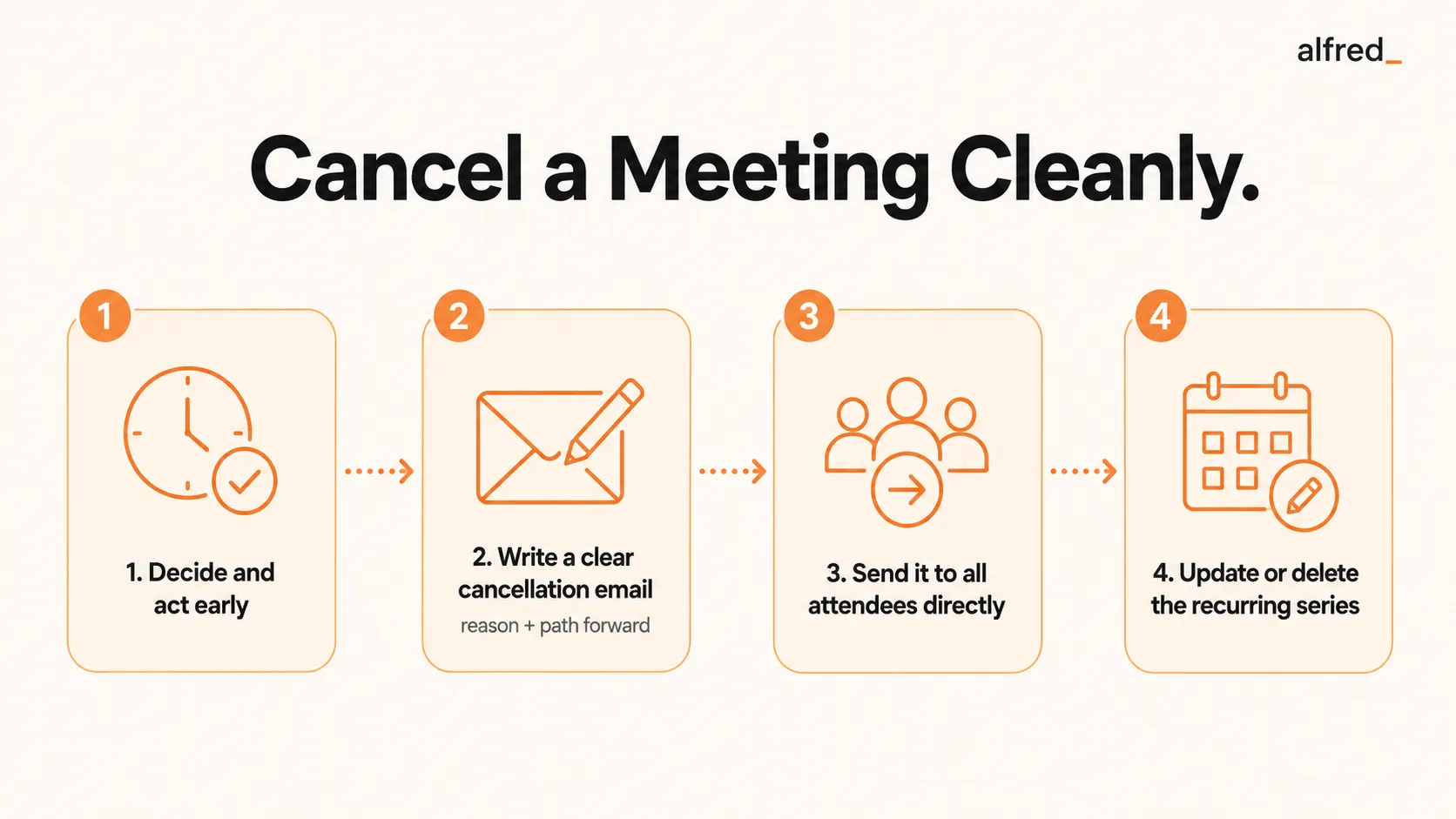
Subject: Cancelling [Meeting Name]: Rescheduling for [Date] Hi all, I need to cancel our [meeting name] scheduled for [date/time]. [Brief reason: e.g., "A conflict has come up that I can't move" / "I don't think we're ready to make this decision yet, we need [X] first."] I'm proposing we reschedule to [specific date/time alternative]. I'll include an agenda in the new invite. Sorry for any disruption to your schedule. [Your name] ### Template 2: Canceling Because the Decision Was Made Async Subject: Cancelling [Meeting Name]: No longer needed Hi all, Good news. We resolved the [topic] we were going to discuss in [thread/doc/conversation], so we don't need to meet. The decision is [summary of what was decided]. No action needed from anyone. Cancelling the calendar invite now. [Your name] ### Template 3: Last-Minute Cancellation Due to Conflict Subject: Cancelling today's [Meeting Name] Hi all, I have to cancel today's [meeting name]: [brief honest reason, e.g., "an urgent situation has come up that needs my immediate attention."] I know this is short notice and I apologize for the disruption. I'll reach out to reschedule by [specific timeframe]. In the meantime, if there's anything time- sensitive, please email me directly. [Your name] ### Template 4: Canceling a Recurring Meeting Permanently Subject: Ending our [Meeting Name] recurring series Hi all, I've been reviewing how we're using our meeting time, and I think our [weekly/monthly] [meeting name] has run its course. [Brief reason: e.g., "The project it was built around has wrapped up" / "I think we can handle this asynchronously now."] Going forward, I'll [alternative: send a weekly update email / be available on Slack for questions / schedule time as needed]. I'm cancelling the recurring series today. Thanks for your time on it. It served us well. [Your name] ## Step-by-Step: Cancel a Meeting the Right Way 1 ### Decide as Early as Possible The moment you know a meeting should be cancelled (the purpose has evaporated, key people can’t make it, something more important has emerged), cancel it. Don’t wait, hoping the situation will resolve. Every hour of delay is an hour an attendee spends protecting time for a meeting that isn’t happening. Drucker’s time audit principle: free time returned early has value. Free time returned late does not.
2. Write a Clear Cancellation Email: Reason + Path Forward
Use one of the four templates above. The formula is always the same: (1) state that you’re cancelling, (2) provide a brief honest reason, (3) offer a specific path forward. The path forward might be a reschedule, an async alternative, or an explicit statement that the meeting is no longer needed. Never leave attendees wondering what happens next.
3. Send to All Attendees Directly
Don’t rely on the calendar cancellation notification alone. It’s easy to miss, especially on mobile. Send a direct email to all attendees with the reason and path forward. This communicates respect for their time and ensures everyone receives active notification rather than discovering the cancellation incidentally.
4. Update or Delete the Recurring Series If Applicable
If you’re cancelling a single instance of a recurring meeting, ask whether the problem is structural. Apply Collins’s stop-doing question: “If we were starting from scratch today, would we choose to have this meeting?” If the answer is no, delete the recurring series entirely (or reduce its frequency) rather than letting the problem accumulate. A cancelled instance that should have been a deleted series is a deferred decision, not a solution.
The Meeting You Shouldn’t Have Scheduled in the First Place
Many cancelled meetings are meetings that should never have been scheduled. Lencioni’s framework identifies the root cause: most bad meetings are mismatched types. A strategic conversation scheduled as a weekly tactical. A status update scheduled as a monthly strategic. A five-minute decision scheduled as a one-hour working session.
When you need to cancel because the meeting has “lost its purpose,” the real diagnosis is often that it never had the right purpose to begin with. The fix is not just to cancel this instance. It’s to audit the meeting structure and reschedule with the correct type, duration, and attendee list.
Collins’s question applies here too: “If we were starting from scratch today, would we choose to do this?” For every recurring meeting you inherit, and especially for the ones you’ve run for years, this question deserves a genuine answer. The ones that survive it are worth keeping. The ones that don’t should be cancelled, not carried forward indefinitely by inertia.
Lencioni’s four meeting types and their natural lifespans: Daily Check-Ins exist as long as the team operates together. Weekly Tacticals exist as long as the team has active projects. Monthly Strategics exist as long as there are strategic questions to resolve. When the conditions end, the meeting should end too.
Make Canceling a One-Tap Decision
The reason most pointless meetings survive is not that people lack judgment. It is friction. Canceling well means writing a clear note with a reason and a path forward, sending it directly to every attendee, and managing the reschedule, and all of that is enough small effort that the easier choice is to just let the meeting happen. The discomfort is real, but the busywork around it is what actually keeps the dead meeting on the calendar.
alfred_ removes that friction. It drafts the cancellation in the right shape (cancelling, brief reason, specific path forward), sends it to the attendees rather than relying on a calendar notification they will miss, and handles the reschedule when one is needed. The judgment stays yours: you decide the meeting should not happen. alfred_ makes acting on that decision as cheap as letting the meeting run, which is the only way the good instinct actually wins over the inertia.