


Your phone is not the problem. The problem is the dozen small “why not” decisions that put a notification on it, an app beside it, and a checking habit around it, each one harmless on its own and crushing in aggregate. You did not choose this technology environment so much as accumulate it. Cal Newport’s Digital Minimalism is the argument that the fix is not more discipline against individual apps but a different default posture toward all of them: keep only what earns its place, and use it on terms you set. Here is the philosophy, the 30-day declutter that operationalizes it, and the principles that make it stick.
Newport’s Argument
Cal Newport published Digital Minimalism: Choosing a Focused Life in a Noisy World (Portfolio/Penguin, 2019). The book’s central argument draws on Henry David Thoreau’s framework from Walden (1854): the “cost” of a tool includes not just its purchase price but all the time, attention, and energy required to maintain and use it. Thoreau applied this to physical tools; Newport applies it to digital technologies.
Newport describes the business model of engagement-maximizing platforms as a structural mismatch with user welfare. Companies like Facebook, Twitter, and Instagram employ engineers and designers specifically to maximize the time users spend on their platforms, because advertising revenue scales with engagement. The features that result (infinite scroll, variable reward notifications, social validation metrics) are optimized for platform engagement, not for what users would choose if they were designing their own technology relationship.
Intentional vs. default adoption
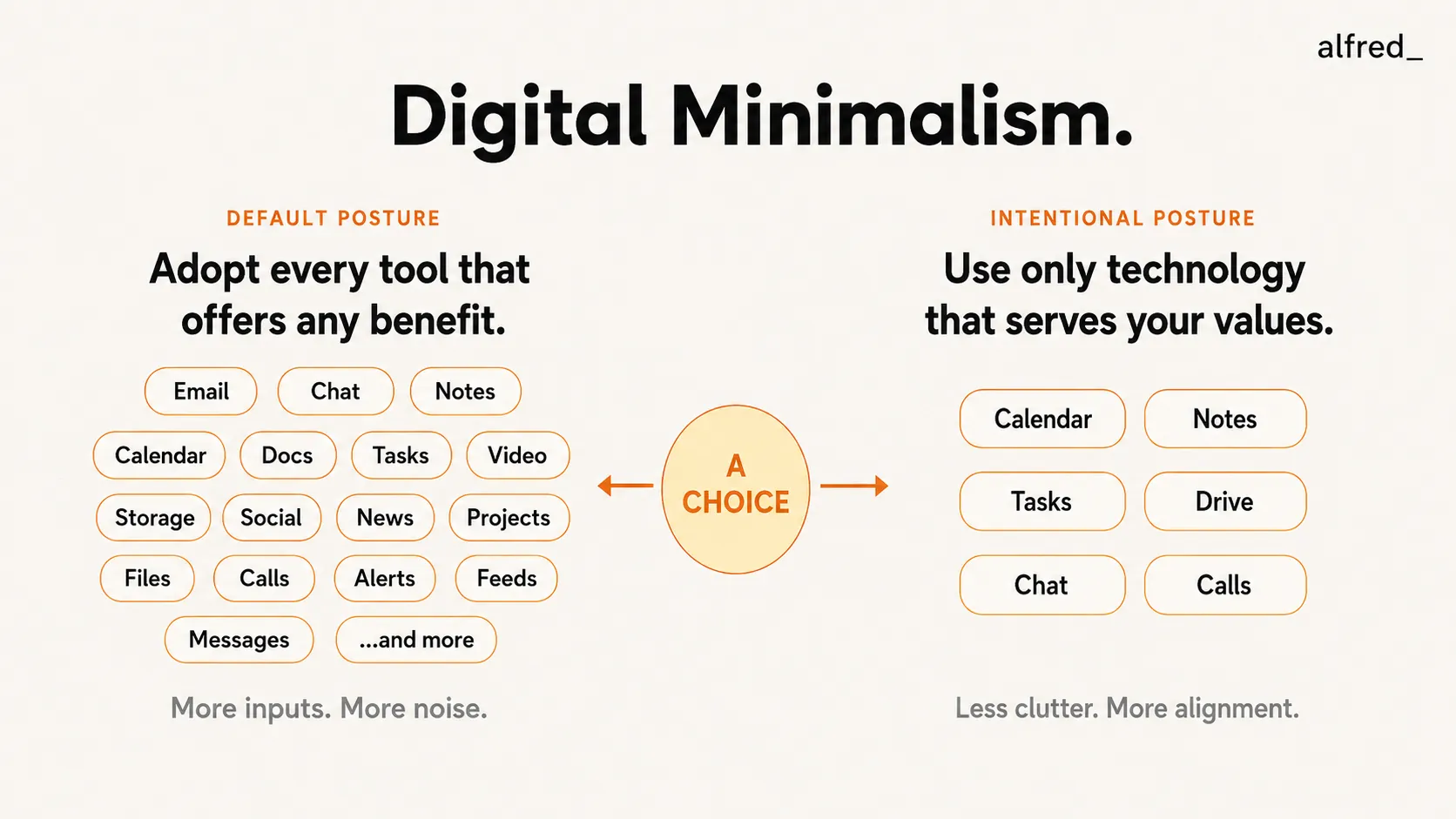
Newport's digital minimalism philosophy rests on a distinction between intentional adoption (choosing a technology because it serves a specific value you hold, used in ways you deliberately design) and default adoption (using any technology that offers any benefit, in whatever way the platform defaults encourage). The costs of default adoption accumulate across all adopted technologies simultaneously.
Newport, C. (2019). Digital Minimalism: Choosing a Focused Life in a Noisy World. Portfolio/Penguin.Newport grounds his argument in Thoreau’s claim in Walden: “The cost of a thing is the amount of what I will call life which is required to be exchanged for it, immediately or in the long run.” Applied to digital tools: the cost of an app is not zero because it is free; the cost is the attention, time, and autonomy exchanged for its use. A tool that provides a small benefit at a large cost in distraction is a net loss, even if the benefit is real.
The 30-Day Digital Declutter
Newport’s practical implementation of digital minimalism is a 30-day digital declutter: step away from all optional technologies (social media, streaming services, news apps, and other non-essential digital tools) for 30 days, then reintroduce only technologies that pass a deliberate evaluation.
The declutter serves two purposes. First, it breaks the habitual checking patterns that have accumulated around these technologies, making it possible to evaluate them clearly rather than from within the habit. Second, it creates space for alternative activities (solitude, craft, direct social connection) that the technologies had been crowding out. Newport argues that many people who complete a 30-day declutter discover that activities they had abandoned (reading, walking, conversation without phones) are more satisfying than the digital alternatives that replaced them.
The reintroduction phase requires each technology to pass three evaluations: Does it serve something I deeply value? Is it the best way to serve that value? Have I decided how I will use it to maximize the value and minimize the costs? Technologies that pass this evaluation are reintroduced on the user’s terms; those that do not are abandoned or kept out.
Practical Principles
- Clutter is costly. The accumulation of mildly beneficial technologies is not neutral: each imposes attention costs, habit formation, and the cognitive overhead of managing another digital relationship. Newport argues that the aggregate cost of many mildly beneficial technologies often exceeds the aggregate benefit, making curation essential even when individual tools seem harmless.
- Optimization matters more than adoption. How you use a technology can be more important than whether you use it. Someone who checks social media once a week for 15 minutes to maintain professional relationships is in a different position from someone who reflexively checks it throughout the day. The same tool, used in deliberately designed ways, produces different outcomes. Newport calls this “the philosophy of use”: defining in advance how you will engage with each technology you keep.
- Solitude is a skill. Newport draws on a tradition of thinkers from Thoreau onward to argue that regular periods of solitude (time without input from other minds, including digital input) are necessary for self-knowledge and mental clarity. Constant connectivity eliminates the opportunity for solitude, not because it is loud but because it is always available as an alternative to being alone with one’s thoughts. Digital minimalism creates structural space for solitude that connectivity crowds out by default.
The Tool That Passes the Test by Subtracting
Most productivity software fails Newport’s three-part test on the first question. It offers a benefit, so you adopt it, and now it is one more app, one more notification stream, one more thing to check. It adds to the clutter it claims to solve. The honest question for any tool is not “does this help?” but “does this reduce the total demand on my attention, or increase it?”
That is the bar alfred_ is built to clear. Its purpose is subtraction: it handles the inbox, the calendar, and the follow-ups so those surfaces stop pulling at you, and it tells you the one thing that genuinely needs you instead of leaving you to monitor everything in case something does. The reason most people cannot hold a digital-minimalist relationship with email is the fear of missing something, which is exactly the fear that keeps the app open and the habit alive. Removing that fear, rather than adding another dashboard, is what makes alfred_ the rare tool that earns its place under Newport’s own criteria. It is technology whose job is to give attention back, not take more of it.