

Why Most Cold Emails Fail
Most cold emails are deleted in under three seconds. The reader doesn’t need to finish reading. The opening line is enough. The failure modes are consistent and predictable:
- Too long. Readers process emails in seconds. If they have to search for the point, they delete.
- About the sender, not the recipient. “We are a leading provider of…” is the signal that this is mass outreach, not genuine contact.
- No clear ask, or an ask with high friction. “I’d love to pick your brain over coffee sometime” requires the recipient to commit time to a stranger with undefined purpose.
- Fake personalization. “I noticed your company is in [industry]” is not personalization. It’s a mail merge variable that reads as automation.
- Buried credibility. Social proof mentioned in paragraph four is not seen by most readers.
Cal Newport’s process-centric framing applies here. A cold email is part of a process: outreach leads to relationship leads to outcome. The question before writing is: what response would most directly advance this process toward resolution? Usually, that response is a specific, low-friction yes to a single clear ask, not a lengthy engagement with your pitch.
The cold emails that get replies are short, specific, credible, and make it immediately obvious why the recipient should care. Every word that doesn’t serve the ask is a word working against you.
The Anatomy of a Cold Email That Works
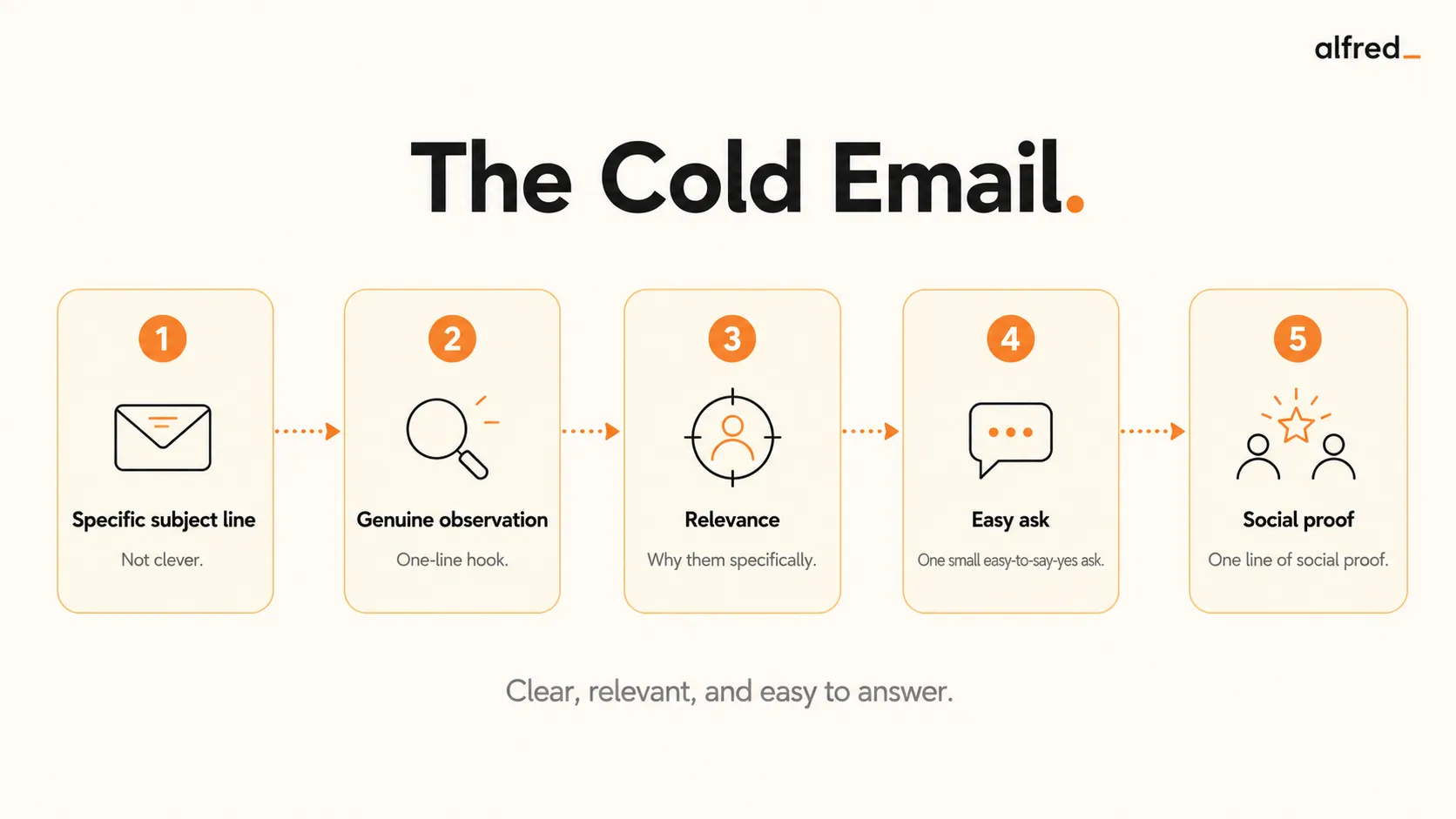
A cold email that gets replies has five elements, in this order:
1. Subject Line: Specific, Not Clever
The subject line should feel like it could have come from someone who knows the recipient, specific enough to not feel automated. “Partnership opportunity” will never be opened. “Question about your Figma plugin system” will. The specificity signals that this email is about them, not about your pipeline.
2. Hook: One Genuine Specific Observation
The first sentence exists to prove you’re not a bot. One genuine, specific observation about the recipient, their work, or their company, not generic flattery. “I’ve been following your writing on distributed systems architecture” requires actual research. “I love the work you’re doing at [Company]” does not.
The hook doesn’t need to be long. One sentence is enough. Its job is to establish that this is a genuine human reaching out with genuine intent, not mass outreach dressed as personal contact.
3. Relevance: Why You’re Reaching Out to Them Specifically
One or two sentences connecting your reason for reaching out to something specific about them. Not “I’m reaching out to professionals in your space.” Instead: “I’m reaching out specifically because of your experience with [X], which is exactly the area I’m trying to navigate.”
4. Ask: One Small, Easy-to-Say-Yes-To Request
This is the most important element. The ask should have the lowest possible friction while still advancing the process. “A 30-minute call” has high friction: it requires them to commit time to a stranger. “A quick answer to one specific question” has low friction. “Would you be open to sharing how you approached [specific thing]?” is low-friction. “Would love to connect and explore synergies” is meaningless.
Jeff Bezos’s “?” email principle applies: communication that forces action doesn’t need to be long. A single focused ask drives more action than a paragraph of context followed by a vague invitation to connect.
5. Social Proof: One Line, Not a Paragraph
One sentence of credibility, not a bio, not a list of accomplishments. “I work with [notable client or context]” or “I built [relevant thing]” is sufficient. The goal is to answer the recipient’s implicit question: “Why should I take this seriously?” Not to impress them with your resume.
Total length target: under 150 words. Under 100 words if you can manage it. Research consistently shows that shorter cold emails have meaningfully higher response rates.
50%
response rate for emails in the 50-125 word range, where replies peak before declining to roughly 44% at 500 words
Cold Email Templates by Use Case
Template 1: Cold Email to a Potential Client
Subject: [Specific observation]: quick question Hi [Name], [One specific genuine observation about their work or company.] I work with [type of company] to [specific result, not "help them grow," but "reduce time-to-close from X to Y"]. I noticed [specific thing relevant to them] and wondered if [specific challenge] is something you're dealing with. If so, I have a few ideas that might be relevant. Worth a 20-minute call this week? [Your name] [One-line credential] ### Template 2: Cold Email to a Potential Hire Subject: Your work on [specific project/skill]: role at [Company] Hi [Name], I came across your work on [specific thing] and was genuinely impressed by [specific detail]. I'm building [team/function] at [Company] and there's a [role] that I think maps directly to your background, specifically [one specific connection]. Would you be open to a 20-minute conversation to see if there's any interest? No pressure either way. [Your name] [Title, Company] ### Template 3: Cold Email Requesting an Introduction Through a Mutual Contact Subject: [Mutual contact] suggested I reach out Hi [Name], [Mutual contact] suggested I reach out. They thought you might be the right person to talk to about [specific topic]. [One sentence on what you're trying to figure out and why it connects to their expertise.] Would you have 15 minutes for a call? I have specific questions and will keep it tight. [Your name] ### Template 4: Cold Email Asking for Expert Perspective Subject: Question about your experience with [specific topic] Hi [Name], I've been reading your work on [specific topic]. Your piece on [specific article/talk/project] was particularly useful to me. I'm working through [specific challenge] and have one specific question I think you'd have a useful perspective on: [the actual question, in one sentence]. If you have two minutes to reply, I'd really appreciate it. No need for a call. [Your name] [Brief one-line credential] ## Step-by-Step: Write a Cold Email That Gets a Reply 1 ### Do Actual Research on the Person Find one genuine specific thing: a paper they published, a talk they gave, a project their company shipped, a detail from their professional history that connects to why you’re reaching out. This takes 5-10 minutes per email. It is not optional. It’s the difference between a cold email that reads as personal and one that reads as a mail merge.
2. Write the Ask First, Then Build Backward
Start with the ask: the single thing you want from this email. Then ask: what does the reader need to know to understand why they should say yes? That’s your email. Everything else is noise. This exercise forces you to be clear about what you actually want, which in turn produces clearer, shorter emails.
3. Write a Subject Line That Doesn’t Feel Automated
Use one of the subject line frameworks below. Test it: does this subject line feel like it could have come from someone you know? If yes, send it. If it reads like a sales template (“Partnership opportunity,” “Introduction,” “Quick question,” “Following up”), rewrite it until it feels specific.
4. Cut Everything About You That Isn’t Relevant to Them
Review every sentence. Highlight the ones that are about you (your company, your product, your background, your goals). For each one, ask: does this help the reader understand why they should reply to me? If not, delete it. Most cold emails are 60% about the sender. Flip that ratio.
5. Send, Track, Follow Up Once
Send the email. Wait 3-5 business days. Follow up once with a reply that adds value: a relevant article, an updated question, a specific reason why you’re following up now. Don’t follow up with “Just checking in.” It adds nothing and signals that you have nothing more to offer. Follow up more than twice and you’ve crossed into spam territory.
The Follow-Up Rule
One follow-up is professional. Two is pushing it. Three is spam. The schedule: wait 3-5 business days after the original email, then send one follow-up reply. If you hear nothing after that, let it go for at least two weeks before any additional contact, and only reconnect if you have something genuinely new to offer.
The follow-up should add value, not just nudge. “Following up on my previous email” with zero additional content is the email equivalent of knocking on someone’s door and saying “I knocked before.” Add something: a relevant piece of information, an updated ask, a specific reason why now is relevant.
Newport’s process-centric principle: what response would close this loop? In a follow-up, the answer is usually: give them an easier path to either yes or no. “If this isn’t relevant right now, no problem. I’ll reach out in Q3 when [thing] happens” lets them off the hook and keeps the door open without being pushy.
Subject Line Frameworks That Work
- Named reference: “[Mutual contact] suggested I reach out” is the highest-converting cold email subject line because it’s not cold
- Specific observation: “Your talk on [topic] at [event]” proves research without announcing it
- Direct question: “Question about [specific aspect of their work]” is simple and honest
- Specific connection: “Re: [specific project/article/announcement]” ties to something recent and relevant
Subject lines to avoid: “Partnership opportunity,” “Quick question,” “Reaching out,” “Introduction,” “Connecting,” “Following up,” and any subject line with your company name in it. These are the most common subject lines in sales outreach. The reader’s spam filter, mental and algorithmic, is tuned to detect them.
Where AI helps with cold emails: structure, editing for concision, subject line variations, and follow-up drafts. Where you still need to do the work: the specific hook, the genuine personalization, and the actual ask. alfred_ can draft cold email follow-ups and track whether you’ve heard back, so no outreach slips through the cracks.