

The Penalty Kick Study
Bar-Eli, Azar, Ritov, Keidar-Levin, and Schein (2007) published “Action Bias Among Elite Soccer Goalkeepers: The Case of Penalty Kicks” in the Journal of Economic Psychology (28(5), 606–621). The setting is ideal for studying action bias: a penalty kick is a binary decision (jump left, jump right, or stay center) with clear outcome data and high stakes.
6.3% vs 28.7%
the rate at which elite goalkeepers stayed in the center versus the rate at which penalty kicks went to the center. Goalkeepers jumped left or right 93.7% of the time despite center being the mathematically optimal strategy based on kick distribution.
Bar-Eli et al. (2007), Journal of Economic Psychology, 28(5)The analysis of 286 penalty kicks found that balls went to the center 28.7% of the time, making center the most frequent single zone. But goalkeepers stayed in the center on only 6.3% of kicks, jumping left or right in 93.7% of situations despite center being the statistically dominant optimal response.
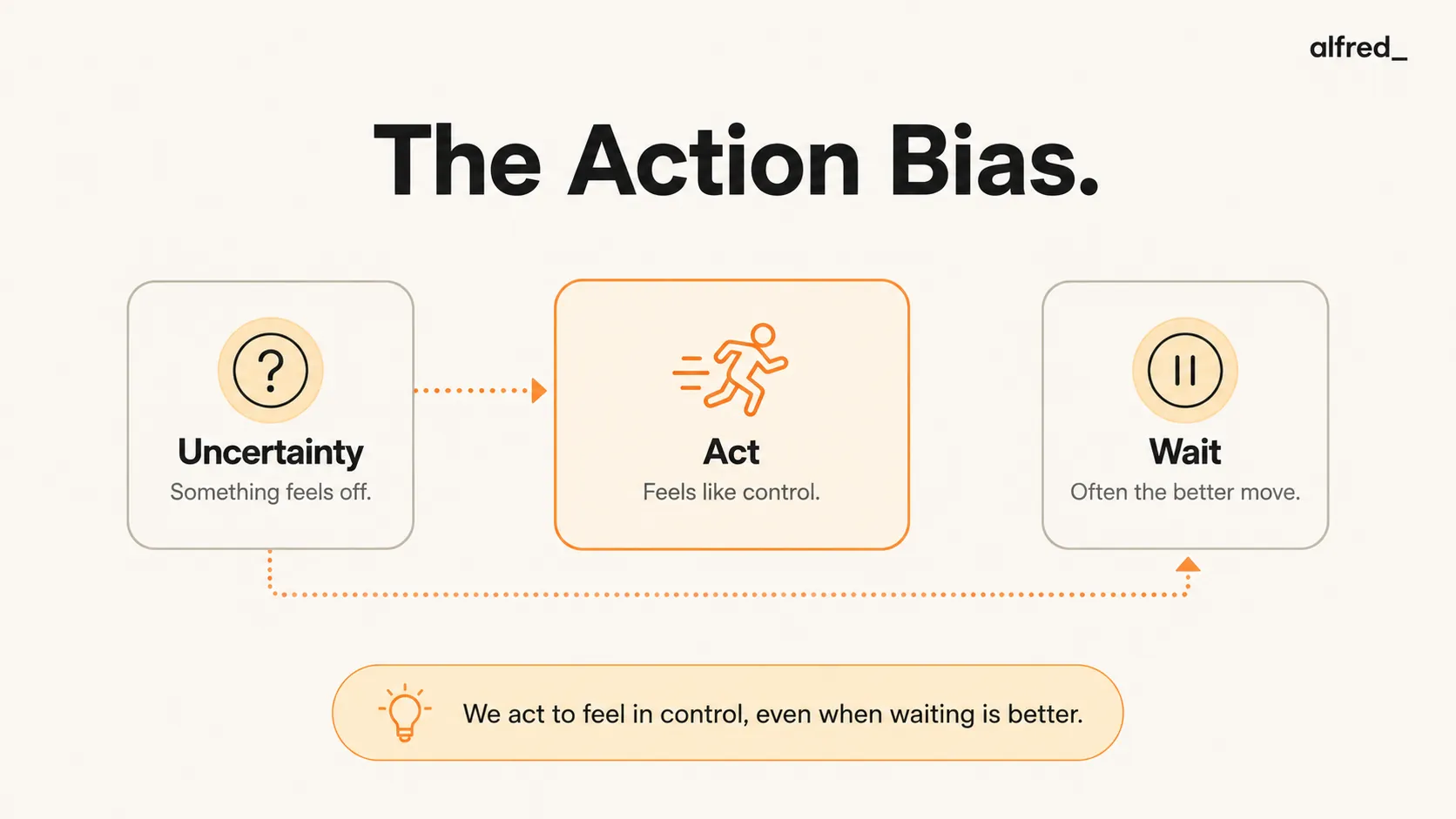
The goalkeepers were not making random errors. They were systematically choosing action (jumping) over the optimal strategy (staying) because the regret structure is asymmetric: if the goalkeeper stands still and the ball goes past, the failure is visible, attributed to passivity, and feels directly caused by the decision to do nothing. If the goalkeeper jumps the wrong way, the failure is attributed to bad luck or the opponent’s skill, not to an active choice. The action protects against the specific form of regret that inaction-failure produces.
Why Action Bias Persists
Norm theory (Kahneman and Miller, 1986) provides the mechanism: people judge outcomes against alternatives that are easy to imagine. Action-failure (“I acted and it didn’t work”) generates counterfactuals focused on which action would have worked better. Inaction-failure (“I didn’t act and something bad happened”) generates counterfactuals about what action would have prevented it. These “I should have done something” counterfactuals are more emotionally salient and socially criticized.
The social accountability dimension amplifies this. Leaders are evaluated by whether they were seen to respond, not just by whether their response was optimal. A leader who visibly acts and fails is seen as having tried; a leader who waited for more information and was ultimately vindicated may still be seen as having been passive during a crisis. The accountability structure reinforces the individual cognitive bias.
Professional Manifestations
- Immediate email response. The reflex to respond to every email within minutes, regardless of whether a response adds value, is action bias in communication. Many emails resolve themselves, are superseded, or produce better outcomes with a measured delay. The cost of waiting is usually lower than the cost of an immediate response that was less considered than the situation warranted.
- Crisis communication before information is available. Organizations frequently issue statements about developing situations before they have the facts, because silence feels like inaction and inaction feels like culpability. The historical track record of premature crisis statements (which often require retraction and worsen the situation) suggests waiting for information usually produces better outcomes than demonstrating responsiveness with incomplete information.
- Strategy adjustment to short-term noise. Quarterly earnings disappointments, competitor announcements, and market fluctuations create pressure to respond with strategic changes. Much of this noise is genuinely uncorrelated with long-term strategic direction. Distinguishing signal from noise requires waiting, but waiting appears passive while action appears engaged.
- Portfolio and process changes at the first problem. New processes, team changes, and strategic pivots triggered by early signs of trouble frequently violate the information needed to distinguish temporary variance from genuine signal. Action bias produces premature responses that create instability rather than correction.