


Quick Definition
AI Task Management Tool software that uses artificial intelligence to automatically capture, schedule, and prioritize tasks, pulling action items from emails, meetings, and messages, then fitting them into your calendar around deadlines and priorities. Unlike traditional to-do apps that require manual entry, AI task managers keep your list current without you lifting a finger.
Why AI Task Management Matters in 2026
The dirty secret of task management: your to-do app is only as good as what’s in it. And most professionals have a massive gap between their actual commitments and what’s written down. Tasks come in through email, Slack, meetings, and verbal conversations, and most never make it into the app.
- 58% of work is “work about work”: organizing tasks, not doing them (Asana Anatomy of Work)
- 40+ tasks per week: the average professional’s juggling act
- 82% lack a time management system: most people wing it (Development Academy)
- Only 11% of tasks are completed on time when manually managed
AI task management tools attack this from two angles: (1) automatically capturing tasks so nothing falls through cracks, and (2) intelligently scheduling them so you work on the right thing at the right time. Here are the 7 best options in 2026.
Our Verdict
Motion is the best AI task scheduler. alfred_ solves the upstream problem: task capture from email.
Most task management failures aren't tool failures. They're capture failures. The best to-do app in the world can't help if the tasks never make it in. Motion is the best pure task scheduler if you already have a clear task list. alfred_ solves the root cause: making sure tasks get captured from email and meetings before they can slip through cracks, plus handling email triage and calendar management.
Best for
- Professionals whose tasks come from email and meetings (alfred_)
- People who know their tasks but can't find time to do them (Motion)
- Teams needing full project management with cross-functional coordination (ClickUp, Asana)
Not for
- Engineering teams: use Linear for issue tracking
- Users who enjoy the ritual of manual daily planning: Sunsama is purpose-built
The 7 Best AI Task Management Tools, Reviewed
1. Motion: Best for Auto-Scheduling Tasks
Price: $19/month Pro AI ($12.73/month annual) | Free trial: 7 days | Works with: Google Calendar, Outlook, Zoom
Motion is the best pure task scheduler on the market. Add a task with a deadline, priority, and time estimate, and Motion places it on your calendar automatically. When priorities shift or meetings run long, Motion reschedules your remaining tasks in real time. Your calendar becomes your to-do list, and the AI decides what you should work on next.
The auto-scheduling engine removes the daily puzzle of “when will I do this?” that derails most task management systems. Motion treats every task as a calendar event, which means tasks cannot be ignored the way items on a static list can. For professionals who know their tasks but struggle to find time for them, Motion solves the right problem.
The gap is on the input side. Motion relies on you to create every task manually. It does not scan your email for action items or pull commitments from meeting notes. If tasks are falling through cracks because they never make it onto your list, Motion cannot help with what it does not know about.
2. alfred_: Best for Automatic Task Capture From Email
Works with: Gmail, Outlook, Google Calendar
alfred_ solves the upstream problem that breaks most task management systems: capture. It reads every incoming email, identifies action items, deadlines, and commitments, and adds them to your task list automatically. No forwarding emails to a special address, no manual entry, no hoping you remember to write it down later.
The Daily Brief is where task management meets awareness. Each morning, alfred_ surfaces your tasks alongside email summaries and calendar context, so you see everything you need to act on in one view. Tasks extracted from email are linked to the original thread, so you never lose context on where a commitment came from.
alfred_ is not a task scheduler. It will not auto-block time on your calendar for each task the way Motion does. Its strength is making sure nothing falls through the cracks in the first place. For professionals whose tasks come primarily from email and meetings, alfred_ captures what other tools miss entirely.
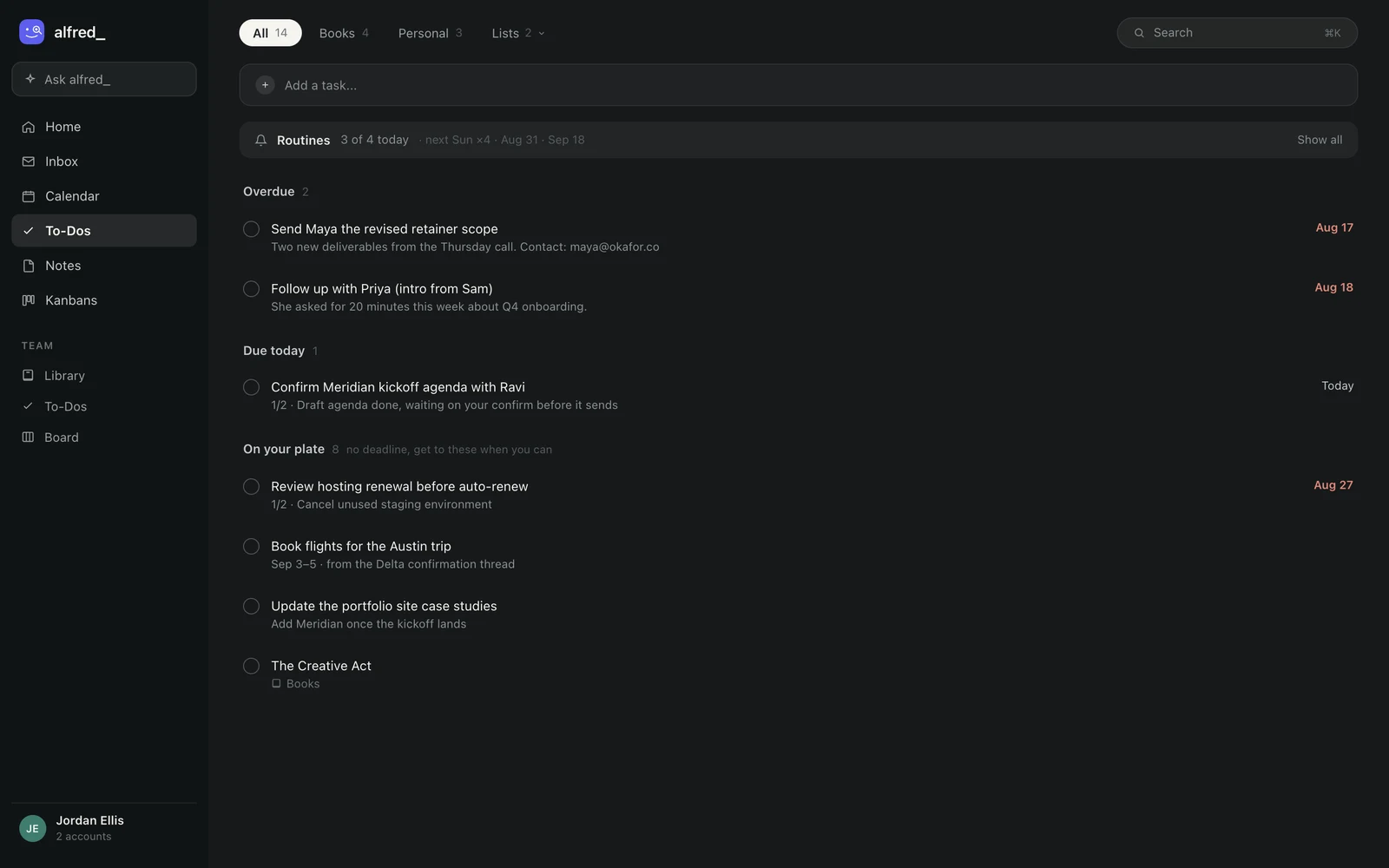
The to-do list alfred_ maintains: overdue first, then today, then the no-deadline backlog, with tasks captured from email threads. Shown with sample data.
3. Todoist: Best for Simple, Affordable Task Management
Price: Free plan available; Pro at $5/month | Works with: Gmail, Outlook, Slack, Google Calendar, 60+ integrations
Todoist is the most refined traditional task manager. Natural language input (“Call vendor re: contract Friday p1”) creates tasks instantly with dates and priorities parsed automatically. Projects, labels, and filters let you organize without forcing a rigid structure. The free tier is genuinely useful for individuals, and Pro at $5/month is the best value in the category.
Todoist’s speed and simplicity are its competitive advantage. The app loads instantly on every platform, captures tasks in under two seconds, and never gets in your way with features you did not ask for. Quick Add from any screen on mobile makes it the fastest capture tool for moments when a task hits you away from your desk.
The limitation is that Todoist is entirely manual. Every task enters the system because you put it there. There is no AI scanning your email, no auto-scheduling, and no calendar integration that blocks time for tasks. Todoist added AI task suggestions recently, but the core remains a beautifully designed manual system. If your bottleneck is capturing tasks, not organizing them, Todoist does not solve the root cause.
4. ClickUp: Best for Teams Needing Full Project Management
Price: Free plan available; Unlimited at $7/user/month (annual) | Works with: Slack, GitHub, Google Drive, Figma, HubSpot
ClickUp combines task management with docs, goals, whiteboards, dashboards, and time tracking in a single platform. For teams that need cross-functional project coordination with dependencies, milestones, and reporting, ClickUp delivers breadth that standalone task managers cannot match. ClickUp Brain adds AI summarization and doc generation for an additional $9/user/month.
The team features are where ClickUp excels. Multiple views (list, board, Gantt, calendar), custom fields, automations, and real-time collaboration make it a legitimate project management platform. For organizations with five or more people coordinating across projects, ClickUp replaces the need for separate task, doc, and goal tools.
The tradeoff is complexity. Individual users rarely need Gantt charts and portfolio views. The setup time for a ClickUp workspace is measured in days, not minutes, and the learning curve is steeper than any other tool on this list. If you need a team project management platform, ClickUp is strong. If you need a personal task manager, it is overkill.
5. Asana: Best for Structured Team Workflows
Price: Free Personal plan for up to 2 users; Starter at $10.99/user/month (annual) | Works with: Slack, Google Drive, Microsoft Teams, Salesforce, Jira
Asana is the gold standard for structured team task management. Workflow Builder lets you create repeatable processes with automations, approvals, and handoffs. Portfolios give leadership visibility across multiple projects. Asana AI generates status updates, suggests next steps, and summarizes project progress.
What separates Asana from ClickUp is opinionated structure. Asana guides teams toward best practices with templates and workflow patterns rather than offering maximum flexibility. For teams that want a clear system rather than a blank canvas, Asana reduces the decisions required to get organized.
For individual task management, Asana is heavier than necessary. The free plan caps features at a level that pushes teams toward paid plans relatively quickly, and the per-user pricing means costs scale fast. Asana works best for teams of 10 or more where structured workflows and cross-project reporting justify the investment.
6. Linear: Best for Engineering Teams
Price: Free plan available; Basic at $10/user/month (annual) | Works with: GitHub, GitLab, Slack, Figma, Sentry
Linear is purpose-built for software engineering teams. It handles issues, sprints, cycles, and roadmaps with an interface that prioritizes speed above all else. Keyboard shortcuts drive every action, page transitions are instant, and the design eliminates the clutter that slows down other project tools. AI features auto-triage issues and generate summaries.
Linear’s opinionated workflow (cycles instead of sprints, triage instead of backlog grooming) reflects how the best engineering teams actually work. The GitHub and GitLab integrations link commits and PRs directly to issues, closing the loop between code and task management without manual updates.
Linear is not a general-purpose task manager. It has no personal to-do features, no email integration, and no calendar views. If you are not managing software development, Linear is the wrong tool entirely. For engineering teams frustrated with Jira’s complexity, Linear is the most common destination.
7. Sunsama: Best for Daily Planning and Timeboxing
Price: $20/month (annual) or $25/month (monthly) | Free trial: 14 days | Works with: Gmail, Outlook, Asana, Trello, Jira, Linear, Todoist, ClickUp
Sunsama pulls tasks from your existing tools and walks you through a structured daily planning session each morning. You review upcoming calendar events, select tasks from connected apps, assign time estimates, and build a realistic day. The shutdown routine at day’s end closes open loops and carries forward anything unfinished.
The timeboxing approach forces honesty about capacity. When your planned tasks exceed available hours, Sunsama tells you before you start. This prevents the chronic overcommitment that undermines most task management systems. The integration library is excellent, pulling from nearly every popular task and project tool.
Sunsama does not create tasks for you or schedule them automatically. It is a daily planning layer that sits on top of your existing task sources. If you enjoy the ritual of intentional planning and want a tool that enforces that discipline, Sunsama is the best option available. If you want tasks captured and scheduled without daily input, look elsewhere.
How to Choose the Right AI Task Management Tool
| Need | Best Pick | Price |
|---|---|---|
| Auto-schedule tasks into calendar blocks | Motion | $19/month |
| Capture tasks from email and meetings automatically | alfred_ | $29.99/month |
| Simple, fast, affordable personal task list | Todoist | Free / $5/month |
| Full team project management in one platform | ClickUp | From $7/user/month |
| Structured team workflows with automations | Asana | From $10.99/user/month |
| Engineering issue tracking and sprint management | Linear | Free / $10/user/month |
| Guided daily planning with timeboxing | Sunsama | $20/month (annual) |