


You set the out of office. You told the team you would be unreachable. You packed your bags. And on day two of the trip, you are standing on a beach, phone in hand, refreshing your inbox out of a reflex you did not consciously choose. Sound familiar? Disconnecting from work on vacation is one of those things everyone agrees they should do and almost nobody actually manages. This is not a failure of discipline. It is a predictable result of how your brain treats unfinished work, and it has a fix.
This guide is about the mental side: why switching off is so hard, what it actually costs you when you do not, and the specific moves that let you put the phone down and keep it down. The pre-trip task list and the auto-reply wording live in other guides. This one is about your head.
Why You Cannot Stop Checking
Start with the reason, because most advice skips it and goes straight to “just relax,” which has never once helped anyone relax.
Your brain holds unfinished tasks in an active, slightly nagging state until they feel resolved. Psychologists call it the Zeigarnik effect: open loops keep pinging your attention so you do not forget them. At work this is useful. On vacation it is torture, because the loops are still open but you have removed your ability to close them. So your mind keeps surfacing the half-finished proposal, the email you are not sure landed, the decision someone might be making without you. Refreshing the inbox is your brain trying to close a loop. It almost never does. It usually opens three more.
There is a second layer on top of that: uncertainty. You check because you do not know what is waiting. Is it nothing, or is it the one client email that matters? Not knowing is more stressful than knowing, so you keep checking to relieve the uncertainty, which is exactly why “just use more willpower” fails. You are not fighting laziness. You are fighting an information gap, and the only durable fix is to close the gap, not to white-knuckle it.
The Real Cost of Staying Half-Connected
It is tempting to think a few quick checks are harmless. They are not, and the reason is sharper than “vacations are for relaxing.”
Staying half-connected gives you the worst of both states at once. You are not working, because you cannot actually do anything useful from a beach with a phone and no context. And you are not resting, because part of your attention is permanently parked on the office. You get neither the output of work nor the recovery of rest. You just get to feel anxious somewhere prettier.
The research on this is unambiguous. Psychological detachment, genuinely disengaging from work mentally and not just physically, is what drives recovery. People who detach report lower exhaustion, better mood, and more energy when they return. People who stay tethered come back about as depleted as they left, which quietly defeats the entire point of taking time off. A check-in here and there does not keep you on top of things. It just spreads a thin film of work stress over the one stretch of time meant to dissolve it.
And there is a slower cost. Every time you answer an email on vacation, you teach your team and your clients that you are reachable on vacation. The boundary you announced in your auto-reply gets quietly overwritten by your own behavior. Next time, they will expect a reply, and you will feel obligated to give one.
The One Thing That Makes Disconnecting Possible
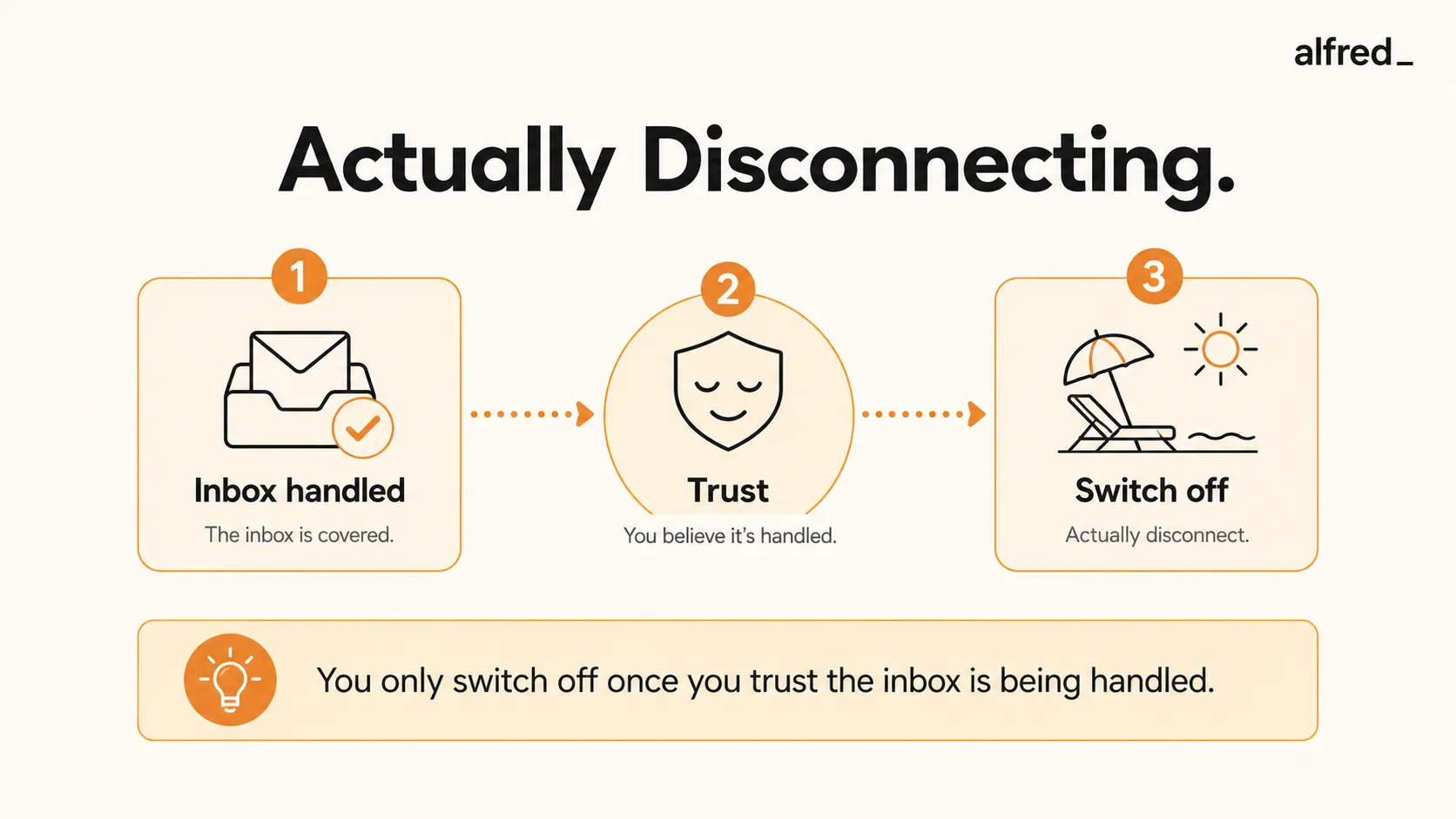
Here is the part most “digital detox” advice misses entirely. You cannot relax your way out of checking email. You can only trust your way out of it.
The urge to check is, at its core, a trust problem. You check because some part of you does not believe the inbox is safe unattended. You are the failsafe. If you stop watching, something might slip, and it will be your fault. As long as that belief is intact, no meditation app or “be present” advice will hold, because the underlying fear is rational. Inboxes genuinely do contain things that matter.
So the move is not to suppress the urge. It is to make it unnecessary. When you genuinely trust that the inbox is being watched, sorted, and held while you are gone, the compulsion to check loses its fuel. There is nothing to relieve, because the uncertainty is gone. That trust comes from two places: a human backup briefed for the genuine emergencies, and a system that triages the everyday flow so the pile never forms. Get both in place and disconnecting stops being a feat of willpower. It becomes the obvious, easy thing to do.
How to Actually Switch Off
You disconnect in layers, removing the triggers before you remove yourself. Do these in the days before you leave, not on the plane.
Close the open loops on paper, before you go
The night before you leave, do a full brain dump. Write down every open task, every "I should follow up on," every half-decision rattling around. Getting them out of your head and onto a list tells your brain the loops are captured and safe to drop. This is the single most effective antidote to lying awake on vacation mentally re-litigating work.
Name one backup and one emergency channel
Pick a single person who can cover genuine emergencies, brief them properly on what to watch and what they can decide without you, and agree on exactly one way they will reach you if the building is on fire. One channel, one person. Everything else routes to them, not to you. Now there is a defined path for a real crisis, which means the absence of a message on that channel is positive proof nothing is wrong.
Remove the trigger, not just the willpower
Log out of work email, delete the app for the duration of the trip, turn off every work notification, and push work apps off your home screen. Do not rely on self-control against a one-tap habit, because you will lose. Make checking genuinely inconvenient and the reflex fades within a day or two on its own. You cannot mindlessly refresh an app that is no longer there.
Make checking pointless by handling the inbox
This is the one that actually breaks the loop. If something is triaging your inbox while you are away, then checking it yields no new information worth having, so the urge has nothing to feed on. You are not white-knuckling against the impulse. You have made the impulse obsolete, because the work the impulse was trying to do is already being done.
Give yourself a buffer day to land
Detachment takes most people two to three days to kick in, and re-entry has its own gravity. Block the first morning back as a catch-up window before any meetings. Knowing there is dedicated time to handle the return makes it far easier to leave it alone while you are away, because you are not borrowing against an unprotected Monday.
Notice that four of these five steps happen before the trip starts. Disconnecting is not something you do on vacation. It is something you set up so that vacation can do it for you.
Where the Trust Actually Comes From
The reason this matters so much is that the urge to check is downstream of the fear of missing something. Take away the thing being missed and the urge has no root. When your inbox is genuinely being handled, every imagined catastrophe loses its grip: the client email is seen and sorted, the urgent thread is flagged, the noise is already cleared. There is no fire to discover, because someone, or something, is already watching the smoke detector. The mechanics of setting that up live in our guide on how AI handles your inbox overnight and in the out of office setup. This is the behavioral payoff of doing that work: a quiet mind.
When You Slip (Because You Will)
Even with all of this in place, you will probably check at least once. That is fine. The goal is not zero, it is to keep one slip from becoming the whole trip.
If you do check and find something, resist the urge to act on it immediately. Acting is the trap, because it drags you fully back in for an hour over something that could wait a week. Note it, decide whether it truly cannot wait for your backup, and in almost every case it can. If you find yourself reaching for the phone out of plain anxiety rather than any real reason, that is your signal that the loops are not closed. Go back to the brain dump and write down whatever is nagging you. Naming it usually quiets it.
And be honest about the difference between staying available for an actual emergency and staying available to feel important. Most of the checking we do is the second one wearing the costume of the first. Setting a real emergency channel, as in step two, is what lets you tell them apart. If nothing has come through on that channel, nothing is wrong, full stop.
Holding the line here is also how you protect future vacations. The boundaries you keep on this trip are the ones your team learns to respect. For the deliberate version of that, see how to set email boundaries.
The Bottom Line
You cannot discipline your way into disconnecting, and you cannot relax your way there either. The urge to check work email on vacation is a trust problem dressed up as a willpower problem. You check because the inbox feels unsafe unattended and the loops in your head are still open. Close the loops on paper, remove the triggers so checking takes effort, name one human for true emergencies, and put a system in place that handles the everyday flow so the pile never forms. Do that, and disconnecting stops being a battle you fight all week. It becomes the natural result of having nothing left to worry about, which is, after all, the entire point of going away.