

An AI executive assistant for founders is not a nice-to-have you get to later. It gives you back the hours you now spend on inbox triage, calendar tetris, and follow-up chasing. In the earliest stage of a company you are the CEO, the salesperson, the support desk, and the scheduler all at once. Every email lands in your lap, every meeting gets booked around your fragmented day, and there is no executive assistant outside your office to absorb the load. An AI executive assistant fills exactly that gap: it handles the admin layer so you can spend your scarce attention on the work only you can do.
This guide is for founders and early operators who cannot yet justify a human EA but feel the admin tax every day. We will cover why founders drown in admin, what an AI executive assistant handles, an honest AI versus human comparison for your stage, and how to set alfred_ up in your first week.
Why founders drown in admin
The problem is not that founders are disorganized. It is structural: in an early-stage company the admin work belongs to no one else, so all of it routes to you by default. Three forces compound the load:
Context switching taxes every hour. You jump from a customer thread to a hiring decision to a vendor invoice to a calendar conflict, and each switch costs focus you never fully recover. For a founder, that cost is paid dozens of times a day, and it is invisible until you look up and realize you did no deep work at all.
Every email is yours. There is no filter between the outside world and your attention. Sales inquiries, support questions, investor updates, and cold outreach all pile into one inbox that only you can read. Even the emails you do not need to answer cost you the moment of reading, judging, and deciding.
There is no EA yet, and the math is hard. A full-time executive assistant is a meaningful salary, plus onboarding time and the overhead of delegating well. At pre-seed or seed stage that is a stretch, so many founders quietly decide to power through. The result is that the admin layer never gets owned by anyone, so it stays on the founder.
This is the mental load that quietly caps a founder’s output. You are not short on ambition; you are short on the free attention to act on it. An AI executive assistant for founders is designed to lift that specific weight.
What an AI executive assistant handles for a founder
The phrase “AI assistant” gets thrown at every chatbot, so it is worth being precise. alfred_ is an AI personal assistant for work. It keeps track of the replies you owe and the replies you’re waiting on, manages your calendar, prepares you for meetings and sends a morning brief, across Gmail and Outlook. It is not a chatbot you have to prompt. It is a memory-driven coordination layer across your email, calendar, tasks, notes, and SMS that acts on the admin layer without you having to ask each time. Here is what that looks like in practice.
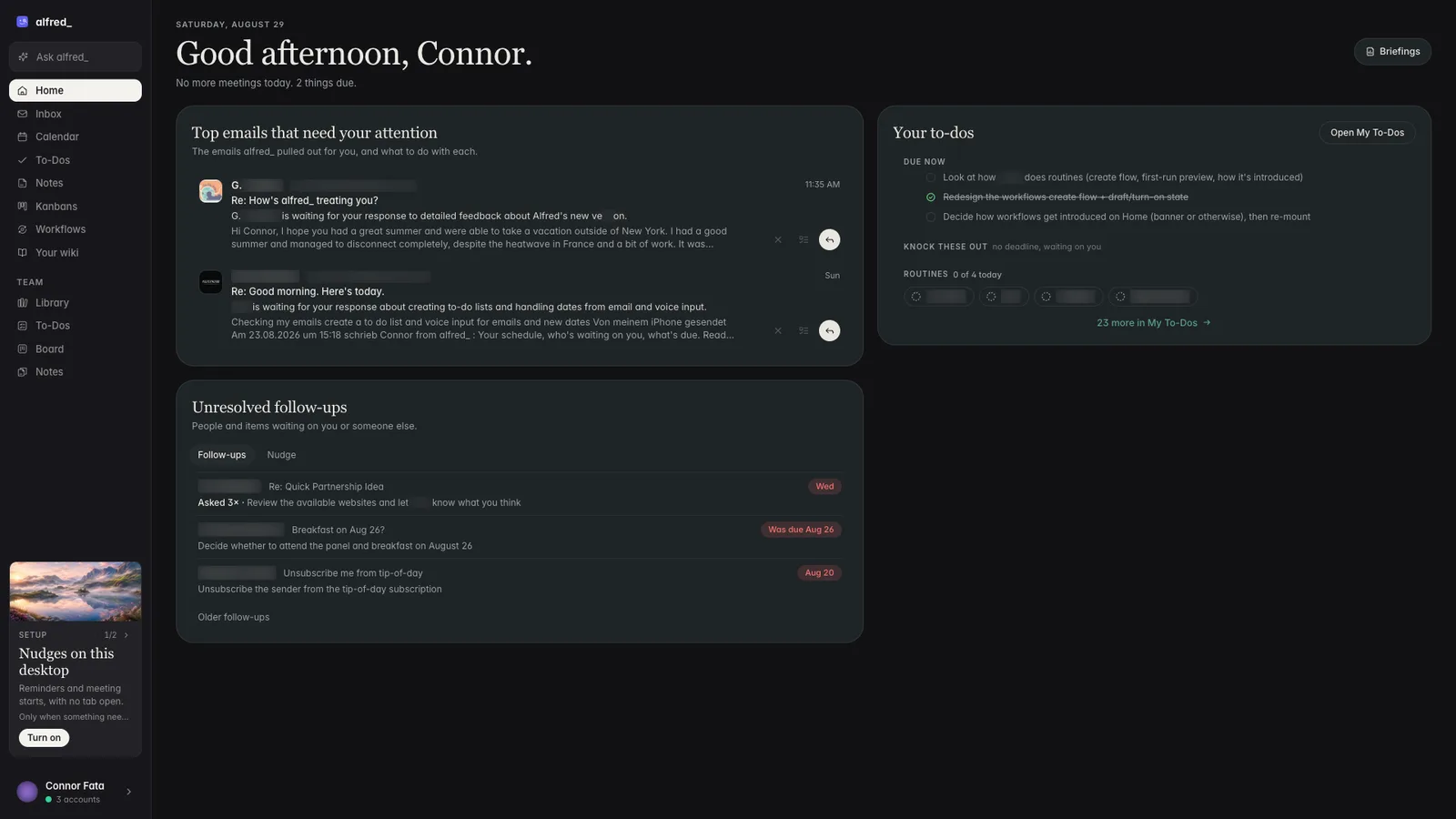
Inbox triage. Instead of a flat wall of unread messages, alfred_ sorts signal from noise. It surfaces what actually needs you, groups the rest, and keeps the low-value stuff from stealing your morning. You start the day knowing what matters instead of scrolling to find out.
Drafts in your voice. For the emails that need a reply, alfred_ writes drafts that sound like you, not a generic template, and you always approve before anything sends. The assistant does the drafting labor; you keep final say over every word that goes out under your name.
Follow-up memory. The follow-ups founders drop are rarely dropped on purpose. They slip because no system is holding the thread. alfred_ remembers who you are waiting on and who is waiting on you, and it nudges you before things go cold. The introduction you promised, the reply you meant to send, the vendor who went quiet: those stop falling through the cracks.
A proactive daily brief. Once a day, alfred_ briefs you on what needs attention: the threads that matter, the meetings ahead, the promises coming due. It is what a good EA does when they walk you through your day, except it arrives without you asking.
Calendar coordination. Scheduling is pure admin tax that eats founder time in five-minute increments. alfred_ handles the back-and-forth of finding times across your Google Calendar or Outlook and keeps your day from fragmenting into unusable gaps.
SMS nudges. Because you live on your phone, alfred_ reaches you over SMS with the nudge that matters right now, so you are not tethered to the inbox to stay on top of things.
The through-line is subtraction. A good AI executive assistant does not add another dashboard to check; it removes decisions and reminders from your head. For the deeper category breakdown, our guide to the best AI executive assistant covers what to look for, and the AI executive assistant overview explains how the coordination layer fits together.
AI EA vs hiring a human EA at your stage
This is the honest section. An AI executive assistant is not a strict replacement for a great human EA, and pretending otherwise does you no favors. Each makes sense at a different point.
When a human EA makes sense. If you have the budget and your admin load is judgment-heavy, relationship-heavy, or physical-world work (complex travel, sensitive negotiations, running your household, acting as a true chief of staff), a human is worth it. A human EA builds real relationships and takes ownership in gray areas in a way software does not. The tradeoff is cost, hiring time, and management overhead, and for most funded companies past a certain size it is clearly worth it.
When an AI EA makes sense. At the founder stage described here, the honest answer for most people is: start with AI. The bulk of the admin tax drowning you is not judgment-heavy. It is volume: triaging a busy inbox, drafting routine replies, remembering follow-ups, and defending your calendar. That is exactly what an AI executive assistant for founders is built to absorb, at a fraction of the cost of a hire and with a free trial to test first. No recruiting, no onboarding month, no learning to delegate.
The realistic path is sequential, not either-or. Many founders start with an AI EA now to reclaim their days, then add a human EA later when the company can support it and the work grows complex enough to need judgment. The AI layer does not go away when they do; it keeps handling the high-volume admin so your human EA can focus on the high-judgment work. You are not choosing forever. You are choosing what covers the admin layer today.
| At the founder stage | Human EA | alfred_ |
|---|---|---|
| Cost | $60,000–$150,000/yr plus recruiting | $29.99/mo, free trial first |
| Time to useful | Weeks of hiring plus an onboarding month | Day one (connect inbox and calendar) |
| Inbox triage and drafts in your voice | Yes | Yes, you approve every send |
| Follow-up memory | Depends on the person | Automatic |
| Calendar coordination | Yes | Yes (Google Calendar, Outlook) |
| Judgment calls, relationships, physical-world tasks | Yes | No, escalates to you |
| Hours | Business hours | 24/7 Our for founders page goes deeper on how alfred_ fits this stage. |
How to set alfred_ up as your founder EA (first week)
The setup reaches value fast. Here is a realistic first week.
Day one: connect and let it read. Start a free trial and connect your Gmail or Outlook and your Google Calendar. This step unlocks everything, because the assistant works from your real context, not a blank slate, and begins learning what your day actually looks like.
Days two to three: tune the triage and the voice. Correct alfred_ where it gets your priorities wrong, and lightly edit the drafts that do not sound like you yet. Every approval teaches it your voice and judgment, which is why the value curve is not flat: the assistant gets more useful every day. See how the drafting and triage work on the email product page.
Days four to five: lean on the brief and the follow-ups. Start your morning with the daily brief instead of the raw inbox, and let the follow-up memory catch the threads you would have dropped. This is where most founders feel the shift: the background sense that something is slipping starts to quiet down.
End of week one: hand over the calendar. Let alfred_ coordinate a few meetings end to end. Once you trust it with scheduling, you have offloaded one of the most time-fragmenting parts of running a company. By now the goal is simple: you check less and do more, because the admin layer finally belongs to something other than you.
Get the admin layer off your plate
You did not start a company to spend your best hours triaging email and rescheduling meetings. That admin tax is real, and it is paid out of the one budget you cannot refill: your attention. An AI executive assistant for founders covers that layer today, before you can justify a human hire, and it gets sharper the longer it works with you.
Start a free trial and get the admin layer off your plate with alfred_. Give it your inbox and your calendar, and spend your week on the work only a founder can do.