


Should you check email on vacation? If the point of the trip is to actually rest, the honest answer is no. For most people, checking once mid-trip does not solve a problem. It just transfers the stress of work onto the time you set aside to recover from it. There is one narrow exception, covered below, but the default should be to leave the inbox closed.
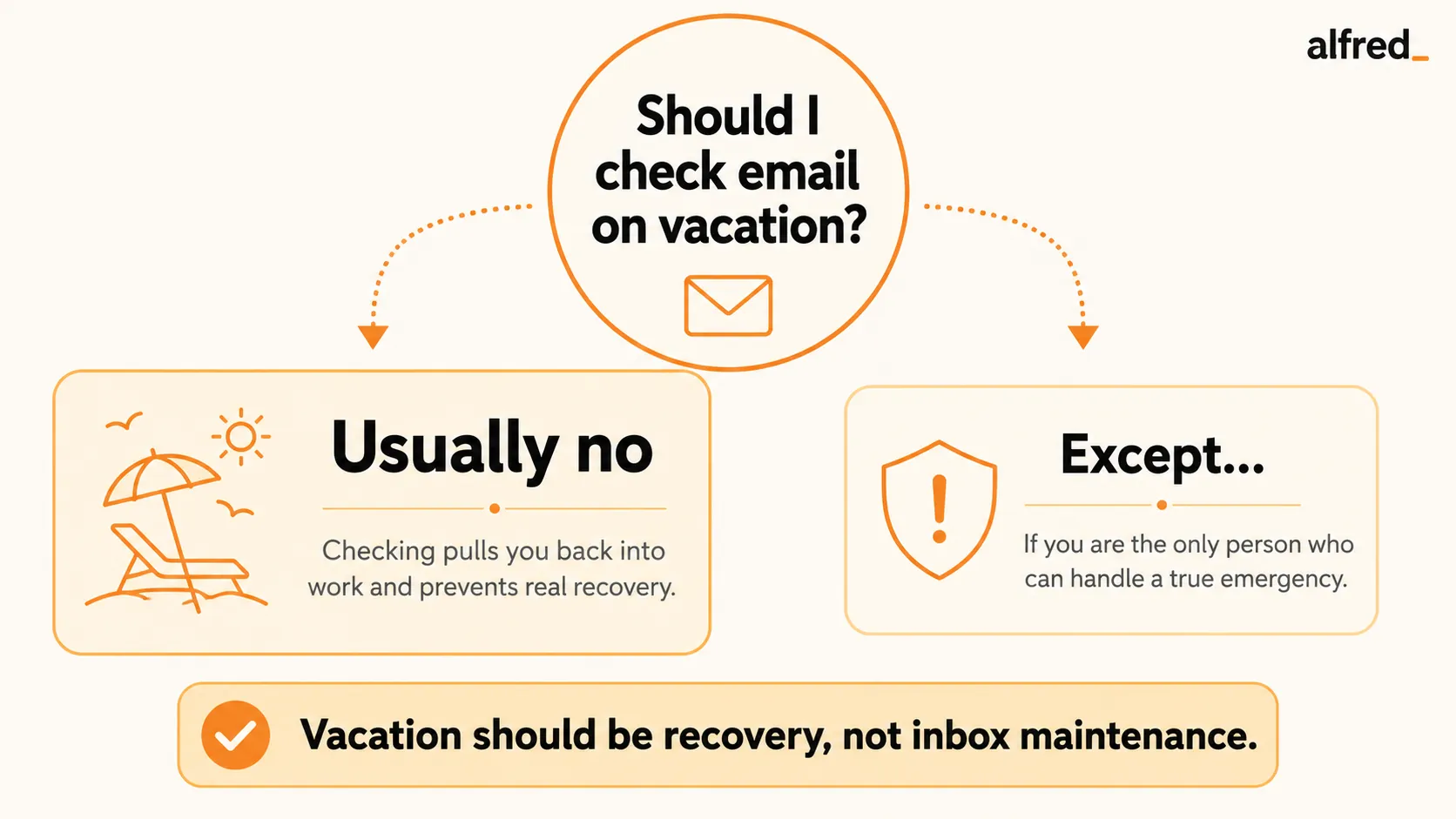
That answer feels uncomfortable, because the urge to check is real and the fear behind it feels rational. So let us take it seriously: the honest case for checking, the honest case against, what actually happens when you open the inbox on a beach, and the practical middle ground that beats both extremes.
The Honest Case for Checking
This is not a one-sided question. There are real reasons people check, and pretending otherwise does not help.
- Genuine peace of mind. For some people, a thirty-second glance that confirms nothing is on fire is more relaxing than wondering all week. If checking lowers your anxiety instead of raising it, that is a legitimate reason.
- A specific live situation. A deal closing, a launch shipping, a client decision pending. If something concrete is in flight that only you can resolve, total silence can be genuinely costly.
- A smaller pile on return. Skimming and archiving the obvious noise mid-trip can mean a less brutal Monday. The logic is sound even if the method usually backfires.
- Your role actually requires it. Founders, on-call staff, and a handful of senior roles cannot vanish completely. The realistic goal there is to shrink checking to a tiny window, not eliminate it.
The Honest Case Against
Now the other side, which is stronger than most people admit.
- You see the problem but cannot fix it. This is the core trap. Reading an urgent email from a lounge chair gives you the stress of the problem with none of the ability to solve it. You have ruined the afternoon and changed nothing.
- One check is never one check. Opening the inbox once primes your brain to keep returning. The phone comes out at dinner, then at the pool, then first thing in the morning. The trip quietly becomes a working trip.
- Recovery needs real detachment. The restorative part of time off comes from your mind fully leaving work, not hovering near it. A single intrusion can reset that clock and keep you in a low hum of work mode the whole time.
- You are training the wrong expectation. If you reply to one email on day two, colleagues learn you are reachable. The volume aimed at you rises precisely because you proved the auto-reply was a bluff.
What the Research and Common Sense Say
You do not need a cited study to know how this plays out, and the broad pattern is well established in how people experience time off. Detachment from work during leave is consistently tied to better recovery, lower fatigue, and more energy on return. Constant connectivity points the other way. The thing that actually restores you is the psychological distance, the sense that work is genuinely not your problem right now, and that distance is exactly what a quick inbox check destroys.
Common sense lands in the same place. Think about your last few vacation email checks honestly. How many surfaced something that truly could not have waited until you were back? For most people the answer is close to zero. The checking was not solving problems. It was managing the anxiety of not knowing, and it managed that anxiety badly, because every check that turned up nothing urgent still cost attention and still pulled you back to work for no return.
That reframe matters: the urge to check is rarely about a real message waiting. It is about uncertainty. Your brain assumes something is quietly going wrong and the inbox is the only way to confirm it is not. Which means the fix is not more checking. It is removing the uncertainty before you ever leave.
It also reframes the “how often” question. People ask how often to check email on vacation hoping for a safe number, like once a day, that lets them relax. But frequency is the wrong dial. Checking once a day still keeps work resident in your head every single day of the trip, because each check reopens the loop. If you genuinely cannot go to zero, stretch the interval as far as your role allows, every two or three days at most, and always at a planned time rather than whenever the anxiety spikes. The goal is not a tolerable checking schedule. It is the smallest amount of checking you can get away with on the way to needing none.
The Practical Middle Ground
You do not have to choose between obsessive refreshing and white-knuckle total silence. The better path is to make checking unnecessary, so that not checking feels safe rather than reckless.
- Set a real out of office. State your return date, name one backup contact with their email, and make clear you will reply in order when you are back. This manages everyone else’s expectations and quietly gives you permission to not respond instantly. See our out of office email templates for wording you can copy.
- Brief your backup for real. Naming someone does nothing if they do not know what they are covering. Before you go, tell them the two or three threads most likely to need attention, where things stand, and what they can decide without you.
- Define one true emergency channel. Agree that a genuine emergency comes as a phone call or text, not an email. This is the single move that kills the urge to check, because you now know the rare real crisis will reach you another way. The inbox no longer has to be monitored.
- If you must check, do it on purpose. Once every couple of days, at a fixed time, never first thing in the morning or last thing at night. A deliberate, bounded check is a different thing from compulsive refreshing. Open it, scan it, close it, and go back to your trip.
- Put triage in place so the pile sorts itself. The deeper fear is the avalanche waiting on Monday. If something is reading and sorting your inbox while you are gone, that fear has no fuel, and the reason to check disappears entirely.
That last point is where the question really gets solved. The reason most people check is the dread of what is accumulating. Take that away and the decision is easy.
Let Something Else Handle the Inbox
Let alfred_ triage your inbox while you are off
alfred_ reads every email that arrives during your vacation, sorts the signal from the noise, and has draft replies waiting for the few that matter. So the reason you would check, the fear of the pile, simply is not there. You come back to a short, sorted list instead of hundreds of unread, and the trip stays a trip.
See how alfred_ handles your inbox overnightThis is the quiet reason the checking habit is so hard to break: the inbox really is unmanaged while you are gone, so checking feels responsible. Once a system is handling it, checking is just a habit with nothing behind it. If the real problem is that work bleeds into your time all year, start with how to set email boundaries.
The Bottom Line
Should you check email on vacation? For almost everyone, no. The checking rarely solves a real problem and usually just smuggles work into the time you took off to escape it. The one fair exception is a specific, time-sensitive thing only you can handle, and even then you check once at a set time, not all day. The far better move is to make checking pointless before you leave: a clear out of office, a briefed backup, one emergency channel, and triage running on the inbox while you are gone. Do that, and the question answers itself. There is nothing to check, because nothing important can slip through, and the vacation gets to be a vacation.